 22 min read
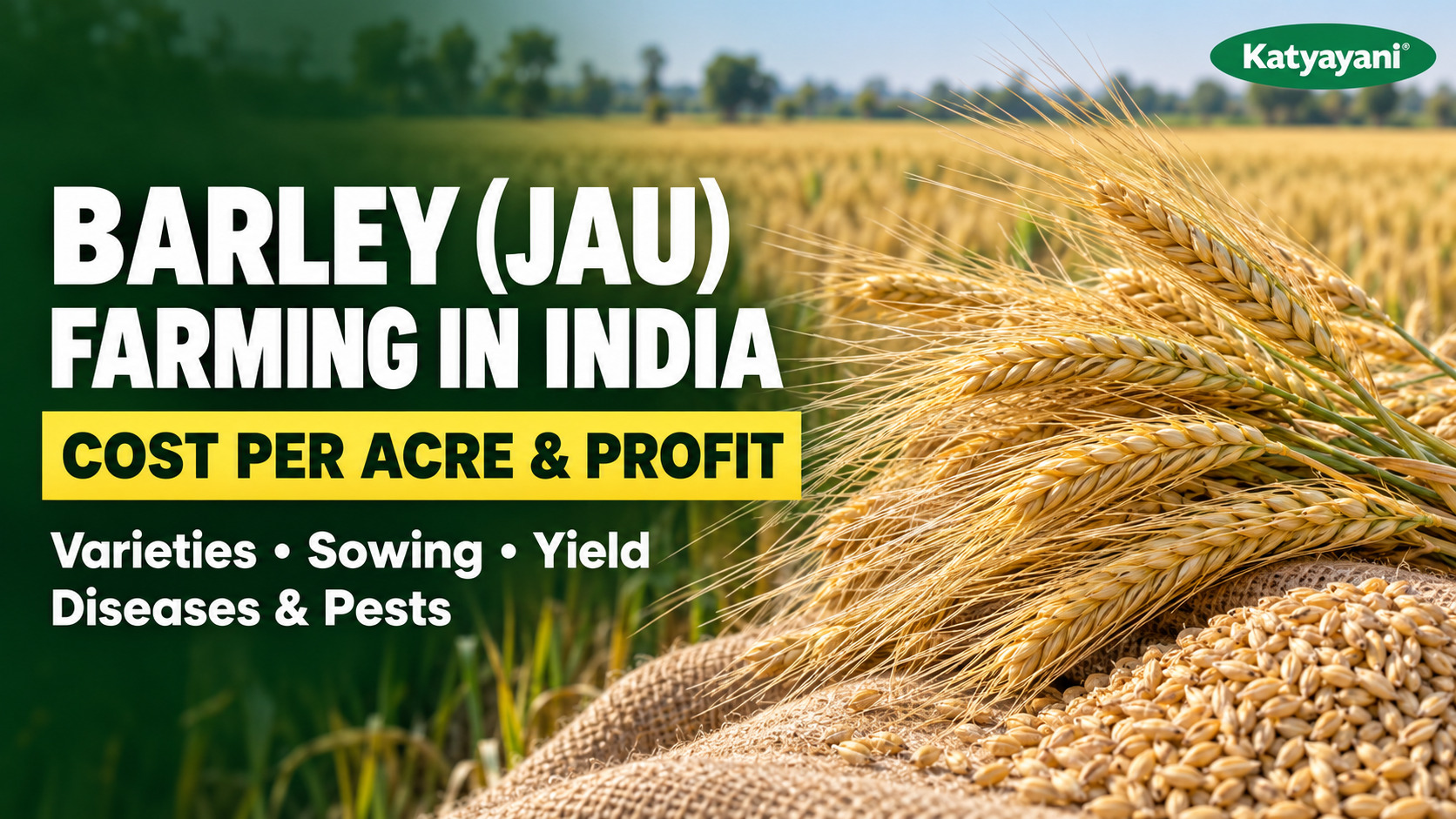
Barley (jau) is a low-input rabi cereal. In north-west India, sow irrigated barley between 5 and 25 November (late sowing 1 to 20 December) at about 40 kg seed per acre (100 kg per hectare), with 3 irrigations, and expect about 16 to 22 quintal per acre from a good variety. The national average is nearer 12 quintal per acre. In a 2023-24 Haryana survey the full cost was about Rs 28,300 per acre and the net return about Rs 5,500. The 2027-28 MSP is Rs 2,286 per quintal. The main losses come from yellow rust, blotches, aphids and late sowing.
What is barley (jau), where is it grown in India and what is it used for?
Barley (Hordeum vulgare, jau in Hindi) is a rabi cereal. Most of it is grown in Rajasthan, Uttar Pradesh, Madhya Pradesh, Bihar, Punjab, Haryana, Himachal Pradesh, Jammu and Kashmir and Gujarat. The IIWBR review of barley diseases puts the split of Indian barley at about 70 percent for cattle and poultry feed, 25 percent for malt and malt extract, and about 5 percent for food.
Farmers call it the poor man's crop, and there is a reason. It asks for less fertiliser and fewer waterings than wheat, and it puts up with dry, salty and thin soils better. That is why you see it on marginal land, on the edge of the wheat belt, and on fields where the last irrigation is never certain.
There are two ways to make money from it. You can grow feed or dual-purpose barley and sell it locally or feed it to your own animals. Or you can grow two-row malt barley for a maltster under contract, which pays better on paper but comes with strict grain quality and paperwork. We cover both below, so you can decide before you buy seed.
Barley is also food. Sattu and missi roti are made from it in the hills and tribal belts, and malt goes into beer, whisky, malted drinks and biscuits. If you grow it for the kitchen, ask for hulless types, because the husk comes off easily.
Which states grow the most barley, and how much does India produce?
Rajasthan has the largest barley area and production in India. The 2025 CCSHAU Haryana study adds that Haryana has the best yield per hectare (3,573 kg), even though its area is small. Uttar Pradesh, Madhya Pradesh, Punjab, Haryana and Bihar are the other main plains states. We could not find an official ranking beyond Rajasthan, so we do not give one.
| Year | Area | Production | Average yield | Source |
|---|---|---|---|---|
| 2011-12 | about 0.65 million ha | about 1.61 million tonnes | 24.8 quintal per ha (about 10.0 per acre) | IIWBR EB-44 |
| 2018-19 | 6 lakh ha | 17.5 lakh tonnes | 2,881 kg per ha (about 11.7 quintal per acre) | IIWBR EB-68 |
| 2023 | 5.51 lakh ha | 16.99 lakh tonnes | 3,082 kg per ha (about 12.5 quintal per acre) | Quoted in the CCSHAU Haryana study from government data |
Read the Haryana numbers twice. Barley area there fell from 30,320 ha (2001-05 average) to 9,400 ha (2021-24 average), while yield went up. The authors blame low profit compared with wheat and mustard. So barley is not a free swap for wheat. It makes sense when you have a buyer, a feed use, or land that wheat does not suit.
Malt barley, feed barley or hulless barley: which one should you grow?
Grow malt barley only if a maltster or contractor is already waiting for your grain. It needs a two-row variety, a higher fertiliser dose and clean, even grain. Grow feed or dual-purpose barley if you sell locally or keep animals. Grow hulless barley if the grain is for eating.
| Type | Typical varieties (IIWBR) | Where it suits | Main catch |
|---|---|---|---|
| Two-row malt barley | DWRB 160, DWRB 123, DWRB 101, DWRB 92, DWRB 182, DWRUB 52 (timely sown); DWRB 91 (late sown) | Irrigated land in the north-west plains, with a contract or an assured buyer | Higher fertiliser dose (90:40:20), 3 to 4 irrigations, grain quality is checked when you deliver |
| Feed and dual-purpose barley (DWRB 137 is six-row) | DWRB 137, BH 946, BH 902, RD 2552, RD 2786, BH 959 | Irrigated or rainfed fields, local market, fodder and feed | No malt premium; sold at the feed rate or against MSP |
| Hulless barley | NDB 943 (UP, irrigated, timely sown) | Food use | Lower yield (about 25 quintal per ha average in the IIWBR table) |
Variety names come from IIWBR bulletins EB-68, EB-72 and EB-89. NDB 943 shows up in EB-72 with the note chhilka rahit, which means without husk. If the contractor hands you seed, grow what he gives you and do not mix it with your own.
Which barley variety is best for your zone? Yield per acre and per hectare
For irrigated, timely-sown malt barley in the north-west plains, the IIWBR table puts DWRB 160 on top at 53.7 quintal per hectare, about 21.7 per acre. DWRB 182, DWRB 101, DWRB 92 and RD 2849 sit near 50 quintal per hectare. For December sowing, DWRB 91 gives about 40.6 quintal per hectare.
| Variety | Sowing condition | Average yield (q per ha / per acre) | Potential (q per ha) | Use |
|---|---|---|---|---|
| DWRB 160 | Timely, irrigated | 53.70 / 21.7 | 74.07 | Malt |
| RD 2849 | Timely, irrigated | 50.90 / 20.6 | 69.69 | Malt |
| DWRB 101 | Timely, irrigated | 50.10 / 20.3 | 67.44 | Malt |
| DWRB 92 | Timely, irrigated | 49.81 / 20.2 | 69.06 | Malt |
| DWRB 182 | Timely, irrigated (10 to 25 Nov) | 49.68 / 20.1 | 74.50 | Malt; yellow rust resistant per EB-90; matures in about 133 days |
| DWRB 123 | Timely, irrigated | 48.70 / 19.7 | 67.26 | Malt |
| DWRUB 52 | Timely, irrigated | 45.10 / 18.3 | 58.40 | Malt |
| DWRB 91 | Late sown, irrigated | 40.62 / 16.4 | 58.90 | Malt |
| DWRUB 64 (six-row) | Late sown, irrigated | 40.50 / 16.4 | 61.20 | Malt (six-row) |
That table is for the north-western plains zone: Punjab, Haryana, Delhi, most of Rajasthan, western UP, the Terai of Uttarakhand, Jammu and Kathua, Una and Paonta. It comes from EB-68, except DWRB 182. These are trial averages on good land. On light soil, or with a late irrigation, plan on less.
Other zones are different. Here is what EB-72 and EB-89 give for feed and dual-purpose types.
| Zone / state | Variety | Condition | Average yield (q per ha / per acre) |
|---|---|---|---|
| North-west plains | DWRB 137 (six-row) | Irrigated, timely | 52.20 / 21.1 (potential 80.0 q per ha) |
| North-west plains | BH 946 | Irrigated, timely | 51.96 / 21.0 |
| North-west plains | BH 902 | Irrigated, timely | 49.75 / 20.1 |
| North-west plains | RD 2552 (feed and fodder) | Irrigated, timely | 44.06 / 17.8 |
| Rajasthan (nematode areas) | RD 2052 | Irrigated, timely, molya resistant | 30.68 / 12.4 |
| Central zone (MP, Chhattisgarh, Gujarat, Kota and Udaipur, Bundelkhand) | BH 959; RD 2786; DWRB 137 | Irrigated, timely | 49.90 / 20.2; 50.20 / 20.3; 42.49 / 17.2 |
| North-east plains, Bihar and Jharkhand | HUB 113 | Irrigated, timely | 43.20 / 17.5 |
| North-east plains, eastern UP | DWRB 137; K 508 (UP) | Irrigated, timely | 37.93 / 15.4; 40.50 / 16.4 |
| Saline and alkaline land | RD 2907; Narendra Jau 1 (UP) | Irrigated, timely | 35.54 / 14.4; 22.30 / 9.0 |
Choose by zone first and by yield second. A variety that does well at Karnal can fail in Bihar. The IIWBR review says north-west varieties are badly hit by spot blotch in the warm, humid north-east plains, and that varieties bred for other zones can be badly hit by yellow rust in the north. So a high number in the table is only useful if the variety was bred for your climate.
Two more pointers from the same review. If your field has molya (cyst nematode), RD 2035, RD 2052 and RD 2592 are named as resistant. If yellow rust is your worry in the north-west plains, the review names DWRUB 52, DWRB 73, DWRUB 64, DWRB 91 and DWRB 92. Before you pay for seed, ask your KVK or seed dealer what is actually available this season. A famous variety you cannot get is no use to you.
How is barley grown, step by step? Jau ki kheti at a glance
Here is the whole season on one page. Each step has its own section below, with the numbers.
| Step | What to do | Details in this guide |
|---|---|---|
| 1. Field and soil | Well-drained loam or light soil, levelled. Check the soil report before deciding fertiliser | Fertiliser section |
| 2. Variety and seed | Choose by zone and sowing date; use clean, certified seed | Variety section |
| 3. Seed treatment | Insecticide first (termite), then fungicide (smut), then biofertiliser | Seed treatment section |
| 4. Sowing | Seed drill at 18 to 23 cm rows, 5 to 7 cm deep, 5 to 25 November for timely irrigated crops in the north-west plains | Sowing section |
| 5. First irrigation and top dressing | At active tillering, 30 to 35 days after sowing, with the second half of nitrogen | Fertiliser and irrigation |
| 6. Weeds | Spray 30 to 35 days after sowing, or pendimethalin 1 to 3 days after sowing | Weed section |
| 7. Scouting | Weekly walk from January for rust, blotches and aphids | Disease and pest sections |
| 8. Harvest and storage | End of March to first half of April, at 12 to 13 percent grain moisture; store below 12 percent | Harvest and storage sections |
When to sow barley in India, and how much seed per acre?
In the north-west plains, sow irrigated barley between 5 and 25 November. Late-sown crops go in between 1 and 20 December. Use 100 kg seed per hectare for timely sowing, about 40 kg per acre. For late-sown malt barley use 125 kg per hectare, about 50 kg per acre. Keep rows 18 to 23 cm apart and 5 to 7 cm deep.
| Item | Per hectare | Per acre (our arithmetic) | Source |
|---|---|---|---|
| Seed rate, timely sown | 100 kg | about 40 kg | EB-68, IIWBR barley page |
| Seed rate, late sown malt barley | 125 kg | about 50 kg | EB-68 |
| Row spacing | 22 to 23 cm (feed), 18 to 20 cm (malt); EB-90 gives 20 cm rows and 5 cm between plants for DWRB 182 | Same | IIWBR barley page, EB-90 |
| Sowing depth | 5 to 7 cm | Same | IIWBR barley page |
| Timely sowing date, irrigated | 5 to 25 November (EB-44); 10 to 25 November for DWRB 182 and DWRB 137 | Same | EB-44, EB-90, EB-89 |
| Late sowing date, irrigated | 1 to 20 December | Same | EB-44 |
A word on bigha. A bigha is a different size in different states, so we will not give you one number. Take the 40 kg per acre figure and multiply by the share of an acre your local bigha covers. If your bigha is half an acre, you need about 20 kg. Do the same with fertiliser, spray and cost, and your own numbers will be right for your own field.
Use a seed drill if you can. It puts the seed at an even depth and an even spacing, and IIWBR names it as the best method. A Happy Seeder can sow straight into rice-residue fields. If you sow by hand behind a plough, open the furrows first, as the IIWBR brochure describes, and keep the depth within the 5 to 7 cm range.
Rainfed fields are sown earlier, while the soil still holds moisture. A Hindi Vikaspedia summary gives 20 October to 10 November for rainfed barley and up to 25 November for irrigated. The page text did not open for us, so confirm the dates with your state university. For eastern UP, Bihar and central India we could not find an official sowing window. If you also grow wheat, our guide on wheat sowing time and seed rate helps you split the land between the two crops.
What happens if you sow barley late, or too early?
Late sowing costs yield. In the IIWBR table, malt varieties sown in November give about 45 to 54 quintal per hectare, while the late-sown varieties sown in December give about 40. That is a loss of roughly 5 to 14 quintal per hectare, or 2 to 6 quintal per acre, before you count the extra seed (about 10 kg more per acre) you must use for December sowing.
Sowing too early has its own cost. The IIWBR review says powdery mildew is most common in early-sown crops with a thick canopy, and that it shows up first around tillering. So there is no gain in rushing ahead of the window. Sow inside it, with treated seed.
If rain or a late rice harvest pushes you into December, do three things. Switch to a late-sown variety such as DWRB 91 or DWRUB 64, raise the seed rate to 125 kg per hectare, and keep your first irrigation on time. That is what the IIWBR bulletins advise, and it protects most of the yield you can still save.
How do you treat barley seed against smut, leaf stripe and termites?
IIWBR says treat seed in this order: insecticide for termites first, fungicide for smut second, biofertiliser last. Doses run from 2 to 3 g per kg of seed for carboxin, carbendazim or thiram mixes, and about 1 to 1.5 g per kg for tebuconazole 2 DS. The exact product dose is on the pack, so read it before you mix.
| Problem | What IIWBR documents say (per kg or per 100 kg seed) | CIB&RC barley row (up to 30.09.2026) |
|---|---|---|
| Loose smut (khuli kangiyari) | Carboxin (Vitavax) or carbendazim (Bavistin) 2 g per kg seed (EB-68); 2.5 g per kg (IIWBR review) | Carbendazim 50 WP: 2 g per kg seed. Carboxin 75 WP: 2 to 2.5 g per kg seed, one-time treatment |
| Covered smut (band kangiyari) | Thiram plus Bavistin or Vitavax mixed 1:1 at 2.5 g per kg (EB-68); tebuconazole as per pack (EB-90 says 1 g per kg of 2 DS; the review says 1.5 g per kg) | No separate covered smut row found |
| Mixed seed-borne diseases | Carboxin 37.5 percent plus thiram 37.5 percent WS at 3 g per kg (EB-44, EB-90); Raxil 1 g per kg (IIWBR barley page) | Thiram 75 WS has a barley row for leaf stripe |
| Termites | Chlorpyrifos 20 EC, 125 ml (EB-44) or 150 ml (EB-68) in 5 litres of water per 100 kg seed | Chlorpyrifos 20 EC: 4 to 6 ml per kg seed (a higher figure than IIWBR) |
| Nitrogen and phosphorus support | Azotobacter plus PSB seed treatment (EB-68) | Not a CIB&RC pesticide row |
Start with loose smut. The CIB&RC list has a barley row for carbendazim 50 WP at 2 g per kg of seed, and Katyayani sells carbendazim 50 WP seed treatment (SuperStin). Its page lists smut and has an FAQ about wheat and barley smut, but the answer and the dose are blank on the page, so go by the pack and the 2 g per kg figure from the CIB&RC list.
Then the termite part. The official sources do not agree on chlorpyrifos: IIWBR gives 1.25 to 1.5 ml per kg of seed, and the CIB&RC list gives 4 to 6 ml per kg. Do not pick a number from a blog. Use the dose printed on the label of the product you buy, and ask your KVK or agriculture officer if it still looks different. If you have had termite damage before, our collection for termite control in wheat shows what we stock for the same pest; the pages are written for wheat, so check the pack for barley.
Biofertiliser goes on last, once the chemical dressing has dried. Wear gloves, treat on a clean floor or sheet, and dry the seed in shade before sowing. Our fungicide application methods guide explains dry dressing and slurry.
Do not skip this step to save a few rupees. The IIWBR review says smut is now rare in India because most farmers treat seed, and that net-type net blotch, loose smut and covered smut all travel with the seed. If you keep your own seed, never take it from a field that had black ears.
How much fertiliser does barley need per acre?
For irrigated, timely-sown feed barley, IIWBR recommends 60 kg N, 30 kg P2O5 and 20 kg K2O per hectare, which is about 24:12:8 kg per acre. Malt barley gets 90:40:20 per hectare, about 36:16:8 per acre. Put half the nitrogen and all the phosphorus and potash in at sowing. Give the rest of the nitrogen after the first irrigation.
| Crop and condition | N : P2O5 : K2O per hectare | Per acre (our arithmetic) | Source |
|---|---|---|---|
| Feed barley, irrigated, timely or late | 60 : 30 : 20 | about 24 : 12 : 8 | IIWBR barley page, EB-89 |
| Malt barley, irrigated, timely | 90 : 40 : 20 (EB-44 says 90 : 30 : 20) | about 36 : 16 : 8 | IIWBR barley page, EB-68, EB-90 |
| Rainfed, plains and northern hills | 40 : 20 : 20 | about 16 : 8 : 8 | IIWBR barley page |
| Dual purpose (grain and fodder) | 75 : 30 : 20 plains; 60 : 30 : 20 hills | about 30 : 12 : 8 plains | IIWBR barley page |
| Extra for malt quality | 20 kg sulphur; 25 kg zinc sulphate where zinc is short | about 8 kg sulphur; about 10 kg zinc sulphate | EB-68 |
Here is that in bags, by our own arithmetic. Using urea (46 percent N), DAP (18:46:0) and muriate of potash (60 percent K2O), feed barley needs roughly 26 kg DAP, 42 kg urea and 13.5 kg potash per acre. Malt barley needs roughly 35 kg DAP, 65 kg urea and 13.5 kg potash per acre. Half the urea goes in at sowing and half after the first irrigation. Treat this as a starting point and adjust it with your soil test. If you have never read the report, how to read your soil health card explains it in plain words.
Sulphur is the part many farmers miss. EB-68 asks for 20 kg sulphur per hectare (about 8 kg per acre) for malt quality. One simple way to supply it is ammonium sulphate, which carries 21 percent nitrogen and 24 percent sulphur. Our arithmetic says about 34 kg per acre gives 8 kg of sulphur and also about 7 kg of nitrogen, which you then subtract from your urea. The Katyayani page for ammonium sulphate for wheat and barley lists barley under cereals, but it gives no cereal dose, so follow your soil test and the pack.
On the bio side, EB-68 asks for Azotobacter plus PSB seed treatment. Katyayani has an Azotobacter bio-fertiliser whose page lists barley under field crops, and a phosphate solubilizing bacteria (PSB) product. The PSB page says it suits all crops and does not name barley. Neither page prints a seed dose, so use the pack. These do not replace the chemical fertiliser above; they support it.
On zinc, EB-68 says to add zinc sulphate only where the soil is short of it. We did not find an official barley-specific guide to deficiency symptoms, so we will not guess from leaf colour. A soil test is the safe way to know. Yellowing in patches, with stunting, can also be molya, as we explain in the disease section.
How many irrigations does barley need, and when?
Irrigated barley needs 2 to 3 waterings, and malt barley 3 to 4. Give the first at active tillering, 30 to 35 days after sowing. Give the second at flag leaf, 60 to 65 days. Give the third at the milky stage, 85 to 90 days. Do not flood the field, because heavy irrigation can cause lodging and fewer tillers.
| Irrigation | Days after sowing | Growth stage | Note |
|---|---|---|---|
| 1st | 30 to 35 | Active tillering | Give the top-dressing of nitrogen after this irrigation |
| 2nd | 60 to 65 (EB-68 malt barley: 65 to 70) | Flag leaf to ear emergence | Do not skip: this decides grain number |
| 3rd | 85 to 90 (EB-68 malt barley: 90 to 95) | Milky stage | Stop before grain hardens |
| 4th (malt barley, if needed) | As needed | Grain filling | EB-68 allows a fourth if the season is dry |
| Sprinkler | First at 20 days; then every 25 days | Whole season | EB-68 |
Think of the three waterings as three jobs. Around day 30 the plants start putting out side shoots, called tillers. That first irrigation, with the nitrogen top-dressing, decides how many ears you will get. Around day 60 the flag leaf and the ear are forming. If the crop is dry now, you can lose grain number, and a late watering will not win all of it back. Around day 85 to 90 the grain is filling with a milky juice. A last watering keeps it plump.
The calendar is a guide, not a rule. On light soil the crop shows stress sooner. Walk the field the evening before a planned watering. If the top soil is dry and crumbly, and the leaf tips are rolling by afternoon, do not wait for the date. If it rained last week, check before you irrigate. A watering you did not need costs you money and raises the chance of lodging.
How do you control weeds in barley?
IIWBR recommends one spray 30 to 35 days after sowing. Use pinoxaden (Axial) for grass weeds such as mandusi and wild oat, and metsulfuron or 2,4-D for broadleaf weeds such as bathua. Pendimethalin goes on 1 to 3 days after sowing instead. Never mix pinoxaden with 2,4-D. Spray the 2,4-D a week after the pinoxaden.
| Weed type | Product (IIWBR EB-68, per acre) | When | Main weeds |
|---|---|---|---|
| Narrow leaf (grasses) | Pinoxaden 5 EC: 350 ml | 30 to 35 days after sowing, 120 litres water per acre | Mandusi, wild oat, poa, lomad ghas |
| Broadleaf | Metsulfuron: 8 g; or 2,4-D: 500 ml | 30 to 35 days after sowing, 120 litres water per acre | Bathua, jangli palak, maina, senji, makoi, krishnaneel, chatri-matri |
| Both | Isoproturon 75 WP: 500 g; or pendimethalin 30 EC: 1,250 to 1,500 ml | Isoproturon at 30 to 35 days; pendimethalin 1 to 3 days after sowing | Where isoproturon fails against mandusi, use pinoxaden or pendimethalin |
In practice, look at the weeds before you choose. If your field is full of mandusi (the grass that looks like wheat), a broadleaf spray will do nothing. If it is full of bathua, a grass spray will do nothing. Pick the product for the weed you can see. Use a flat-fan nozzle and the full 120 litres of water per acre, because a thin spray leaves patches.
- Time it from the sowing date. The window is 30 to 35 days. A spray at 45 days is late for the crop and the weeds.
- Rotate herbicides from year to year. IIWBR says to rotate, and to add fodder crops like berseem or oats to the rotation.
- Keep a hand hoeing after the first irrigation. It is still part of the IIWBR package.
- Do not let weeds go to seed. They are next year's problem.
Label Check: In the CIB&RC Major Uses of Pesticides herbicide list (up to 30.09.2026) we searched the text for barley and found no barley row. The herbicide rows name wheat, rice and other crops. IIWBR recommends these herbicides on barley, so they sit in the research package, but a label that does not list barley is not a barley label. Read the pack and ask your KVK before you buy. We have not linked a herbicide for this reason.
The IIWBR documents also give slightly different doses in different years. The 2013 brochure gives 3,333 to 4,950 g of pendimethalin per hectare, while EB-68 gives 1,250 to 1,500 ml per acre, about 3,090 to 3,700 ml per hectare. Go with the number on your label.
What are the common diseases of barley, and how do you tell them apart?
The main barley diseases in India are yellow rust, brown (leaf) rust, net blotch, spot blotch, powdery mildew, loose and covered smut, stripe disease, barley yellow dwarf and molya (cyst nematode). Rusts like cool, wet weather, mostly in the north-west. Spot blotch and net blotch like warm, humid weather, mostly in the east.
| What you see | Likely cause | Where and when it is common | What to do |
|---|---|---|---|
| Narrow yellow to orange-yellow stripes of powdery spores along the leaf; spreads fast | Yellow (stripe) rust | Cool, humid north-west plains; 2 to 15 degrees C with leaves wet 8 to 10 hours. Early attack can stop ear emergence | Resistant variety; one sprayed fungicide at first appearance (see next section) |
| Small orange-brown pustules scattered on the upper leaf, later black streaks | Brown (leaf) rust | Warmer weather, 20 to 25 degrees C with a wet spell; common but seldom severe over wide areas | Same fungicide programme if it starts early and heavy |
| Dark brown net-like streaks across and along the leaf, with a yellow edge (net form); small round to oval dark spots with a yellow halo (spot form) | Net blotch | Humid spells of 10 hours or more at 15 to 20 degrees C; also seed- and stubble-borne. Losses reported 10 to 44 percent | Treated, clean seed; clear stubble; resistant variety; fungicide if severe |
| Dark brown oval to long blotches that join up; leaves dry out early; flag leaf attack hurts most | Spot blotch | Warm, humid weather: UP, Bihar, Jharkhand, West Bengal, Assam. Losses commonly 10 to 30 percent | Choose a tolerant variety for the east (the review names DWRUB 52, DWRB 73, DWRUB 64, RD 2552); fungicide if severe |
| White fuzzy tufts that become powdery on leaves and sheaths, mainly at tillering | Powdery mildew | Early sown, dense crops in cool, humid weather. Usually gone by ear emergence; losses minimal in India but up to 25 percent in heavy cases | Avoid over-dense crops; the same triazole fungicides work |
| Black powdery ears that emerge earlier than healthy ones (loose smut) or ears held under a grey membrane until threshing (covered smut) | Loose smut, covered smut | Seed-borne. Rare now where seed is treated | Seed treatment only; there is no cure in a standing crop |
| Long narrow yellow streaks turning brown along the whole leaf, splitting leaf, stunted plants, grey-brown twisted ears | Stripe disease (Drechslera graminea) | Seed-borne; transmission is high when soil is below 12 degrees C at sowing | Treated seed; sow on time. The review reports losses of 20 to 70 percent from stripe disease in 1992-93 |
| Bright yellow, stiff, upright leaves with saw-edged margins, in scattered plants that later form round patches; poor tillering | Barley yellow dwarf virus (spread by aphids) | Early infection can cause up to 100 percent loss | Control aphids early; remove self-sown barley and grasses before sowing |
| Stunted, patchy crop with yellowing like a nutrient problem; roots look bushy, with white cysts later turning brown | Molya (cereal cyst nematode) | North-east Rajasthan and adjoining Haryana | Grow a resistant variety (RD 2035, RD 2052, RD 2592); rotate with a non-host crop for 1 to 2 years; control grassy weeds |
These symptoms, climate ranges and loss figures come from the IIWBR review (Gangwar et al., 2018). It is the best single Indian reference we found. Use the table as a field guide, not a lab test.
Here is how it looks on the ground. In January you walk in and see narrow yellow stripes on the lower leaves. Rub one between your fingers. If your skin turns yellow-orange, that is rust spore, and it spreads fastest when nights are cold and the leaves stay wet for hours. Now compare with a leaf that has brown net-like lines and a yellow rim. That is net blotch, and it does not leave yellow powder on your hand.
A caution before you reach for the spray tank. Yellow patches in a stunted crop are not always disease. Waterlogging, a missed top-dressing, termites and molya all look alike from the bund. Pull up a few plants from the middle of a patch. White cysts on the roots mean molya. Eaten roots mean termites. Spray only when you know what you are treating.
Which is the best fungicide for barley?
For yellow and brown rust, IIWBR recommends one spray of propiconazole 25 EC or tebuconazole 250 EC at about 1 ml per litre (0.1 percent). That is 200 ml of fungicide in 200 litres of water per acre, once the disease appears. If it keeps spreading, spray again after 15 to 20 days. For smut, do not spray at all; treat the seed.
| Disease | IIWBR recommendation | Dose and timing | CIB&RC barley row? |
|---|---|---|---|
| Yellow and brown rust, leaf blight | Propiconazole 25 EC or tebuconazole 250 EC (EB-68); triadimefon 25 WP also in EB-44 | 200 ml in 200 litres per acre (0.1 percent), after first appearance; repeat after 15 to 20 days if needed | No barley row for propiconazole, tebuconazole or triadimefon in the list we read; their rows name wheat and other crops |
| Rusts, powdery mildew, spot and net blotch (review) | Triazoles at 0.1 percent: azoxystrobin 25 EC, triadimefon, difenoconazole 25 EC, propiconazole, tebuconazole | 1 ml per litre of water | Same gap |
| Loose smut | Seed treatment | 2 to 2.5 g per kg seed | Yes: carbendazim 50 WP and carboxin 75 WP |
| Stripe disease and leaf stripe | Seed treatment | See the seed table | Yes for thiram 75 WS (leaf stripe) |
Be straight with yourself about the label. The CIB&RC lists we read (up to 30 September 2026) have barley rows for carbendazim and carboxin (loose smut), thiram (leaf stripe), carbofuran (aphid, cyst nematode) and chlorpyrifos 20 EC (termite, on seed). They have no barley row for propiconazole, tebuconazole, triadimefon or imidacloprid, even though IIWBR bulletins recommend them on barley. That is a gap between research advice and the label, not a ban.
If you decide to spray for rust, Katyayani lists propiconazole (Boost) in its collection of fungicide for wheat rust. Barley is not on those pages and Boost shows no barley dose, so treat it as the same active that IIWBR names, and check the pack and your KVK before you use it on barley.
A practical rule: spray only when rust has started and your variety is susceptible. The review says a foliar fungicide pays on susceptible varieties in disease-prone or wet seasons where yield potential is above 2.0 tonnes per hectare, about 8 quintal per acre. On a poor rainfed crop it often does not pay. When you do spray, wet the leaf properly. Our notes on fungicide application methods cover nozzle and volume.
How do you control aphids, termites and molya (cyst nematode) in barley?
For aphids, IIWBR advises spraying a strip 3 to 5 metres wide around the field as soon as they appear, using imidacloprid 200 SL at 100 ml per hectare (about 40 ml per acre). If the attack is heavy, spray the whole field after 15 days. For termites, treat the seed or broadcast chlorpyrifos with sand 15 days after sowing. For molya, use rotation and a resistant variety.
| Pest | IIWBR EB-68 advice | Per acre (our arithmetic) | CIB&RC barley row? |
|---|---|---|---|
| Aphid (also spreads yellow dwarf virus) | Imidacloprid 200 SL (Confidor) 100 ml per hectare, border strip first; repeat in 15 days if heavy | about 40 ml | No imidacloprid barley row. Carbofuran 3 CG has one for barley aphid |
| Termite in standing crop | Chlorpyrifos 3 litres per hectare mixed with 20 kg sand and 2 to 3 litres water, broadcast 15 days after sowing | about 1.2 litres chlorpyrifos | Chlorpyrifos 20 EC has a barley row for seed treatment only |
| Molya (cyst nematode) | Carbofuran 3 G at 33 kg per hectare; rotation with a non-host for 1 to 2 years | about 13.5 kg granules | Carbofuran 3 CG: aphid, cyst nematode, 33.3 kg product per hectare |
Aphids come in from the edges, which is why IIWBR says to treat the border first. Check the field edges every week from January. They also matter beyond the leaf damage, because they carry barley yellow dwarf virus from grasses and self-sown barley into your crop. Katyayani sells an imidacloprid insecticide for aphids (70 WG). The page lists aphids and other sucking pests, but it names no crop and prints no dose, and the CIB&RC list has no barley row for imidacloprid. The IIWBR dose is for a 200 SL product, so do not carry that number over to a 70 WG pack. Use the pack and ask your KVK.
Termites are the quiet loss. You see dry, yellowing patches, and plants that pull out with no roots. If you did not treat the seed, IIWBR describes broadcasting chlorpyrifos with sand 15 days after sowing. Chlorpyrifos is the active the CIB&RC list gives for barley termite on seed. Our termite control in wheat collection is the closest match we have; the same advice applies, so read the barley line on the pack.
Molya is harder. Patches are stunted and thin, the crop looks hungry, and the roots look bushier than normal, with white cysts that later turn brown. The IIWBR review says there is no soil nematicide that is both effective and cheap enough for a low-value crop like barley, so the main answer is a resistant variety and rotation. Our crop rotation guide shows how to fit a non-host crop into the plan. IIWBR EB-68 lists carbofuran 3 G at 33 kg per hectare, and the CIB&RC list has a barley row for it. Carbofuran is a toxic granule, so apply it as the label directs, wear gloves, and keep children and animals away. Katyayani also has a collection of bio-nematicides for wheat nematodes. Those pages do not mention barley or molya, so see them as a supporting option and not a cure.
One more job before the season starts: remove self-sown barley and grasses. The review says they carry rusts, mildew and the aphids that spread yellow dwarf.
When is barley ready to harvest, and how long is the barley crop duration?
Barley matures in about 113 to 133 days, depending on the variety and the zone. DWRB 182 takes about 133 days. DWRB 137 takes about 127 days in the north-west plains and 113 to 115 days in the central and north-east zones. In the north-west plains the crop is ready from the end of March to the first half of April, at about 12 to 13 percent grain moisture.
Do not guess the date. Look at the field. The straw turns golden and dry, the ears droop, and the grain is hard when you bite or press it. This is our practical rule, not an IIWBR figure. What IIWBR does say is to harvest at full maturity and before the grains shatter and the ears turn brittle. Wait too long and the heads break and drop grain. Cut too early and the grain is damp and light.
- Cut at full maturity, before shattering. For malt barley IIWBR advises machine harvest at about 12 percent moisture.
- Thresh 2 to 3 days after cutting with a power thresher. A combine harvester does cutting, threshing and cleaning in one pass (EB-90).
- Keep malt barley separate and clean. Mixed varieties and damp grain are the usual reasons a lot gets rejected.
How do you store barley after harvest?
Dry the grain well before storing it. IIWBR EB-68 says to bring moisture below 12 percent, clean the bags and the godown, and take out damaged grain first. Damaged seed feeds secondary insects. After that, protect the stored lot from insects and rats, and keep it somewhere cool and dry.
- Clean first. Sweep the godown and fumigate it before you load. Dirty bags and old grain are where storage insects start.
- Spray the bags with malathion 50 EC at 10 ml per litre of water, or deltamethrin 2.5 SC at 0.5 ml per litre (EB-68).
- Fumigation. EB-68 gives aluminium phosphide 56 percent, one pouch (10 g) per tonne of grain in an airtight godown. It is a highly toxic fumigant, so it should be done only by a trained person, with the label and the safety rules followed.
- Rats. EB-68 describes a bait of zinc phosphide, flour and edible oil placed in several spots. Keep it away from children and pets.
Check the lot every few weeks. A warm smell, caking, or fine dust at the bottom of the bag means insects or damp. Spread the grain in the sun for a day and re-bag it. For a malt lot, damp grain is the commonest reason for rejection, so do not store it near a wet wall.
How much barley do you get per acre? Yield per acre, per hectare and per bigha
With a good IIWBR variety under irrigation, expect roughly 16 to 22 quintal per acre in the north-west plains. The national average is nearer 12 quintal per acre (30.8 quintal per hectare in 2023). Haryana farmers in the 2023-24 survey averaged 42 quintal per hectare, about 17 quintal per acre. Per bigha, it depends on how big your bigha is.
| Measure | Per hectare | Per acre (our arithmetic) | Source |
|---|---|---|---|
| India average, 2018-19 | 28.81 quintal | about 11.7 quintal | EB-68 |
| India average, 2023 | 30.82 quintal | about 12.5 quintal | Quoted in the Haryana study |
| Haryana farmers (Rewari, Mahendergarh), 2023-24 survey, main produce | 42.0 quintal | about 17.0 quintal | Pawar et al. 2025 |
| IIWBR malt barley varieties, timely sown, NWPZ (average of trials) | 45 to 54 quintal | about 18 to 22 quintal | EB-68, EB-90 |
| Late sown malt barley | about 40 quintal | about 16 quintal | EB-68 |
Why is the gap so wide? The trial numbers come from good land, certified seed and timely irrigation. The national average includes rainfed fields, late sowing and poor seed. Closing even half of that gap is where the profit is. To get a bigha number, take the per-acre figure and multiply by the share of an acre your bigha covers. We do not print one fixed number because bigha size is not the same in Rajasthan, UP, Bihar or Punjab.
Do not forget the straw. In the Haryana survey it was worth about Rs 9,170 per hectare, roughly Rs 3,700 per acre, and many farmers feed it to their own animals.
What is the cost of barley cultivation per acre?
A 2023-24 survey of 50 barley farmers in Rewari and Mahendergarh, Haryana (CCSHAU Hisar) put the full cost at Rs 69,940 per hectare, about Rs 28,300 per acre. That includes rent on your own land and a charge for your management. The variable cost was Rs 37,830 per hectare, about Rs 15,300 per acre. Harvesting and threshing was the biggest single line.
| Cost item | Rs per hectare (Haryana survey 2023-24) | Rs per acre (our arithmetic) |
|---|---|---|
| Field preparation | 5,649 | about 2,290 |
| Seed and sowing (about 93 kg seed per ha) | 3,835 | about 1,550 |
| Manure and fertiliser | 4,113 | about 1,660 |
| Irrigation (about 4 irrigations) | 5,305 | about 2,150 |
| Plant protection (weeds, insects, disease) | 1,024 | about 410 |
| Harvesting and threshing | 16,625 | about 6,730 |
| Interest on working capital | 1,279 | about 520 |
| Variable cost, total | 37,830 | about 15,310 |
| Management and risk factor | 7,566 | about 3,060 |
| Transport | 1,294 | about 520 |
| Rental value of own land | 23,250 | about 9,410 |
| Total cost | 69,940 | about 28,300 |
The full table is in the CCSHAU paper (Table 2). Look at where the money goes. Fertiliser, seed and plant protection together come to about a quarter of the variable cost, while harvesting and threshing alone takes over two-fifths. So harvest cost is the line to watch before you cut corners on inputs. Two districts, one state and one year make a small sample, so treat the table as a guide. Your own number will move with hired labour rates and how many waterings you give.
For comparison, the Economic Affairs study of Rajasthan (cost data to 2015-16) puts barley at Rs 18,703 per hectare on cash cost A2 and Rs 48,348 per hectare on the fuller cost C2 in TE 2015, about Rs 7,570 and Rs 19,570 per acre. It shows how fast costs have climbed. It is ten years old, so do not use it as a current budget.
How much profit does barley give per acre?
Profit per acre is quintals per acre times price per quintal, plus straw, minus cost. At the 2027-28 MSP of Rs 2,286 and the 2023-24 Haryana cost, 12.5 quintal per acre just breaks even on full cost. At 17 quintal you keep about Rs 10,600, and at 20 quintal about Rs 17,400, before straw. On cash cost alone the margins look bigger.
Formula: Net profit per acre = (quintal per acre x price per quintal) + straw value - cost per acre. Use cash cost (about Rs 15,830 per acre) to see what you really spend, and full cost (about Rs 28,300) to see whether your land and your own time are paid for.
| Yield per acre | Grain value at MSP Rs 2,286 | Profit over cash cost (Rs 15,834) | Profit over full cost (Rs 28,304) |
|---|---|---|---|
| 12.5 quintal (India average, 2023) | Rs 28,575 | about Rs 12,740 | about Rs 270 |
| 17 quintal (Haryana survey average) | Rs 38,862 | about Rs 23,030 | about Rs 10,560 |
| 20 quintal (IIWBR variety average, irrigated, timely) | Rs 45,720 | about Rs 29,890 | about Rs 17,420 |
Cash cost here is the variable cost plus transport from the Haryana table (Rs 15,310 plus Rs 524 per acre). Straw adds about Rs 3,700 per acre and is not in the table. The numbers mix 2023-24 costs with a 2027-28 MSP, so replace them with your own bills. And the MSP only helps if your state or an agency actually buys barley at that rate. Otherwise you sell at the mandi or to a maltster.
The Haryana farmers reported a net return of Rs 13,698 per hectare, about Rs 5,500 per acre, at their own sale price. By our arithmetic from the table that price was about Rs 1,773 per quintal, below the 2027-28 MSP, which is part of why the margin was thin. The authors also report that 92 percent of the farmers felt barley paid less than competing crops, and 88 percent said low use of barley as a staple was a problem.
So what should you do? Compare the crop with wheat and mustard on your own soil before you move acres. Barley wins when you have a buyer, a feed use, a field that wheat does not suit, or an irrigation you cannot trust. It loses when you grow it by default and sell in a hurry.
On a thin margin, insurance matters. Ask your bank or CSC whether barley is notified in your district this season. Our posts on PMFBY rabi registration and frost damage claim under PMFBY explain the process and the 72-hour rule.
What is the MSP and price of barley per kg in India?
The Cabinet approved a barley MSP of Rs 2,286 per quintal for the 2027-28 marketing season, which covers the crop you sow this rabi and harvest in spring 2027. That is up Rs 136 from Rs 2,150, and works out to Rs 22.86 per kg. Market price moves with the mandi and the week, so check Agmarknet or your local mandi before you sell.
| Item | Figure | Source |
|---|---|---|
| MSP, marketing season 2027-28 | Rs 2,286 per quintal (Rs 22.86 per kg) | News report of the 30 Sep 2026 Cabinet table, AgroSpectrum |
| MSP, marketing season 2026-27 | Rs 2,150 per quintal | Same table |
| Increase | Rs 136 per quintal (6.3 percent) | Same table |
| Cost of production in that table | Rs 1,447 per quintal | Same table |
| Margin over that cost | 58 percent | Same table |
| Market (mandi) price | Not available to us. Check Agmarknet or your local mandi | Live check needed |
Our rabi MSP crop-wise rates post has the full list. We could not find a published malt barley contract price, and we will not guess one. Before you commit land, ask the buyer in writing for the rate, the moisture and quality limits, and the payment date. If the buyer will not put it in writing, that tells you something.
How do you sell malt barley under contract, and what quality do maltsters want?
Contract farming is how most Indian malt barley is sold. Private companies work with farmers in several states, using two-row varieties. IIWBR says yield and malt quality depend on variety, sowing date, plant density, fertiliser, irrigation, weed control and quality seed. So the contract should spell out the seed, the rate, the quality limits and what happens to rejected grain.
| Quality measure | DWRB 182 | DWRB 101 | RD 2849 | DWRB 160 |
|---|---|---|---|---|
| Plump grain (percent) | 86 | 91 | 91 | 96 |
| Thin grain (percent) | 2.7 | 1.3 | 1.4 | 0.8 |
| Husk (percent) | 12.0 | 9.8 | 11.0 | 11.4 |
| Protein (percent) | 11.3 | 10.8 | 10.6 | 10.5 |
| Germination energy (percent, 72 hours) | 97.5 | 98 | 97.5 | 96 |
| Beta-glucan (percent) | 4.7 | 5.7 | 5.4 | 7.3 |
| Malt extract (percent) | 79.4 | 79.9 | 79.1 | 79.3 |
| Diastatic power (Lintner) | 86 | 74 | 75 | 83 |
These are variety quality values from IIWBR EB-90. The bulletin text is in an old Hindi font, so we read the numbers directly and interpreted the labels. They show how varieties differ, but they are not a buyer's specification. The company may set its own protein and plump grain limits, so get them in writing. Use the contractor's approved seed, keep varieties apart, cut at the right moisture and store the lot clean and dry.
What are the common mistakes in barley farming?
| Mistake | Why it hurts | What to do instead |
|---|---|---|
| Sowing late without changing variety or seed rate | Late-sown malt barley yields about 40 quintal per hectare against 45 to 54 when timely sown | Sow 5 to 25 November; for December use DWRB 91 or DWRUB 64 at 125 kg per hectare |
| Using a north-west variety in the humid east, or the reverse | The IIWBR review says spot blotch hits north-west varieties in the east and yellow rust hits other zones' varieties in the north | Pick a variety listed for your zone |
| Skipping seed treatment or saving seed from a smutty field | Smut, stripe disease and net-type net blotch are seed-borne | Treat every lot; buy clean seed |
| Heavy irrigation | IIWBR warns that heavy irrigation can cause lodging and fewer tillers | Follow the 30 to 35, 60 to 65, 85 to 90 day plan and split nitrogen |
| Mixing pinoxaden and 2,4-D in one tank | IIWBR says not to mix them | Spray 2,4-D a week after pinoxaden |
| Spraying weedicide after 35 days | The advice window is 30 to 35 days | Time the spray from the sowing date |
| Spraying a fungicide for every yellow leaf | Yellowing can be nematode, termite, waterlogging or a missed top dressing | Dig up plants, check roots and the underside of leaves first |
| Ignoring self-sown barley and grasses | They carry rust, mildew and aphids that spread yellow dwarf | Clear them before sowing and keep bunds clean |
| Going by a blog dose | IIWBR documents themselves differ on a few doses and the label may not list barley | Read the label; confirm with your KVK |
| Selling in a rush without a price check | Market price can sit above or below MSP | Check mandi rates and, for malt, your contract rate |
Barley crop calendar for the north-west plains: what to do and when
| When | What to do | Note |
|---|---|---|
| Before sowing (October) | Level the field, clear self-sown barley and weeds, check the soil report, arrange seed | Green bridge removal lowers rust and aphid risk |
| Sowing (5 to 25 November) | Treat seed, drill at 5 to 7 cm depth, basal fertiliser (half N, all P and K) | Malt barley: add sulphur, and zinc if short |
| Day 20 to 35 | First irrigation at tillering; top-dress the rest of nitrogen | Sprinkler: first irrigation at day 20 |
| Day 30 to 35 | Weed spray: pinoxaden, or metsulfuron/2,4-D; pendimethalin should have gone on at day 1 to 3 | Do not mix pinoxaden and 2,4-D |
| Day 60 to 65 | Second irrigation; weekly scouting for rust, blotches, aphids | Spray only if rust has begun and variety is susceptible |
| Day 85 to 90 | Third irrigation at the milky stage; watch aphids | Malt barley may get a fourth |
| Late March to mid April | Harvest at 12 to 13 percent moisture; thresh in 2 to 3 days | Store below 12 percent |
| After harvest | Remove or incorporate stubble; rotate a non-host crop where molya is present | Stubble carries net blotch, spot blotch and Septoria |
Conclusion
Barley rewards a farmer who sows on time, picks a variety for the zone, treats the seed and irrigates at the three key stages. At the 2027-28 MSP of Rs 2,286 per quintal it can pay when yields reach 17 to 20 quintal per acre or when a maltster or feed buyer is waiting, but it is a thin-margin crop at the national average of about 12 quintal per acre. Confirm every dose on the pack label and with your KVK before you spray.
Questions Farmers Ask
How much barley seed is needed for 1 acre?
How much does barley yield per acre?
What are the top barley producing states in India?
What is the price of 1 kg of barley in India?
What are the common diseases that affect barley crops?
What is the best fungicide for barley?
What is the average barley yield per hectare?
How long is the barley crop duration?
When should barley be sown in India?
What is the cost of barley cultivation per acre?
How much profit can you make from barley per acre?
Which is the best malt barley variety?

Microbiologist
Microbiologist at Katyayani Organics. MSc in Microbiology, 2.6 years of experience.
View all authorsRead Next in Rabi & Horticulture Crop Guides

Integrated Pest Management (IPM) in Banana: Weevils, Aphids, Thrips, Nematodes, Sigatoka and Panama Wilt, Stage by Stage

Beetroot Farming in India: Sowing Time, Varieties, Seed Rate, Fertiliser, Diseases, Yield, Cost and Profit per Acre

Leave a Comment