 27 min read
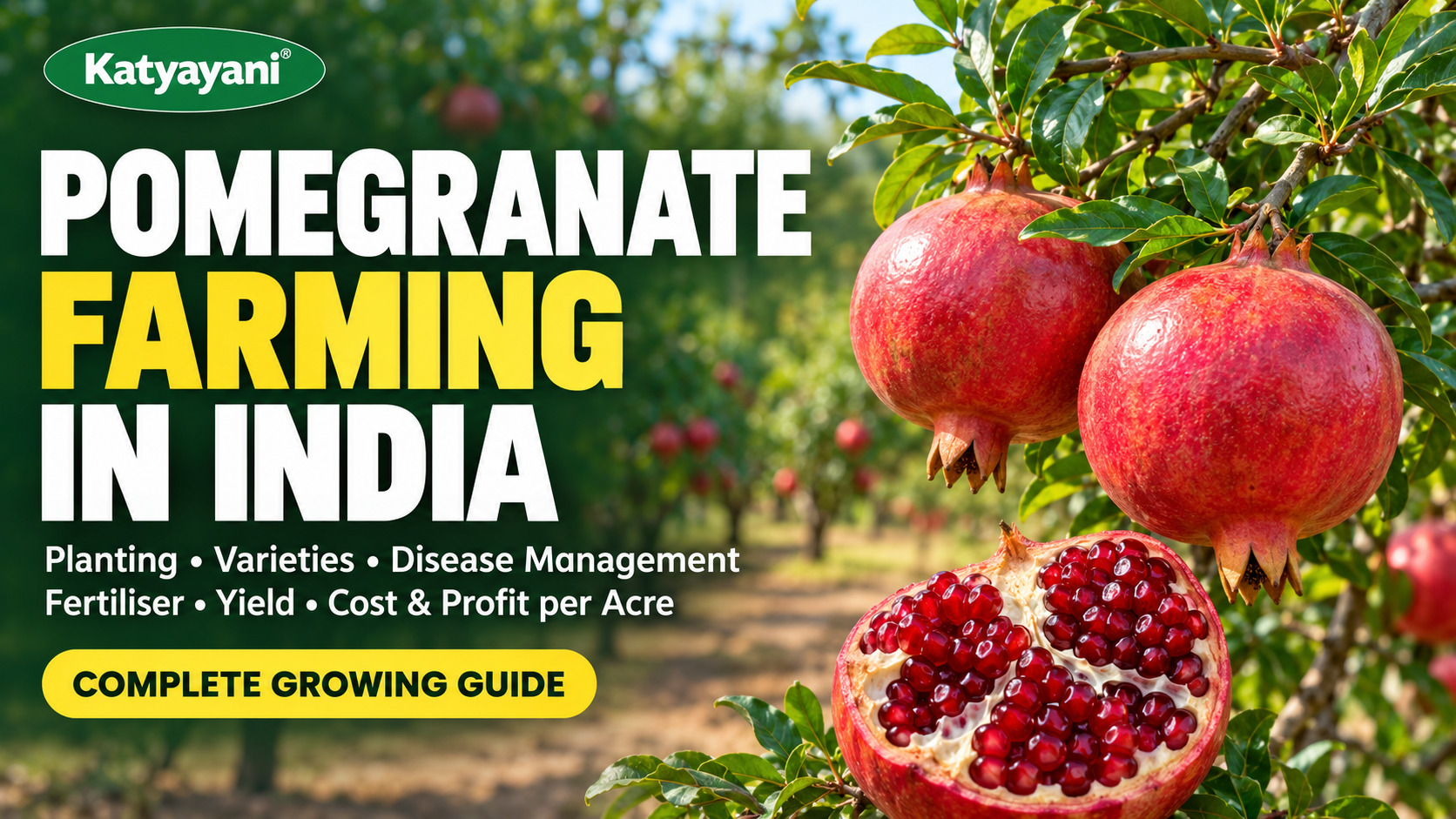
Pomegranate (anar) is planted at the start or end of the monsoon (July to September), or in February to March in sub-tropical areas, at 5 x 5 m or 4 x 4 m with pruning, which is about 160 to 250 plants per acre. Ganesh, Bhagwa, Arakta and Mridula are the common varieties. Trees start bearing from the 4th to 5th year, and a well-kept 8 to 10 year orchard gives 18 to 20 tonnes per hectare (about 7 to 8 tonnes per acre). In an Ahmednagar survey the full cost was about Rs 1.25 lakh per acre and the net return about Rs 1.03 lakh per acre at Rs 40 per kg. Telya (bacterial blight), wilt, fruit borer and thrips cause the heaviest losses.
What is pomegranate farming in India, and where is it grown?
Pomegranate (anar in Hindi, dalimb in Marathi) is a hardy fruit tree that does best in dry, sunny country with irrigation. The NHB package names Solapur, Sangli, Nashik, Ahmednagar, Pune, Dhule, Aurangabad, Satara, Osmanabad and Latur in Maharashtra, Bijapur and Bagalkot in Karnataka as the main commercial districts, with smaller areas in Gujarat, Rajasthan, Uttar Pradesh, Andhra Pradesh and Tamil Nadu.
Maharashtra has most of the commercial orchards. Think of the crop as a long-term orchard, with the first fruit in the fourth year.
Think of it as a ten-year decision, not a one-season crop. NHB says the plant starts bearing from the fourth year and that a well-developed 8 to 10 year tree yields 18 to 20 tonnes per hectare, with yield falling gradually after 25 to 30 years. In the first two or three years you can grow pulses, vegetables or a green manure crop between the rows to cover some running cost.
What is the best time to plant pomegranate in India?
Plant at the start of the monsoon or just before it ends. NHB's package says exactly that. The NHB model project adds February to March for sub-tropical regions and July to August for tropical regions. In practice that means June to September for most of peninsular and western India, and spring planting where winters are cold.
| Stage | When | Source |
|---|---|---|
| Field planting of grafts or air layers | Start of monsoon or end of monsoon | NHB planting page |
| Planting, sub-tropical regions | February to March | NHB model project |
| Planting, tropical regions | July to August | NHB model project |
| Air layering of shoots | May to June; rooting visible July to August; potted in shade; field transfer September to October | NHB propagation page |
| Pit digging | At least 10 to 15 days before planting, left open to the sun | NHB planting page |
Do not plant in a hurry. Pits need 10 to 15 days in the sun, so start in May or June if you plan to plant with the first rains. Buy plants from a source that can show they are disease-free: the NRCP package starts its telya advice with selecting disease-free planting material, and an infected sapling carries the problem into a new orchard.
Which soil and climate suit pomegranate?
NHB says pomegranate grows well in medium-deep, loamy, well-drained soil with a pH around 7.5, and that heavy soils with poor drainage are unsuitable. The tree likes a semi-arid climate with mild winters and hot summers, 25 to 35 degrees C, and 500 to 800 mm of annual rainfall. It is hurt if temperature stays below 11 degrees C for long.
Two points matter more than the numbers. First, dry weather while the fruit develops gives better colour and quality; humid, cloudy weather at fruit set hurts colour and raises pest and disease attack. Second, drainage: the ICAR-NRCP package ties wilt to poorly drained soil and crowded planting. Choose the plot before you choose the variety.
Which pomegranate variety is best? Ganesh, Bhagwa, Arakta, Mridula and others
Ganesh has been the main commercial variety of Maharashtra for years, and Bhagwa (red skin, deep red arils) is listed with it as a commercial cultivar. Arakta and Mridula give darker red arils. Pick the variety your buyer asks for and your nursery can certify, then compare the table below.
| Variety | What NHB says | Note |
|---|---|---|
| Ganesh | Prolific bearer; very large fruit, yellowish red rind, pinkish aril, soft seeds; average 8 to 10 kg per tree | Commercial cultivar of Maharashtra |
| Arakta | Fruit smaller than Ganesh; dark red arils, soft seeds | Red-aril type |
| Mridula | Like Ganesh but dark red arils (pink in hasta bahar); fruit 250 to 300 g | Colour changes with bahar |
| Muskat | Red rind, pink arils; fruit 300 to 350 g | |
| Jyoti (IIHR) | Large fruit, dark red arils, very soft seeds; fruits borne on the inner canopy so less sun scald | |
| Ruby (IIHR) | Like Ganesh in size; reddish brown rind with green streaks, red bold arils; 270 g fruit; 16 to 18 tonnes per hectare | About 6.5 to 7.3 tonnes per acre |
| Dholka | Large fruit, yellowish red rind, pinkish white aril | Popular in Gujarat |
| Bhagwa | The Ahmednagar paper lists Bhagwa, Super Bhagwa and Ganesh as the commercial cultivars of Maharashtra | Red skin and arils |
One caution. Variety yields differ by place, and one Pakistan field trial ranked cultivars by blight resistance but found all three susceptible. No pomegranate variety is blight-proof, so the choice of variety does not replace clean plants, drainage and sprays.
What spacing should you use, and how many pomegranate plants per acre?
NHB gives 5 x 5 m, or 4 x 4 m if the plants are pruned regularly. That is about 162 or 253 plants per acre. ICAR-NRCP recommends 4.5 x 3 m (about 300 per acre) in well-drained sandy loam and says to avoid high density because roots of neighbouring trees should not touch. The NHB model project uses 200 plants per acre.
| Spacing | Plants per hectare | Plants per acre (our arithmetic) | Source |
|---|---|---|---|
| 5 x 5 m | 400 | about 162 | NHB planting page |
| 4 x 4 m (with regular pruning) | 625 | about 253 | NHB planting page |
| 4.5 x 3 m | about 741 | about 300 | ICAR-NRCP package (wilt row) |
| NHB model project | about 494 | 200 | NHB model project |
Closer is not always better. The same NRCP table that gives 4.5 x 3 m lists high-density planting under things not to do for wilt, since neighbouring roots touching spreads the fungus. If your soil is heavy or your area has wilt history, use the wider spacing.
How do you plant and train a pomegranate orchard, step by step?
- Prepare the land. Plough 2 to 3 times to a fine tilth and level it.
- Dig pits. Pits are 60 cm each way. Leave them open in the sun for 10 to 15 days.
- Fill the pits. Cover the bottom 30 cm with dry leaves, then fill with topsoil mixed with 20 to 25 kg FYM, 1 kg single super phosphate and 500 g neem cake, and water.
- Plant the graft. Dig a small hole for the soil ball, take off the polythene bag without breaking the ball, lower the plant, press soil lightly around the stem, water and stake it.
- Remove low side shoots. At planting, take off side shoots up to 10 to 15 cm.
- Train for 18 months. Let the tree grow freely and keep 4 to 5 well-spread shoots as the main frame. Remove sprouts up to 30 cm in the first 6 months, 60 cm by 12 months and 100 cm by 18 months.
- Remove suckers early. Suckers from the base grow tall, branch little and bear little. Cut them as they appear.
- Keep young spurs. Fruit is borne at the tips of short spurs. A spur bears for 3 to 4 years, so cut old spurs and inward-growing shoots and encourage new shoots on 1 to 3 year wood. These training and pruning steps are from the NHB bahar and training page.
What is bahar treatment, and which bahar (ambe, mrig or hasta) should you take?
A pomegranate tree flowers all year if watered all year, and you get a small, scattered crop that is hard to sell. Bahar treatment forces one main flowering. Withhold water, let the leaves drop, prune, feed and irrigate again, and the tree flowers together. NHB says to do this only on established trees, and the three flowering seasons are ambe, mrig and hasta.
| Bahar | Flowering | Harvest (NHB) | Pros and cons (NHB) |
|---|---|---|---|
| Ambe (ambia) | January to February | June to September | Fruit develops in dry months so colour and quality are good and pests are fewer. Needs assured irrigation |
| Mrig | June to July | December to February | Most favoured: flowering and fruiting coincide with rain or follow it, so less irrigation. Fruit that develops in rain and matures in winter loses some colour and sweetness |
| Hasta | September to October | March to April | Attractive rind and dark arils, limited supply so higher value. Water stress is hard to give because withholding water falls in the rains, so flowering is poor |
Choose the bahar by your water, your market and your pest pressure, as NHB advises, and not because your neighbour took it.
How is the treatment done?
- Stop irrigation about two months before the intended flowering and lightly earth up the basin. This makes the tree shed its leaves.
- Prune medium about 40 to 45 days after water is withheld.
- Feed straight after pruning. Apply the recommended fertiliser (next section) and restart irrigation.
- Expect profuse flowering, then fruit ready in 4 to 5 months, per the NHB page.
A note on the water-stress step. NHB's own page warns that it cannot be done properly if the stress period falls in the rainy season, and that is why hasta bahar often fails.
What is the fertiliser schedule for pomegranate, tree by tree?
The Maharashtra Agriculture Department table in the NHB manuring page gives the dose per tree by age. For a tree older than 5 years it is 30 to 40 kg FYM, 625 g N, 250 g P and 250 g K per year. For bearing trees, give half the nitrogen and all the phosphorus and potash at bahar treatment, and the other half of the nitrogen about 1.5 months later.
| Tree age (years) | FYM (kg) | N (g) | P (g) | K (g) | In fertilisers (our arithmetic) |
|---|---|---|---|---|---|
| 2 | 5 | 250 | 125 | 125 | urea 0.54 kg; SSP 0.78 kg; MOP 0.21 kg |
| 3 | 10 | 500 | 125 | 250 | urea 1.09 kg; SSP 0.78 kg; MOP 0.42 kg |
| 4 | 20 | 500 | 125 | 250 | urea 1.09 kg; SSP 0.78 kg; MOP 0.42 kg |
| 5 | 20 | 500 | 125 | 250 | urea 1.09 kg; SSP 0.78 kg; MOP 0.42 kg |
| Above 5 | 30 to 40 | 625 | 250 | 250 | urea 1.36 kg; SSP 1.56 kg; MOP 0.42 kg |
The kilogram figures use urea at 46 percent N, single super phosphate at 16 percent P2O5 and muriate of potash at 60 percent K2O, and they are our own conversion; DAP or complex fertilisers will supply N and P together, so adjust the urea. The NHB model project gives a similar range of 600 to 700 g N and 200 to 250 g each of P2O5 and K2O per tree per year.
- First three years: the NHB table says to split the chemical dose into three equal parts, in July, September and February.
- Where to put it: in the tree basin, about one metre away from the trunk, not against the stem.
- Micronutrients: test the soil or leaf before adding zinc, iron or boron, and use your soil health card as the starting point.
- Organic manure: more FYM improves water holding, which also helps against fruit cracking (see below).
How often should you irrigate pomegranate?
Once the plant is established, give a weekly irrigation in summer and every two weeks in winter. NHB also gives a stage-wise plan around bahar: 2 irrigations before flowering, 4 during flowering, 6 at fruit set and development, 4 at fruit maturity and 2 after harvest, at intervals from 5 to 10 days. Fruit drop and cracking follow moisture stress between flowering and ripening.
| Stage | Number of irrigations | Interval (days) |
|---|---|---|
| Before flowering | 2 | 5 |
| During flowering | 4 | 7 |
| Fruit set and development | 6 | 10 |
| Fruit maturity | 4 | 7 |
| After harvest | 2 | 5 |
The NHB table adds that the frequency depends on season and soil type, so read it as a starting point. The NHB model project reports that drip irrigation saves about 44 percent of the water and raises yield by 30 to 35 percent, which is why most new orchards are laid out with drip from day one.
What are the common problems of pomegranate, and how do you tell them apart?
Walk the orchard every week and match what you see to the table below before you spray. Many problems look alike from the bund: a yellow tree can be wilt, root damage, water-logging or a trunk borer.
| What you see | Likely cause | When it is common | First step |
|---|---|---|---|
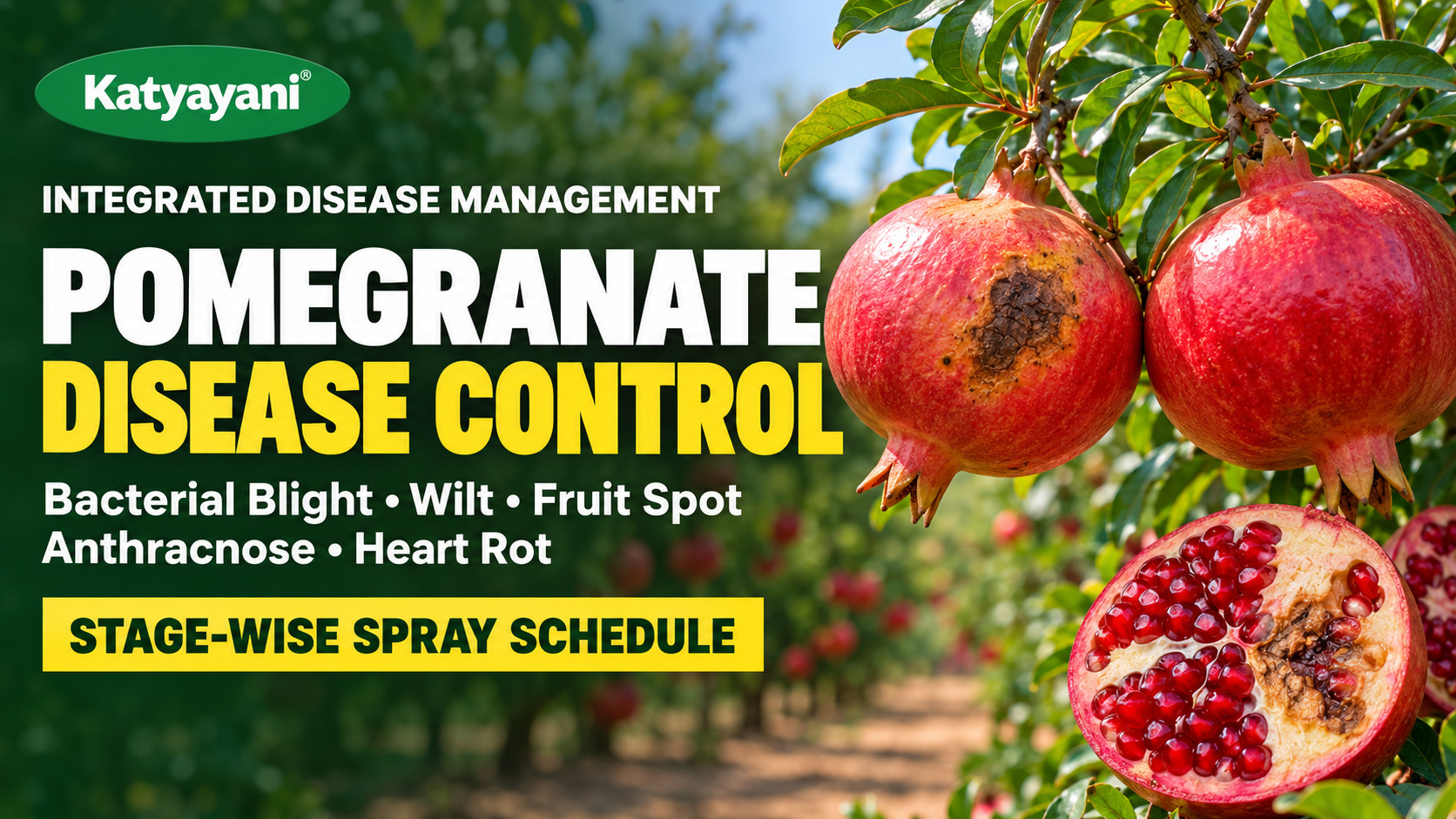
| Small oily, water-soaked spots on young leaves, later dark and angular; oily spots on young fruit; cankers on new twigs; L or Y shaped cracks on fruit | Telya (bacterial blight) | Rain and humidity, warm weather | Remove infected twigs and fruit; registered copper-based protection (see telya section) |
| One branch yellows and dries, then the whole tree | Wilt (mar), fungal complex | Heavy, badly drained soil; crowded planting | Isolate the tree and keep infested wood out of the field (see wilt section) |
| Tiny pinholes with sawdust on the trunk about a foot above the soil; sudden yellowing | Shot hole borer | Weak trees; often with wilt | Keep infested wood out of the field; see the wilt section |
| Small irregular black spots joining into big spots on the fruit | Cercospora fruit spot | After fruit formation | Collect and destroy affected fruit; protective fungicide |
| Reddish brown circular spots, pale arils, rot | Alternaria fruit spot | Humid weather | Destroy fruit; protective fungicide |
| Round black spots from the calyx end, foul smell | Aspergillus fruit rot | After flowering, wet weather | Avoid injury at harvest; protective fungicide |
| Scab or silvery scars on the rind, curled leaf tips, flowers shedding | Thrips | After pruning, on tender leaves | Remove pruned material; spray before flowering |
| Small entry hole in the fruit, droppings at the hole, bad smell, fruit falls | Pomegranate (anar) butterfly, fruit borer | Mostly mrig bahar | Destroy fruit; spray when over half the fruits are set |
| Sticky honeydew and black sooty mould on leaves or fruit | Aphids, whitefly, mealybug or scale | Soft new growth, humid weather | Light irrigation, remove twigs, spray as per label |
| Split fruit | Cracking (boron short, uneven water, delayed harvest) | Dry spell followed by heavy water or rain | Even irrigation, boron, timely harvest |
These symptoms are from the ICAR-NRCP package and NHB pages, with the L, Y and star shaped cracks from an open-access 2025 Frontiers in Plant Science paper on bacterial blight. Use the table as a field guide, not a lab test.
What is telya (bacterial blight) in pomegranate, and how do you control it?
Telya is the Marathi name for bacterial blight of pomegranate, caused by the bacterium Xanthomonas axonopodis pv. punicae. It shows as oily spots on leaves and fruit, cankers on twigs and cracked fruit. It spreads on rain splash and wind-driven rain, so the answer is clean planting material, orchard hygiene and a protective copper spray programme started before the rains.
What does telya look like?
- Leaves: small water-soaked spots that turn dark brown to black and angular, often with an oily ring around them; heavy attack drops leaves.
- Twigs and nodes: dark cankers at the nodes of new shoots, then dieback.
- Fruit: oily spots that turn dark, join up and split in L, Y or star shaped cracks. Cracked fruit rots and cannot be sold.
- Weather: the Frontiers study links outbreaks to humidity above 80 percent and 25 to 35 degrees C,.
How is telya managed?
The ICAR-NRCP package gives a clear order of work. Start with disease-free plants. During dormancy spray Bordeaux mixture at 1 percent. After every pruning, paste the cut ends with 10 percent Bordeaux paste. Destroy fallen twigs, leaves and fruit outside the orchard, and do not reuse an old spray solution. In the rainy and post-rainy season keep a protective copper-based programme going with a registered product from the list below, repeated at the label interval.
In the CIB&RC fungicide list (up to 30.09.2026) the pomegranate bacterial blight rows are copper sulphate pentahydrate 6% SC (2.5 ml per litre, waiting period 33 days), copper sulphate 47.15% plus mancozeb 30% WDG (waiting period 44 days) and kasugamycin 5% plus copper oxychloride 45% WP (waiting period 10 days). Use these registered products with good sanitation and Bordeaux on pruning cuts.
What causes wilt (mar) in pomegranate, and can an infected tree be saved?
Wilt is a fungal disease complex that attacks the roots and lower stem. The first sign is one branch yellowing and drying; the whole tree follows. The ICAR-NRCP package ties it to poorly drained soil and crowded planting, so prevention is better than cure: well-drained soil, wider spacing and clean saplings.
- Pinholes in the trunk. Small pinholes with fine powder on the trunk about a foot above the soil, with yellowing, point to a shot hole borer attack on a weak tree.
- Cultural control. Use spacing of 4.5 x 3 m on well-drained sandy loam, avoid high density, keep roots of neighbouring trees from touching, avoid water-logging, and keep infested cut trees out of the field because they are a source of spores.
- Soil biology. A bio-fungicide such as Katyayani's Trichoderma harzianum bio-fungicide can be added to the soil programme alongside drainage and hygiene.
If most of the canopy has dried, the realistic goal is to stop the spread: remove the tree and keep the wood out of the orchard.
How do you control fruit spot, anthracnose and fruit rot?
Fungal spots start after flowering in humid weather. Destroy infected fruit, avoid injury at harvest, and spray a registered fungicide protectively from flower initiation, repeating at the label interval. The NHB fruit-spot page advises 2 to 3 sprays at 15-day intervals after fruit formation.
| Disease | Symptom | Registered pomegranate use (CIB&RC) |
|---|---|---|
| Cercospora fruit spot and leaf spot | Small irregular black spots that join; water-soaked leaf spots, leaves drop | Azoxystrobin 23% SC; copper sulphate 47.15% plus mancozeb 30% WDG |
| Alternaria fruit spot | Reddish brown circular spots; arils turn pale | Copper sulphate 47.15% plus mancozeb 30% WDG |
| Aspergillus fruit rot | Black spots from the calyx end, rotten smell | Kasugamycin 5% plus copper oxychloride 45% WP |
Choose a product that lists pomegranate and the disease on its label, count the waiting period back from your harvest date, and rotate between groups. For how to spray evenly, see our guide to fungicide application methods and our note on choosing an orchard sprayer.
How do you control pomegranate fruit borer (anar butterfly) and thrips?
The pomegranate butterfly, Deudorix isocrates, is the worst fruit pest. The ICAR-NRCP package says it can destroy up to 50 percent of the fruits. The female lays an egg on the flower calyx or a small fruit, and the caterpillar bores in and eats the seeds. Destroy holed fruit, remove flowering weeds, and spray when more than half the fruits have set.
- Symptoms: a small entry hole, droppings stuck around it, an offensive smell, then rot and fruit fall. It is most common in the mrig bahar.
- Cultural: collect and destroy all affected fruit as soon as you see it, and remove flowering weeds, especially the daisy family, which feed the adults.
- Spray timing: when more than 50 percent of fruits have set, then repeat after two weeks. Spray in the evening with a sticker. Do not mix insecticides and fungicides in one tank.
Thrips (Rhipiphorothrips cruentatus and Scirtothrips dorsalis) come up with tender growth after pruning. They rasp the fruit and cause a scab that cuts market and export value, curl leaf tips and make flowers shed. The package says to remove pruned material and burn it, rake the soil, keep basins clean, and spray before flowering and again after berry formation.
The registered pomegranate rows are listed in the next section, and one of them is chlorantraniliprole 9.3% plus lambda-cyhalothrin 4.6% ZC, for fruit borer and thrips. Katyayani sells Chloda (chlorantraniliprole 9.3% plus lambda-cyhalothrin 4.6% ZC), the same active combination. The CIB&RC pomegranate row is 200 ml per hectare (about 81 ml per acre by our arithmetic) in 1,000 litres of water, with a 7 day waiting period.
Other pests to know: aphids on new shoots, whitefly and mealybug (sooty mould), scale, the fruit fly in the rainy season (NHB suggests methyl eugenol traps because sprays cannot reach the grub inside the fruit), and the bark-eating caterpillar (clean the web, put a petrol-soaked swab in the hole and seal it with mud). Fruit and canopy sprays disturb natural enemies, so spray only after scouting.
Which sprays have a pomegranate row on the CIB&RC list?
The CIB&RC lists (up to 30 September 2026) are the registered uses. The rows below are registered pomegranate uses. Doses are per hectare unless shown; the waiting period is the minimum gap between the last spray and harvest.
| Problem | Active ingredient with a pomegranate row | Dose | Waiting period (days) |
|---|---|---|---|
| Bacterial blight | Copper sulphate pentahydrate 6% SC | 2.5 ml per litre, 750 to 1,000 litres per hectare | 33 |
| Bacterial blight, Alternaria and Cercospora leaf spot | Copper sulphate 47.15% plus mancozeb 30% WDG | 2,500 g per hectare in 500 litres | 44 |
| Bacterial blight, leaf spot, fruit rot, anthracnose | Kasugamycin 5% plus copper oxychloride 45% WP | 0.1 percent formulation, 500 to 1,000 litres per hectare | 10 |
| Leaf and fruit spot | Azoxystrobin 23% SC | 0.1 percent formulation | 5 |
| Thrips and fruit borer | Chlorantraniliprole 9.3% plus lambda-cyhalothrin 4.6% ZC | 200 ml per hectare in 1,000 litres | 7 |
| Thrips | Tolfenpyrad 15% EC | 1,000 ml per hectare in 500 litres | 7 |
| Thrips and pomegranate butterfly | Cyantraniliprole 10.26% OD | 750 ml per hectare in 1,000 litres | 5 |
| Thrips and fruit borer | Broflanilide 20% SC | 125 ml per hectare in 500 litres | 1 |
This is a selection of rows, not every registered product. The long waiting periods matter if you export or sell to a buyer with residue limits, so count back from your harvest date before you pick a product.
Why do pomegranate fruits crack, and how do you prevent it?
Cracking is a serious loss. NHB links it to boron deficiency in young fruit, and in bigger fruit to big swings between day and night temperature, a dry spell followed by heavy irrigation or rain, late harvest of ripe fruit, and pest or disease attack. The fix is steady moisture, more organic manure, boron, and picking on time.
- Water evenly. Irrigate regularly through the entire fruit development stage, as NHB advises, and never let the basin dry out and then flood.
- Build soil water-holding capacity with FYM and mulch.
- Spray boron and GA on young fruit. NHB gives boron at 50 ppm and gibberellic acid at 40 ppm on young fruit. Our arithmetic: 50 ppm boron is 50 mg of boron per litre, which is about 0.25 g per litre if the product is 20 percent boron.
- Harvest on time. Ripe fruit left on the tree splits.
Katyayani's Boron 20% page carries a Best Fertilizer For Pomegranate Crop label and lists flower drop and fruit cracking among the signs of boron deficiency. The calcium nitrate page lists fruit cracking among the disorders calcium corrects. Neither replaces even irrigation.
When and how do you harvest pomegranate, and how do you grade and store it?
Harvest when the rind turns yellowish and the fruit gives a metallic sound when tapped. The round fruit looks flattened on the sides and the beak at the base shrinks. Cut with secateurs, leaving 1 cm of stalk, and finish the picking in 2 to 3 rounds within about a month. Do not wait, because late picking cracks fruit.
- Cure the harvested fruit in shade for a week to harden the skin.
- Grade by colour, size and weight. NHB's grades run from Super (over 750 g), King (500 to 750 g), Queen (400 to 500 g) and Prince (300 to 400 g) to 12-A (250 to 300 g, 1 to 2 spots) and 12-B (under 250 g).
- Pack in corrugated boxes with paper padding.
- Store at 5 degrees C and 90 to 95 percent humidity for up to two months; for longer storage keep it at 10 degrees C to avoid chilling injury.
How much does pomegranate yield per acre, and when does it start bearing?
Expect fruit from the fourth year (NHB) or fifth year (NHB model project). A well-managed 8 to 10 year orchard gives 18 to 20 tonnes per hectare, which is about 7.3 to 8.1 tonnes per acre. The NHB model project assumes 4 tonnes per acre in year 5 and 7 tonnes per acre from year 8. A 2016-17 survey in Ahmednagar averaged about 5.7 tonnes per acre.
| Measure | Per hectare | Per acre (our arithmetic) | Source |
|---|---|---|---|
| Well-developed tree, 8 to 10 years | 18 to 20 tonnes | about 7.3 to 8.1 tonnes | NHB harvesting and yield page |
| NHB model, year 5 | about 9.9 tonnes | 4 tonnes | NHB model project |
| NHB model, year 8 onward | about 17.3 tonnes | 7 tonnes | NHB model project |
| Ahmednagar growers, 2016-17 | 14.07 tonnes | about 5.7 tonnes | Shrote et al. 2018 |
| Ruby variety | 16 to 18 tonnes | about 6.5 to 7.3 tonnes | NHB variety page |
| Ganesh, per tree | 8 to 10 kg per tree | depends on plants per acre | NHB variety page |
What is the cost of pomegranate cultivation per acre?
The 2016-17 Ahmednagar survey of 36 growers put the full cost (Cost C) at Rs 3,08,985 per hectare, about Rs 1.25 lakh per acre. That includes Rs 76,984 per hectare of rent on your own land. The cash-type cost (Cost A) was Rs 1,77,601 per hectare, about Rs 71,900 per acre. Manure, plant protection and labour were the big lines.
| Cost item (Ahmednagar survey, 2016-17) | Rs per hectare | Rs per acre (our arithmetic) |
|---|---|---|
| Manures | 36,252 | about 14,670 |
| Plant protection | 34,076 | about 13,790 |
| Hired labour, male | 24,371 | about 9,860 |
| Hired labour, female | 10,577 | about 4,280 |
| Irrigation charges | 20,785 | about 8,410 |
| Machine power | 9,135 | about 3,700 |
| Fertilisers (N, P, K together) | 11,399 | about 4,610 |
| Cost A (cash-type cost) | 1,77,601 | about 71,870 |
| Cost B (adds rent on land and interest on fixed capital) | 2,89,829 | about 1,17,290 |
| Cost C (full cost, adds family labour) | 3,08,985 | about 1,25,040 |
That is the cost of running a bearing orchard. Setting one up costs more. The NHB model project estimates Rs 1,75,000 for one acre: Rs 31,400 for cultivation items in the first year, Rs 45,000 for the irrigation source, Rs 20,000 for drip, Rs 45,000 for infrastructure and Rs 33,600 for land development including fencing. It also shows a capital subsidy of 20 percent in the financing plan; for schemes you can use now, see our guide to agriculture subsidy schemes in India.
Two things change your own number most: how many years of cost you carry before fruit, and how much you spend on sprays. In the survey plant protection alone was about Rs 13,800 per acre, as much as hired male labour. A clean planting, good drainage and timed sprays are the cheapest way to cut that line.
How much profit does pomegranate give per acre?
Profit per acre is kilograms per acre times price per kilogram, minus cost. At the Rs 40 per kg of the 2016-17 survey and the survey yield of about 5.7 tonnes per acre, gross return was about Rs 2.28 lakh per acre and net return over full cost about Rs 1.03 lakh. The break-even price was about Rs 22 per kg. Replace Rs 40 with the price you actually get.
To work out profit per acre, multiply kilograms per acre by your price per kilogram and subtract cost per acre. The break-even price is cost per acre divided by kilograms per acre. In the Ahmednagar survey, Rs 1,25,040 divided by 5,693 kg gives about Rs 22 per kg.
| Yield per acre | Gross at Rs 40 per kg | Net over Cost A (Rs 71,870) | Net over Cost C (Rs 1,25,040) |
|---|---|---|---|
| 4 tonnes (NHB model, year 5) | Rs 1,60,000 | about Rs 88,100 | about Rs 35,000 |
| 5.7 tonnes (Ahmednagar survey average) | Rs 2,27,700 | about Rs 1,55,800 | about Rs 1,02,700 |
| 7 tonnes (NHB model, year 8 onward) | Rs 2,80,000 | about Rs 2,08,100 | about Rs 1,55,000 |
These rows use a 2016-17 cost and price with model yields, so they show how the arithmetic works. The paper reports a net profit of Rs 2,53,695 per hectare (about Rs 1.03 lakh per acre) and a benefit-cost ratio of 1.82. Get a written rate by grade from buyers before you plant.
Also remember the waiting years. A new orchard is cash-negative for the first three or four years; the profit above applies only from the bearing years. For crop insurance, see weather based crop insurance (RWBCIS).
A mrig bahar calendar for pomegranate: what to do and when
| When (mrig bahar example) | What to do | Note |
|---|---|---|
| About April to May | Stop irrigation about 2 months before flowering; light earthing up; prune medium 40 to 45 days after stopping water | Dates are our arithmetic from NHB steps and the June to July flowering window |
| At pruning | Paste cut ends with Bordeaux paste; apply half the N and all P and K; restart irrigation | NHB table; NRCP paste advice |
| Before flowering | First thrips spray; keep basins clean; remove pruned material | NRCP package |
| June to July (flowering) | Irrigate as per the stage table; start protective copper sprays against telya as rains begin | Use products from the registered list |
| About 1.5 months after the first dose | Second half of nitrogen | NHB table |
| Fruit set (over 50 percent set) | Fruit borer spray; remove holed fruit and flowering weeds | NRCP package |
| Fruit development | Even irrigation; boron on young fruit; fungal protection against spots and rot | NHB |
| December to February | Harvest, cure, grade, store | NHB mrig harvest window |
| After harvest | Remove and burn infected twigs and fallen fruit; 2 irrigations; prune and clean | NHB, NRCP |
What are the most common mistakes in pomegranate farming?
| Mistake | Why it hurts | What to do instead |
|---|---|---|
| Planting uncertified or infected saplings | Telya and wilt enter the orchard with the plant | Buy disease-free plants from a source you can trace |
| Planting in heavy or water-logged soil, or too close | Wilt and shot hole borer build up where roots touch and water stands | Well-drained sandy loam; 4.5 x 3 m or wider |
| Letting the tree flower all year | Small, scattered crop that sells badly | Choose one bahar and do the treatment properly |
| Taking hasta bahar in a rainy area | Water stress cannot be given, so flowering is poor | Choose ambe or mrig where possible |
| Spraying products with no pomegranate use on the label | Residue and legal risk | Use products registered for pomegranate, as in the CIB&RC table above |
| Reusing an old spray solution | NRCP says old solutions are not effective | Mix fresh and spray the same day |
| Mixing insecticide and fungicide in one tank | NRCP says it reduces the effect of both | Spray separately |
| Ignoring fallen fruit and twigs | They carry blight and fruit rot into the next season | Remove and destroy them outside the orchard |
| Uneven watering during fruit growth | Fruit cracking and drop | Follow the stage schedule; use drip and mulch |
| Selling without a price check | Price can swing a lot between grades and weeks | Get written rates by grade before harvest |
Conclusion
Pomegranate pays the grower who treats it as a long project: clean plants, well-drained land, one properly managed bahar, even watering and a protective spray plan against telya, fruit borer and thrips. On the 2016-17 Ahmednagar numbers it gave about Rs 1.03 lakh per acre over full cost at Rs 40 per kg, with a break-even near Rs 22 per kg, but your own cost, yield and price will decide the result. Use only products registered for pomegranate, and count the waiting period back from harvest.
Questions Farmers Ask
How many pomegranate plants per acre?
What is the best time to plant pomegranate in India?
Which is the best pomegranate variety?
How much fertiliser does a pomegranate tree need?
What is bahar treatment, and which bahar is best?
What is telya disease in pomegranate and how do you control it?
What causes wilt in pomegranate?
How do you control fruit borer and thrips in pomegranate?
Why do pomegranate fruits crack?
How much does pomegranate yield per acre?
What is the cost of pomegranate cultivation per acre?
How much profit can you make from pomegranate per acre?

Microbiologist
Microbiologist at Katyayani Organics. MSc in Microbiology, 2.6 years of experience.
View all authorsRead Next in Rabi & Horticulture Crop Guides
Integrated Pest Management (IPM) in Banana: Weevils, Aphids, Thrips, Nematodes, Sigatoka and Panama Wilt, Stage by Stage
Beetroot Farming in India: Sowing Time, Varieties, Seed Rate, Fertiliser, Diseases, Yield, Cost and Profit per Acre

Leave a Comment