 19 min read
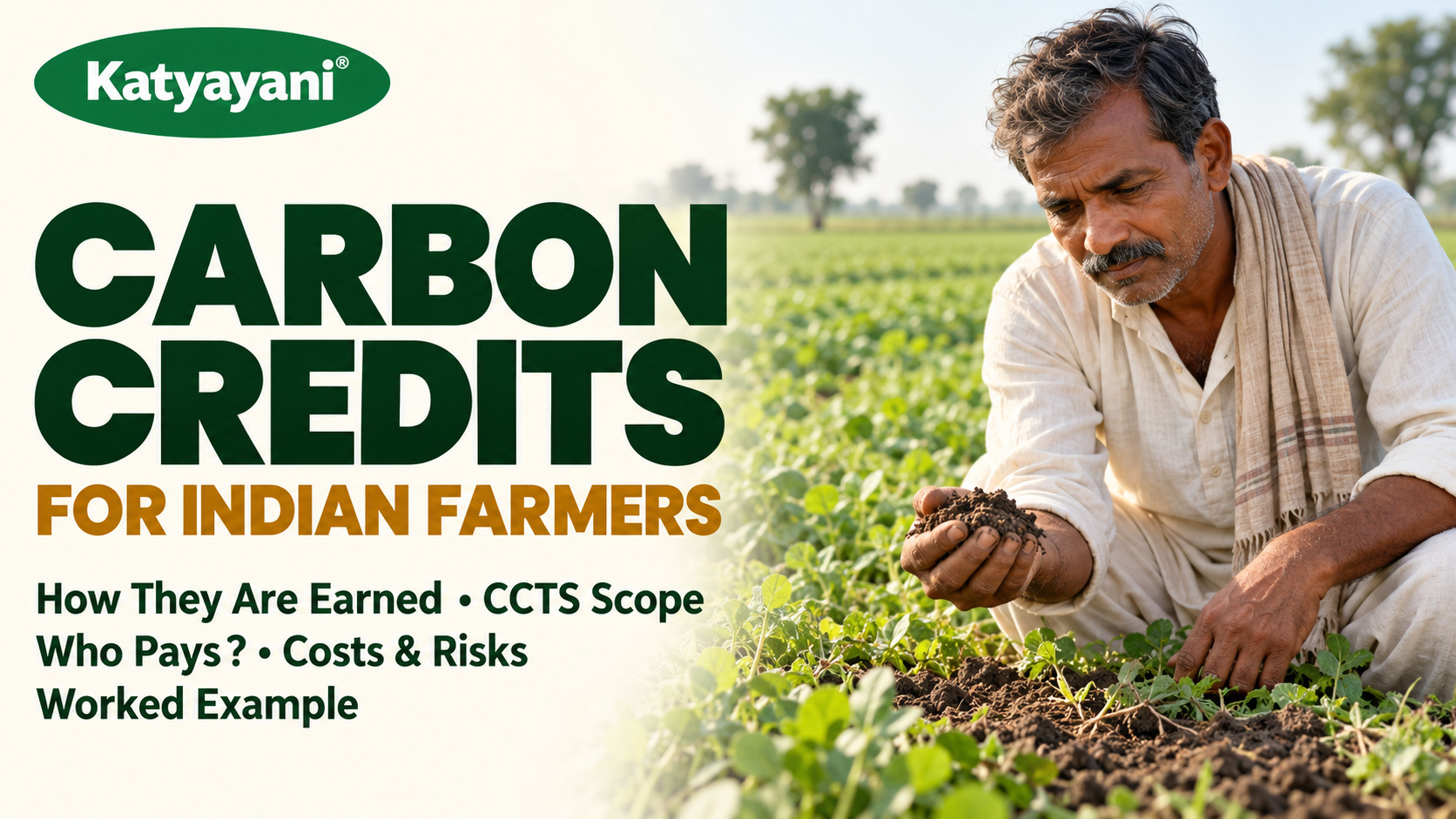
A carbon credit is a certificate for one tonne of carbon dioxide equivalent that a project has removed or avoided, checked by a third party. A single small farm rarely earns from it alone. Farmers join group projects run by a company, FPO or NGO. As of the 21 July 2026 Lok Sabha answer, only two agriculture methodologies are approved under the government CCTS offset route (livestock manure methane, and improved rice management), and the government says no farmer income assessment has been done. Payment depends on credits issued, price and deductions, and can take years. Never pay an upfront fee to join.
What is a carbon credit, and how does it work for a farmer?
A carbon credit is a certificate that says a project removed or avoided one tonne of carbon dioxide equivalent (CO2e). A buyer, usually a company, pays for the certificate to offset its own emissions. For a farmer, the credit comes from changing how the land is managed, such as storing more carbon in the soil or cutting methane from flooded rice.
The key word is equivalent. Methane and nitrous oxide are stronger greenhouse gases than CO2, so their effect is converted to a CO2 equivalent, and a credit certifies one tonne of that.
A credit is not simply a payment for doing good farming. Someone has to prove that your practice changed compared with what would have happened anyway, measure the result, and have an independent body confirm it. Only then is a credit issued and sold. This is why most Indian farmers hear about carbon through a company or group project and not through a government cheque.
How are carbon credits generated on a farm?
Farm credits come from either removing carbon (more carbon stored in soil and trees) or avoiding emissions (less methane or nitrous oxide). The common routes are soil carbon practices, agroforestry, rice methane reduction through direct seeding or alternate wetting and drying, biochar, residue management instead of burning, and livestock manure methane capture.
| Route | What the farmer does | Where the credit comes from | Status in India |
|---|---|---|---|
| Soil carbon (regenerative practices) | Reduced tillage, cover crops, residue retention, compost or biofertiliser, better rotations | Extra carbon stored in soil, estimated with sampling, models and satellite data | Verra VM0042 is used by private developers. Not an approved CCTS methodology on the portal (an improved agriculture land methodology is listed as under consultation) |
| Rice methane: DSR or AWD | Direct seeded rice, or letting the field dry between irrigations instead of keeping it flooded | Less methane from flooded paddy | CCTS approved methodology: improved management practices in rice cultivation. Gold Standard also published a new rice method (DREAM) in 2026 |
| Agroforestry | Plant and keep trees on field bunds or farmland | Carbon stored in growing trees and soil | No agroforestry methodology is in the approved CCTS list. Verra lists a VM0047 afforestation and reforestation method as eligible for the Ministry framework |
| Biochar | Make and apply charred crop waste to soil | Carbon locked in a stable form | Listed as under consultation on the portal page; Verra VM0044 named as eligible under the Ministry framework |
| Residue management | Stop burning straw; incorporate or compost it | Avoided burning emissions and added soil carbon | Often bundled with other practices in private projects. No separate CCTS methodology is listed |
| Livestock manure methane | Capture methane with biogas at household or small farm level | Avoided methane | CCTS approved methodology |
The status column matters. A practice being good for the soil does not mean a methodology exists for it, and without a methodology no credit can be issued. The sources are the Indian Carbon Market portal, the Lok Sabha answer of 21 July 2026 and Verra's May 2024 release.
What is the difference between the voluntary and compliance carbon market?
In a compliance market the government sets emission limits for industries and they must meet them, so demand is forced. In a voluntary market, companies, funds or individuals buy credits by choice, usually for climate pledges. Farm carbon credits in India are almost entirely a voluntary market product today.
| Point | Compliance market | Voluntary market |
|---|---|---|
| Who must buy | Industries given a legal emission-intensity target | Nobody is forced; buyers choose to |
| India example | CCTS Compliance Mechanism. The IETA brief lists nine sectors, including cement, steel, fertilisers, aluminium, textiles and refineries | Verra, Gold Standard and company-run farm programmes; also the CCTS Offset Mechanism, which the IETA brief calls entirely voluntary |
| Can farmers sell? | Not directly. The IETA brief says offsets are not allowed in the compliance mechanism so far | Yes, through approved projects, usually in groups |
| Price | Set by trading on power exchanges once trading starts, within CERC limits | Set by private deals between project developers and buyers |
This is the point most farmer-facing pages skip. The IETA Business Brief says there is no indicated linkage between the voluntary and offset side and the compliance mechanism, and that offsets are not allowed in compliance. So a factory's legal target does not automatically create demand for your farm credits.
What is India's Carbon Credit Trading Scheme (CCTS)?
The CCTS is India's national carbon market framework. The Energy Conservation Act, 2001 was amended to enable a domestic carbon market, and the Bureau of Energy Efficiency (BEE), under the Ministry of Power, runs the scheme. It has two parts: a Compliance Mechanism for large industries with intensity targets, and an Offset Mechanism where other entities can register projects and earn credits.
The Lok Sabha answer of 21 July 2026 states it plainly: the government has notified the Carbon Credit Trading Scheme under the Energy Conservation Act, 2001, as the overarching framework for the domestic carbon market.
| Item | What the sources say | Source |
|---|---|---|
| Legal base | CCTS under the Energy Conservation Act, 2001 | Lok Sabha answer, 21 July 2026 |
| Regulator and administrator | Bureau of Energy Efficiency, Ministry of Power. CERC oversees trading on power exchanges | IETA brief, July 2025 |
| Compliance sectors | Nine sectors listed: aluminium, chlor-alkali, cement, pulp and paper, fertilisers, iron and steel, petrochemicals, petroleum refineries, textiles. Agriculture is not one of them | IETA brief |
| What the Offset Mechanism is | A route where other entities register projects and earn credits; the IETA brief calls it entirely voluntary | IETA brief |
| Sectors open for offset projects | Ten, including Agriculture and Forestry | IETA brief |
| Verification bodies | BEE accredits Carbon Verification (ACV) agencies | IETA brief |
You do not need to understand every rule. What matters to a farmer is the Offset Mechanism: it is the route by which agriculture activities can become government-registered credits that are not tied to one private company.
Is there an agriculture methodology under CCTS as of October 2026?
Yes, but only two. The Ministry of Agriculture told Parliament on 21 July 2026 that two agriculture methodologies are approved under the CCTS Offset Mechanism: methane recovery from livestock and manure management at households and small farms, and emission reduction through improved management practices in rice cultivation.
| Methodology (code on the portal) | Status on the portal page | What it means for a farmer |
|---|---|---|
| Methane recovery from livestock and manure management at households and small farms (BM AG04.001) | Approved | Biogas style projects at household or small farm level |
| Emission reduction through improved management practices in rice cultivation (BM AG04.002) | Approved | Rice water and field management. This is the main crop-based route; read the methodology document for the eligible practices before promising anything |
| Production and use of biochar | Listed as open for stakeholder consultation, not approved | No CCTS credit for biochar yet |
| Improved agriculture land methodology (soil) | Listed as open for stakeholder consultation, not approved | No CCTS credit for soil carbon yet |
| Agroforestry | No methodology named; closest are afforestation and reforestation methods for forestry | Do not assume tree planting on farmland is covered |
These come from the portal page and the Lok Sabha reply, which agree on the two approved ones. Drafts can change quickly, so check the portal again before you enrol. The same Lok Sabha reply says the detailed procedure and approved methodologies together give the framework for taking part.
Status Check: The approved list is short and moving. A company telling you in October 2026 that your soil carbon, biochar or tree planting will earn government CCTS credits should be asked for the methodology code and registration number. If it cannot name both, it is probably selling a private voluntary credit or an idea.
Who verifies and certifies farm carbon credits?
Independent third parties do. In the voluntary market the standards bodies are Verra and Gold Standard, with auditors checking each project. Under the CCTS, BEE-accredited Carbon Verification agencies (ACV agencies) do the verification, and credits are meant to sit in a registry run by the Grid Controller of India.
| Body | Role | Farm relevance (as sourced) |
|---|---|---|
| Verra (VCS standard) | Global voluntary standard and registry | Its VM0042 (improved agricultural land management), VM0044 (biochar) and VM0047 (afforestation, reforestation and revegetation) were made eligible under the Ministry of Agriculture's voluntary carbon market framework, launched January 2024 (Verra release, 21 May 2024) |
| Gold Standard | Global voluntary standard | Published its DREAM rice methodology in 2026. Final publication was said to be anticipated later in 2026, so treat it as new |
| BEE and ACV agencies | Indian offset mechanism administration and verification | BEE accredits ACV agencies. The IETA brief says the issuance registry, to be run by the Grid Controller of India, was still to be set up when it was written |
| ICAR institutes and state agricultural universities | Science partners and pilots | Seven ICAR institutes and four state agricultural universities are part of 11 government-supported voluntary-market pilots |
Ask any project: which standard, which methodology, which verifier, and can I see the registry page? A real project has a public record you can open. The standards and the registry names are in the Verra release, the Gold Standard article and the IETA brief. Verra's own release says the Ministry's framework was meant for farmers, with ICAR leading pilots.
How do farmers actually join a carbon credit project?
Almost always through an aggregator: a company, an FPO, a cooperative or an NGO that signs up many farms, collects field data, hires the verifier and shares the income. The government's draft Programme of Activities (PoA) procedure is designed for this, so FPOs and NGOs can bundle many small farm activities under one framework.
The Lok Sabha reply says the PoA framework is meant to enable Farmer Producer Organizations, NGOs and project developers to aggregate multiple small-scale farm-level activities under a common framework, based on approved methodologies. As of July 2026 it was a draft. In practice, programmes onboard farmer groups rather than individual farmers.
- Find the aggregator. A company, your FPO or an NGO tells you about a programme. Check who they are and whether they have a registered project.
- Check the project record. Ask for the standard (Verra, Gold Standard or CCTS), methodology and project number.
- Sign a written agreement. It should state your share, price basis, deductions, duration and exit terms.
- Record your baseline. Land details, past crops, tillage, irrigation and residue history. Without a baseline there is nothing to compare against.
- Follow the practice and keep proof. Dates of sowing, irrigation, residue handling. Some programmes use satellite checks and apps.
- Wait for verification and sale. A verifier checks, credits are issued, then sold. You are paid after that.
If your FPO is thinking about leading a project, our posts on SHG vs FPO and the FPO credit guarantee scheme explain the group structure and credit side. Carbon work needs paperwork discipline, so an FPO that already keeps member records is better placed.
How much do farmers get paid for carbon credits in India?
There is no published average. The government told Parliament in July 2026 that no assessment of farmer income from carbon credits has been done. Payout depends on the credits issued, the price buyers pay, your share under the contract and the costs deducted, so a promise of a fixed amount per acre is only a sales claim.
| Factor that drives payout | What it means | Who decides it |
|---|---|---|
| Area enrolled | Only the land and seasons covered by the signed project count | You and the developer, in the contract |
| Credits per unit of land | Depends on the practice, the methodology and your baseline; estimated by the project and confirmed by a verifier | Methodology and verifier |
| Price per credit | No official price exists for farm credits; it comes from private deals between the developer and the buyer | Developer and buyer |
| Farmer share | A percentage of net revenue or a fixed upfront sum | The contract |
| Costs deducted | Measurement, reporting, verification, registry fees and developer costs | The contract; ask for an itemised list |
| Timing | Payment follows verification, issuance and sale | Developer; ask for a written date range |
| Official income per acre | Not published; the government says no assessment has been done | Lok Sabha reply, 21 July 2026 |
Be careful with any rupee figure quoted by an agent, an app or a forwarded message. Unless it comes with a project number, a methodology and a contract that shows price, share and deductions, it is a sales claim and not a fact. The Context report by Thomson Reuters Foundation describes farmers facing delayed payment and middlemen taking much of the earnings, so the gap between a headline promise and cash in hand can be wide.
What are the costs of measuring, reporting and verifying (MRV) farm carbon?
No official or published India-specific cost per hectare for MRV is available, so none is quoted here. What the sources do show is that MRV is a real cost that someone pays out of credit income, and that enrolment and sale can be slow and costly.
- Who pays: the project developer usually pays upfront and recovers it from credit sales, which is why the farmer's share is a part of net revenue and not all of it.
- What it covers: baseline records, field data collection, soil sampling or satellite and model estimates, third-party verification and registry fees. The Gold Standard DREAM article describes a lower-cost track for aggregated smallholders using satellite-based digital MRV and conservative default values, so no lab equipment is needed.
- Why small plots struggle: a small holding yields few credits, which may not cover measurement and verification costs unless many farms are pooled.
- Time cost: the Context report describes enrolling farmers and selling credits as slow and costly.
So when an agent says there are no costs, ask who pays them. The answer is nearly always that they are taken from your share before or after the sale. Get the deduction list in writing.
Does direct seeded rice or alternate wetting and drying really cut emissions?
Flooded paddy releases methane, so letting the field dry between irrigations reduces it. A pilot with smallholders in Haryana by IRRI-linked researchers (kharif 2023, puddled transplanted rice) reported lower seasonal greenhouse gas emissions under alternate wetting and drying (AWD) than under continuous flooding.
Two cautions. First, nitrous oxide was slightly higher under AWD in that pilot, which is why the total, not methane alone, is what counts. Second, it was a small pilot run by researchers (Tropentag 2024 abstract). Savings per field are modest, which is why a single small farm usually needs a group project to be worth the paperwork.
For direct seeded rice, the farmer-side agronomy is in our post on the Punjab DSR incentive scheme, which is a separate, state-paid incentive. A carbon project may count DSR as a practice, but the state incentive and a carbon contract are different things. Check that joining one does not conflict with the other. Gold Standard's DREAM article also warns that practices already mandated by national policy, or already widely adopted without carbon finance, are not counted as additional.
What is the difference between a project credit and a payment for farmer practice?
A scheme payment, like the Punjab DSR incentive, is a government grant for doing a practice. A carbon credit payment is a share of the money earned when buyers purchase verified credits. The first arrives at a fixed rate; the second depends on verification, price and how much is deducted, and may take years.
| Point | Government scheme incentive | Carbon credit income |
|---|---|---|
| Who pays | State or central budget | Buyer of the credit, through the developer |
| Amount known upfront? | Yes (for example a fixed rate per acre) | No. Depends on credits issued, price and deductions |
| Timing | After claim processing | Can take years after enrolment |
| Proof needed | Registration and field verification by the department | Baseline, practice records and third-party verification |
| Can you stack them? | Check each scheme's rules | Check the carbon contract for double-claim limits. The IETA brief says an offset project should not be concurrently registered with any other carbon market, with an exception for the Green Credit Programme |
For other state and central support, our overview of agriculture subsidy schemes in India is the place to compare. Never give up a sure subsidy for a speculative carbon promise.
Which carbon credit projects and pilots are running in India?
Two kinds are documented: government-supported pilots for the voluntary market, and private developer programmes that follow Verra or Gold Standard rules. The Department of Agriculture supports 11 pilots through ICAR institutes and state agricultural universities.
| Programme | What is reported | Source |
|---|---|---|
| DA&FW voluntary-market pilots | 11 pilot projects through seven ICAR institutes and four state agricultural universities, for technical support, capacity building and methodology development from regenerative practices | Lok Sabha answer |
| Ministry of Agriculture VCM framework | Verra VM0042, VM0044 and VM0047 made eligible; ICAR to lead pilots | Verra release |
| Private developer programmes | Companies run farm carbon programmes under standards such as Verra and Gold Standard. Judge each one by its registry record and contract, not its brochure | Verra release, Gold Standard article |
Before joining any programme, ask for the registry page, the methodology and the verifier's name. Programmes without these cannot be checked.
Who is eligible, and what land and crop conditions matter?
Eligibility depends on the project's methodology, not on a general rule. Common conditions are that you control the land, can show your past practice (baseline), will follow the agreed practice for the contract period, and are not already claiming the same carbon benefit elsewhere. Land size alone rarely rules you out when you join a group.
- Land control: owned or leased land with a written right to carry out the practice. Tenant farmers should check who owns the credit.
- Baseline and additionality: you must have changed practice because of the project, going beyond routine practice. Gold Standard's rice rules also exclude practices already mandated by policy.
- Crop and method fit: the approved CCTS agriculture methodology for crops covers rice management, not every crop. Soil carbon projects under Verra rules depend on the project design.
- Single registration: per the IETA brief, a CCTS offset project should not be registered with another carbon market at the same time, apart from the Green Credit Programme.
- Record keeping: dates, photos, input bills and app entries, kept for the verifier.
If you are a certified organic or natural farming grower, ask whether the carbon project's records match your existing certification records. Our posts on natural farming mission subsidy and NPOP and PGS organic certification explain what documents you may already hold.
Can better soil and residue management help me earn carbon credits?
They can be part of a project, but only if a verified methodology counts them and a developer is running it. Private projects often bundle residue management and reduced tillage with other practices. On its own, good residue handling is still worth doing for soil health and to avoid burning penalties, whether or not credits ever follow.
The practical steps overlap with advice we already give. Our parali management guide compares bio-decomposer and machinery. A compost or decomposition product such as the Katyayani compost activator works on cellulose and lignin breakdown; follow the pack directions and your KVK advice.
Better rotations and living roots in the soil also matter. See crop rotation examples and benefits and what research says about the soil microbiome. These are soil-health reasons first. Any carbon income is a bonus, not the reason to change your plan.
What are the risks, and how do you spot a carbon credit scam?
The main risks are non-payment, long delays, low or unknown prices, big deductions by middlemen, lock-in contracts and fake or weak credits. The Context report describes middlemen taking much of the earnings and farmers waiting a long time for payment.
| Red flag | Why it matters | What to do |
|---|---|---|
| You are asked to pay a registration or joining fee | Real projects earn from credit buyers, not from farmers joining | Refuse. Check with your KVK or agriculture officer |
| Promise of a fixed income per acre | The government says no income assessment exists | Ask for the basis in writing |
| No project number or standard named | Cannot be checked on a registry | Ask for the Verra, Gold Standard or CCTS record |
| Contract has no share percentage or deduction list | You cannot know what you will receive | Do not sign until it does |
| Long lock-in without exit terms | Rice, soil and tree projects can run for years | Ask what happens if you stop |
| Payment timing is vague | Payment can take years after enrolment | Ask for the expected date and who pays if delayed |
| Agent says credits are sold directly to a factory under CCTS | Offsets are not allowed in the compliance mechanism so far (IETA brief) | Ask for the buyer's name and contract |
Quality of credits is also under pressure. The Context report describes doubts over weak or phantom credits in the voluntary market, which is why buyers now want stricter proof and approvals take longer.
What should you ask before signing a carbon credit agreement?
Get every number and date in writing before you sign. At minimum ask for the project registry number, the share of net revenue to you, the list of costs deducted, the price basis, the payment date and the exit terms. If the aggregator will not put these in writing, walk away.
| Question | Good answer looks like |
|---|---|
| Which standard and methodology? | Name and code, for example Verra VM0042 or a CCTS code, and a link to the registry page |
| Who verifies? | A named independent verifier or accredited agency |
| What is my share? | A percentage of net revenue or a fixed upfront sum, written down |
| What is deducted before my share? | A short, itemised list |
| When do I get paid, and how? | A date range and direct bank transfer |
| What must I do, and for how long? | Specific practices, record keeping, contract period |
| What if credits are not issued? | A clear statement of who bears the loss |
| Can I leave? | Written exit terms and any penalties |
| Does this conflict with a subsidy or insurance? | Written confirmation, or ask your KVK |
Carbon deals are a form of contract, so the same care applies as in any farm agreement. Our guide to contract farming agreements and laws lists what a fair clause looks like, and the points on price, quality, dispute and exit apply here too.
How is a farmer's carbon credit payout calculated?
Payout equals area enrolled, times credits per unit of land, times price per credit, times your share, minus any costs charged to you. Every term comes from your project or contract, and none has an official published value for Indian farms, so ask for each in writing before relying on any total.
Formula: Payout = (area enrolled x credits per unit of land x price per credit x farmer share) - costs charged to you. Fill each term from your signed contract or the project's registry record. If a term is missing, the total cannot be worked out.
| Step | What to ask for | Where the figure comes from |
|---|---|---|
| 1. Area enrolled | Exact acres and seasons covered | Your contract |
| 2. Credits per unit of land | The estimate per acre or hectare and the period it covers | Project design document and verifier report |
| 3. Price per credit | The price basis (fixed, floor or market-linked) | Developer and buyer contract |
| 4. Farmer share | Percentage of net revenue, or upfront sum | Your contract |
| 5. Costs charged to you | Itemised list of deductions | Your contract |
| 6. Payment date | A written date range and the mode of payment | Your contract |
If the developer cannot give you a credits-per-acre estimate, a price basis and the share, you cannot work out the payout and should not rely on any figure quoted verbally.
The honest conclusion: for a small farm, carbon income is a modest, slow top-up and not a main crop income. Make changes that pay on their own (saved water, lower cost, soil health, a state incentive) and treat any credit payment as extra.
How long does it take to get paid?
Expect more than a year, and sometimes several. Project listing, verification, issuance and sale all take time, and payment comes only after credits are sold or the developer chooses to pay in advance. Ask for a written date range and who bears any delay.
| Stage | What happens | What to ask |
|---|---|---|
| Project registration | The project is listed with a standard or the CCTS | The registry page and project number |
| Verification | A third party checks that the practice was followed | Who verifies and how often |
| Issuance and sale | Credits are issued, then sold to a buyer | Who sells and at what price basis |
| Payment to farmer | Share paid after sale, or upfront by some developers | Date range and mode of payment |
Some developers offer an upfront option and pay from their own funds before credits are sold. That is a company choice, not a rule. Ask if your project offers one, and what happens if credits sell for less than planned. The Context report describes enrolment and sale as slow, so plan for a long wait.
What is likely to change next, and what should an FPO or farmer do now?
Three things to watch: the final Programme of Activities procedure for FPOs, any new agriculture methodology (soil, biochar, agroforestry), and whether CCTS credit trading and registries are fully live. Meanwhile, keep records, join only verifiable projects, and make soil and water improvements that pay for themselves.
- Watch the portal. Re-check the offset mechanism page on indiancarbonmarket.gov.in for new approved methodologies and the PoA procedure.
- Keep your own baseline file. Sowing dates, tillage, irrigation, residue handling and input bills for at least the last two seasons.
- FPOs: if you plan to be an aggregator, get legal advice on the PoA draft and the credit-ownership clauses before collecting member data.
- Do not rush. A project that takes your signature before it can show its registry record can wait.
If you want help comparing support for your farm, start with your KVK or state agriculture department. The government sources in this article are the best reference for what is official and what is still a draft.
Conclusion
Carbon credits can become a small extra income for Indian farmers, but they are still early and uneven. The government has approved only two agriculture methodologies under the CCTS Offset Mechanism (as of its July 2026 reply to Parliament), says no income assessment exists, and has the farmer-aggregation procedure in draft. Payout depends on credits issued, price, your share and deductions, and can take years. Join only a project you can check on a registry, get your share and deductions in writing, never pay a joining fee, and do not give up a sure subsidy for a carbon promise.
Questions Farmers Ask
How do farmers earn carbon credits in India?
How much money can a farmer make from carbon credits?
What is the price of a carbon credit in India?
What is the Carbon Credit Trading Scheme (CCTS)?
Is agriculture covered under the CCTS?
Who verifies agricultural carbon credits?
Can a small farmer sell carbon credits directly?
Does direct seeded rice earn carbon credits?
Do farmers have to pay to join a carbon credit project?
How long does it take to receive carbon credit money?
What share of the money goes to the farmer?
Are carbon credits for farmers a scam?

Senior Microbiologist and Production Executive
Senior Microbiologist and Production Executive at Katyayani Organics. BSc in Biotechnology, MSc in Microbiology, 2.5 years of experience.
View all authors

Leave a Comment