 18 min read
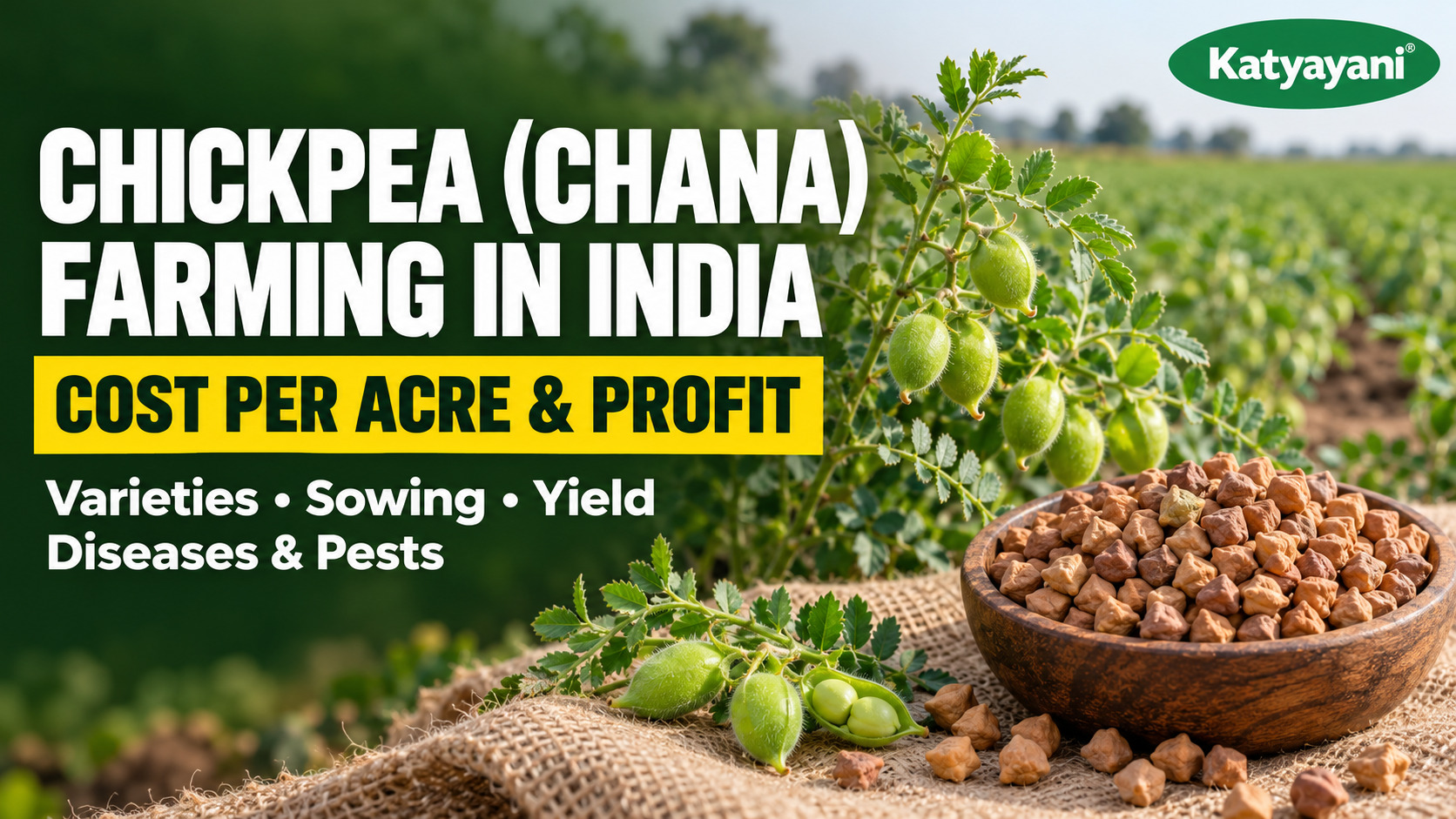
Chana (chickpea, gram) is India's largest pulse. It is a cool-season rabi crop, sown from about mid-October to mid-November (earlier where it is rainfed), at roughly 75 to 80 kg seed per hectare for desi types, which is about 30 kg per acre. Treat the seed, give a phosphorus-led basal dose, irrigate once or twice at most, and watch for wilt in the early weeks and pod borer from flowering. The national average yield in the ICAR-IIPR report is 1,192 kg per hectare (2020-21), about 4.8 quintal per acre, while good package demonstrations gave about 1,611 kg per hectare, about 6.5 quintal per acre. At the 2027-28 MSP of Rs 5,958 per quintal that is about Rs 29,000 to Rs 39,000 gross per acre. Profit depends on your cost: at the all-India cost of production of Rs 3,751 per quintal, each quintal leaves about Rs 2,200. Check the live mandi price before you sell.
What is chana farming in India and which states grow the most?
Chana is the crop most Indian farmers mean when they say dal ki kheti in winter. It is also called gram, Bengal gram or chickpea (Cicer arietinum), and it is sown after the rains on the moisture the soil is still holding. According to the ICAR-IIPR chickpea coordinator report 2021-22, India grew chana on 9.99 million hectares in 2020-21 and harvested 11.91 million tonnes, which works out to 1,192 kg per hectare. Production then rose to 13.98 million tonnes in 2021-22 (a third advance estimate), against 7.33 million tonnes in 2014-15. That is a jump of about 91 percent in eight years, and the report credits better seed, wilt-resistant varieties and policy support.
The crop sits in a handful of states. The table below comes from the state-wise tables in the same report (2020-21, originally Directorate of Economics and Statistics data). The share column is our own sum against the 11.91 million tonne national figure. These are 2020-21 numbers, so ask your agriculture department for the latest year before you quote them anywhere.
| State | Area (thousand ha) | Production (thousand tonnes) | Yield (kg per ha) | Share of national production (our arithmetic) |
|---|---|---|---|---|
| Madhya Pradesh | 2,160 | 3,214 | 1,488 | about 27 percent |
| Maharashtra | 2,231 | 2,396 | 1,074 | about 20 percent |
| Rajasthan | 2,113 | 2,265 | 1,072 | about 19 percent |
| Gujarat | 816 | 1,280 | 1,568 | about 11 percent |
| Uttar Pradesh | 611 | 759 | 1,243 | about 6 percent |
| Andhra Pradesh | 469 | 533 | 1,136 | about 4 percent |
| Karnataka | 713 | 446 | 625 | about 4 percent |
Read the yield column, not just the area. Maharashtra and Rajasthan grow as much chana as Madhya Pradesh but harvest fewer kilos from each hectare, and Karnataka sits far lower still at 625 kg. Much of that gap is water, variety and disease. A farmer in Madhya Pradesh who gets 1,488 kg per hectare is not luckier than you. He is mostly sowing a better-matched variety on time and keeping wilt out of the field. The rest of this guide is about closing that gap on your own plot.
Which soil, season and weather suit chana?
Chana likes a cool, dry winter and a well-drained field. It lives on stored soil moisture, so the first thing to check is not the soil type but whether the field will drain after rain and hold some water at sowing. Heavy irrigation, standing water and warm, humid spells at flowering all work against it. You can grow it on a wide range of soils, but a waterlogged corner will give you dead plants and a patch you will blame on the seed.
- Residual moisture does most of the work. The ICAR-IIPR report says chana is mostly grown on residual soil moisture, and that too few irrigations or rains during the season is a major yield limit.
- Rice fallow can work well. In the report's front-line demonstrations on rice fallow, the improved package gave 1,319 kg per hectare against 1,014 kg with local practice, about 30 percent more.
- Hot soil at sowing is a risk. TNAU lists avoiding sowing in high temperature, and protecting young seedlings from heat, as steps against wilt and dry root rot. A field sown too early into warm soil is the one that shows dead seedlings a month later.
- Acidic, wet soil at sowing is a known trouble spot. The IIPR report names acidic soil, excess moisture at sowing, poor germination and collar rot as constraints in some eastern areas.
- Field practice, not a sourced number: do not sow into a field that stays wet. Cut a drain, or choose a higher plot. We are not giving a pH or temperature range because we did not find one on an official page we could open.
Desi or kabuli chana: which one should you grow?
If you have no assured irrigation or no buyer lined up, grow desi. It is the hardy one, small and dark, and it turns into chana dal and besan, which every mandi buys. Kabuli is the big beige chana that sells as chhole and fetches a better rate per kilo, but it needs more seed, more water, more care, and a buyer who wants it. Many farmers chase the kabuli price and then lose the difference to weak germination, wilt and a smaller yield.
| Point | Desi chana | Kabuli chana |
|---|---|---|
| Seed size (examples from the IIPR report) | Medium to bold brown, about 22 to 26 g per 100 seeds in recent releases (Samriddhi 24.1 g, Pusa Chickpea 4005 22.4 g) | Large and beige, about 27 to 44 g per 100 seeds (Madhav 28.7 g, Kota Kabuli Chana 3 27.3 g, Gujarat Kabuli Gram 1 43.5 g) |
| Typical seed rate (see seed section) | About 75 to 80 kg per hectare, which is about 30 kg per acre | About 100 to 110 kg per hectare, which is about 40 to 45 kg per acre |
| Typical spacing | 30 cm rows, 10 cm between plants | 45 cm rows, 10 cm between plants |
| Yield in recent IIPR releases | About 15 to 21 quintal per hectare depending on variety and zone | About 14 to 20 quintal per hectare (Madhav 19 to 20, but Karan Kabuli 4 only 14 to 15) |
| Maturity in recent releases | About 95 to 133 days | About 100 to 148 days |
| Best fit | Rainfed or residual moisture, wilt-prone fields, local dal and besan market | Irrigated fields with a clear buyer for chhole or export grade |
In words: kabuli costs you more seed per acre and takes longer in some zones, so its higher price has to beat a higher cost and a more uncertain yield. Work out the numbers with your own rates before you switch. One milling study we saw in summary reported kabuli yields of 944 to 1,764 kg per hectare against 811 to 2,558 kg for desi across 46 popular varieties. That is a research summary, not a recommendation, but it tells you the variety you pick matters more than the type.
Which chana variety should you choose for your zone?
Pick a variety released for your zone, and if wilt has ever hit your field, pick one bred for wilt resistance. Then buy certified seed of it, early, because the good varieties sell out. The ICAR-IIPR report lists recent releases by zone. Ask your KVK or state seed corporation which of them is in stock this season, since a release on paper is not the same as seed in the shop.
| Variety (type) | Zone and condition | Average yield (q per ha) | Days to maturity | Notes from the report |
|---|---|---|---|---|
| Samriddhi, IPCMB 19-3 (desi) | Central zone (MP, Maharashtra, Gujarat, Bundelkhand), timely sown, irrigated | 20 to 21 | 100 to 110 | Fusarium wilt resistant introgression line of Pusa 256; 24.1 g per 100 seeds |
| Pusa Chickpea 20211 / Pusa Manav (desi) | Madhya Pradesh, Gujarat, Maharashtra (CGIAR page) | Weighted mean 23.9 under wilt stress (2,392 kg per ha) | 108 (seed to seed) | Wilt resistant; moderately resistant to dry root rot, collar rot, stunt and pod borer (CGIAR) |
| Nandyal Gram 857 (desi) | South zone (AP, Telangana, Karnataka, Tamil Nadu), timely sown, irrigated | 18 to 19 | 95 to 100 | 23.4 g per 100 seeds |
| CG Akshay Chana, RG 2016-134 (desi) | South zone, timely sown, irrigated | 16 to 17 | 100 to 110 | 25.7 g per 100 seeds |
| Pusa Chickpea 4005 (desi) | North west plain zone, timely sown, rainfed | 16 to 17 | 131 | Drought tolerant introgression line; 22.4 g per 100 seeds |
| IPC L 4-14 (desi) | North west plain zone, rainfed | 15 to 16 | 128 to 133 | Drought tolerant introgression line; small seed, 16.6 g per 100 seeds |
| JG 16 (desi) | UP, MP, Gujarat, Maharashtra, Rajasthan; irrigated and rainfed (released 2000) | 20 | 110 to 140 | Older, widely grown; still in demand |
| Anvita, RSG 931 (desi) | North west plain zone, rainfed (released 2004) | 20 | 135 | Double podded |
| Madhav, IPCK 2013-163 (kabuli) | North west plain zone, timely sown, irrigated | 19 to 20 | 147 | 28.7 g per 100 seeds |
| Kota Kabuli Chana 3 (kabuli) | West central zone, timely sown, irrigated | 17 to 18 | 100 to 115 | 27.3 g per 100 seeds |
| Karan Kabuli 4 (kabuli) | South zone, timely sown, irrigated | 14 to 15 | 100 to 115 | 37.8 g per 100 seeds |
How to use the table. Find your zone first, then your water: rainfed, irrigated and timely sown, or late sown. A farmer in the central zone with irrigation and a wilt history should look hard at Samriddhi or Pusa Chickpea 20211. A farmer in the north west plain on rainfed land should look at the drought-tolerant lines such as Pusa Chickpea 4005 and IPC L 4-14. In the south zone, Nandyal Gram 857 is the fastest at 95 to 100 days. The shorter the duration, the less time pod borer and a dry spell have to catch the crop.
Wilt-resistant lines were bred by bringing resistance in from lines such as WR 315 and Vijay, which is why newer releases are worth the effort in a field with a wilt history. In the Madhya Pradesh demonstrations published by Singh (2016) in the Indian Journal of Agricultural Sciences, growers used the wilt-resistant JG 130, JG 11, JG 16 and JG 14, and JG 11 gave the best yield at the 18 to 22 October sowing in 2008-09. The CGIAR note on Pusa Chickpea 20211 says it was built on the Pusa 391 base with the wilt resistance of WR 315. Under wilt stress it gave a weighted mean of 2,392 kg per hectare against 1,877 kg for Pusa 391. These are trial averages. Your field can come in higher or lower depending on water, sowing date and disease.
When is the best time to sow chana?
For most of India, sow between mid-October and mid-November. On rainfed land that depends on stored moisture, go earlier: the second half of October in the north and the first half of October in central and south India. Irrigated chana in the north is usually sown a little later, in the first half of November. Avoid sowing into hot soil in early October if you can, and avoid December, because late sowing shortens the crop and brings it into flowering at the wrong time.
| Region and condition | Sowing window | Source |
|---|---|---|
| Tamil Nadu, rainfed | Last week of September to first week of October | TNAU chickpea crop page |
| Tamil Nadu, irrigated | Second fortnight of October to first week of November | TNAU chickpea crop page |
| North India, rainfed | Second fortnight of October | Government crop profile (summary, VERIFY) |
| North India, irrigated | First fortnight of November | Government crop profile (summary, VERIFY) |
| Central and South India | First fortnight of October to first fortnight of November; avoid December and January | Government crop profile (summary, VERIFY) |
| Eastern India, rainfed | Last week of October to first fortnight of November | AICRP rabi pulses report (summary, VERIFY) |
| Chhatarpur, Madhya Pradesh trials | 18 to 22 October gave the best yield attributes for JG 11 in 2008-09 | Singh (2016) |
The trade-off is simple. Sow too early, in warm soil, and you invite wilt and root rot. Sow too late, and the crop runs short of cool days and meets more heat at pod filling. The TNAU IPM page adds a pest reason for the early end of the window: planting in mid-October helps the crop dodge the peak of gram pod borer. Whatever date you choose, try to sow the same variety on the same days as your neighbours. When a whole block flowers together, pod borer has no single late field to build up in.
How much chana seed do you need per acre, and what spacing should you use?
For desi chana plan on about 30 to 32 kg of seed per acre, which is 75 to 80 kg per hectare, with rows 30 cm apart and about 10 cm between plants. Kabuli needs about 40 to 45 kg per acre (100 to 110 kg per hectare) in rows 45 cm apart. Seed size changes the weight. Bold seed means more kilos for the same number of plants, so always check the 100-seed weight on the bag.
These numbers come from a chain of sources, so treat them as a guide and not a label. A 2024 AICRP rabi pulses report (seen only in summary) lists 75 to 80 kg per hectare for desi and 100 to 110 kg for kabuli, at 30 by 10 cm and 45 by 10 cm spacing. An ICAR-journal trial on desi chana found 75 kg per hectare at 30 cm row spacing gave the top yield (23.26 quintal per hectare) among 60, 75 and 90 kg and among 20, 30 and 40 cm rows. A second ICAR trial found a larger-seeded desi variety did best at 50 kg per hectare, while a smaller-seeded one was fine at 40 kg.
| Per hectare | Per acre (divide by 2.47, our arithmetic) | Note |
|---|---|---|
| 60 kg | about 24 kg | Small-seeded desi with good moisture and good germination |
| 75 kg | about 30 kg | Trial best for desi at 30 cm rows |
| 80 kg | about 32 kg | Upper end for desi |
| 100 kg | about 40 kg | Kabuli, lower end |
| 110 kg | about 45 kg | Kabuli, upper end |
Do a germination test a few days before sowing. Put 100 seeds in a damp cloth and count how many sprout. If fewer than 90 do, add a little to the seed rate instead of sowing thin and hoping. Use a seed drill if you can. It places seed at an even depth in moist soil, and later weeding, spraying and harvest are much easier than in a broadcast field. If you think in bighas, remember that a bigha is a different size in each state, so work out your per-acre seed first and then scale it by your local bigha.
How should you treat chana seed before sowing?
Treat every kilo of seed before it goes in the ground. A cheap seed treatment is the best insurance against wilt and root rot. TNAU lists Trichoderma viride at 4 g per kg, Pseudomonas fluorescens at 10 g per kg, or carbendazim or thiram at 2 g per kg of seed. Do the fungicide or bio-agent first, then Rhizobium and PSB, in shade, and let the seed dry before sowing.
| Treatment | Dose per kg of seed | What it does | Source |
|---|---|---|---|
| Trichoderma viride | 4 g | Protects against soil-borne wilt and root rot | TNAU (Fusarium wilt and IPM pages) |
| Pseudomonas fluorescens | 10 g | Bio-agent alternative to Trichoderma | TNAU |
| Carbendazim or thiram | 2 g (TNAU wilt page also lists carbendazim at 1 g, or thiram plus carbendazim at 1 g plus 2 g) | Chemical option for wilt and root rot | TNAU |
| Rhizobium plus PSB | 20 g each in the Madhya Pradesh demonstrations; TNAU crop page lists one 200 g packet per 10 kg seed | Fixes nitrogen and releases phosphorus | Singh (2016); TNAU |
In plain numbers, one acre of desi chana takes about 30 kg of seed. At 4 g per kg that is 120 g of Trichoderma. At 20 g per kg it is 600 g each of Rhizobium and PSB (our arithmetic). Check on each pack whether a chemical fungicide and a bio-agent may go on the same seed, because a fungicide can kill the living product. The full recipe and the order of steps are in our chana seed treatment guide, and the bio-inoculants are explained in the biofertilizer for chana guide.
If you want a Trichoderma product for the seed or the soil, Katyayani sells Trichoderma viride bio-fungicide powder. Its page describes a 1.5 percent wettable powder for wilt, rot, blight and damping-off in general. It does not name chickpea and shows no dose, so use the dose on the pack label or the 4 g per kg that TNAU lists for chickpea seed.
What fertiliser does chana need per acre?
Chana makes much of its own nitrogen with the help of Rhizobium, so it wants only a small starter dose of nitrogen but a good dose of phosphorus. One Madhya Pradesh demonstration package used 20:60:40 kg of N, P2O5 and K2O per hectare, which is about 8:24:16 kg per acre. TNAU lists 15 to 20 kg of nitrogen, 40 kg of P2O5 and 20 kg of sulphur per hectare with FYM. Let a soil test set your final dose, not a neighbour or a bag label.
| Source | Per hectare | Per acre (our arithmetic) |
|---|---|---|
| Singh (2016), Chhatarpur, MP: improved package | 20 N : 60 P2O5 : 40 K2O kg | about 8 N : 24 P2O5 : 16 K2O kg |
| TNAU chickpea crop page | 15 to 20 kg N, 40 kg P2O5, 20 kg sulphur, 1 kg ammonium molybdate, 5 tonnes FYM | about 6 to 8 kg N, 16 kg P2O5, 8 kg S, 0.4 kg ammonium molybdate, 2 tonnes FYM |
| ICAR-IIPR AICRP trials (6 locations) | Customised fertiliser with N, P, K, S, Zn and Mo at the recommended 100 percent level raised grain yield at all locations | Dose depends on soil test and the recommendation for your zone |
- Test the soil first. Phosphorus, sulphur and zinc are the usual gaps. Our guide to reading a soil health card shows how to turn the report into a dose.
- Put fertiliser in at sowing, in the furrow beside or below the seed. Fertiliser thrown on the surface after the crop is up reaches the roots late.
- Go easy on nitrogen. TNAU keeps warning against too much leafy growth because it brings blight and grey mould.
- Rainfed fields: the IIPR report found a hydrogel at 5 kg per hectare gave the best grain yield under rain-fed conditions, and 2.5 kg per hectare was at par at Nandyal. Whether it pays on your land is a local call.
- Foliar spray: the TNAU crop page lists a 2 percent urea or DAP spray at flowering (about 70 days after sowing) and again 10 days later. We could not confirm this on the IIPR report, so treat it as optional.
If you would rather buy the soil inputs as a set, the Chana Unnati Soil Kit page says it is for chickpea and lists Trichoderma viride (1 to 2 kg per acre), Bhumiraja VAM mycorrhizae (4 to 8 kg per acre), Vasistha (thiamethoxam 1 percent plus chlorantraniliprole 0.5 percent, 2.5 kg per acre, for aphids, stem borers and leafhoppers) and a 200 g mix micronutrient pack of zinc, iron and boron. The page does not say Vasistha is for gram pod borer, so do not buy it for that. For the mycorrhiza and Trichoderma side the logic is the same as in our biofertiliser guide: they work on the root zone, not as a replacement for a basal dose.
How many irrigations does chana need?
Fewer than you think. Many chana fields make a crop on stored moisture alone. If you have water, one irrigation at pod initiation is the TNAU recommendation, and a pre-sowing irrigation helps seed germinate. One irrigation or two is a trade-off. A second light watering helps in a very dry winter on light soil, but every extra watering pushes soft leafy growth and raises the risk of grey mould and blight.
- Water at pod initiation (TNAU). This is when water has the biggest effect on seed filling.
- Skip irrigation in cool, humid, foggy spells unless the field is truly dry. TNAU lists avoiding too much irrigation as a step against Alternaria blight and Botrytis grey mould.
- Do not water a wilt patch to save it. Water does not cure wilt. See the disease section.
- Save stored moisture. Keep weeds down in the first weeks, because they drink the same water as the crop.
- We found no official page that fixes the number of irrigations for every zone, so follow your state university advice for your district.
If you irrigate by drip, the Chana Unnati Drip Kit page says it is for chickpea and gives rates in millilitres per litre of water, not per acre: Trichoderma viride 2 to 3 ml per litre every 15 days, K-Raja mycorrhiza 5 g per litre at flowering and seed setting, Metarhizium 2 to 3 ml per litre every 15 to 20 days, and seaweed extract 2 ml per litre every 20 days. Since chana is mostly a no-irrigation or one-irrigation crop, a drip kit only makes sense if you already run drip on the plot.
How do you control weeds in chana?
The first month decides the weed fight. Chana grows slowly while it is small, and weeds race ahead and steal water and light. The TNAU recommendation is pendimethalin as a pre-emergence herbicide, 1.0 to 1.25 kg active ingredient per hectare, followed by one hand weeding if needed. Keep the field clean for the first 6 to 8 weeks, with inter-cultivation or band weeding, and you will have done most of the job.
| Method | Dose or timing | Source and note |
|---|---|---|
| Pendimethalin, pre-emergence | 1.0 to 1.25 kg active ingredient per hectare (about 0.4 to 0.5 kg per acre, our arithmetic) plus one hand weeding | TNAU crop page; Singh (2016) used 1 kg per hectare |
| Inter-cultivation or band weeding | Through 6 to 8 weeks | TNAU IPM page |
| Oxyfluorfen, pre-emergence | 150 or 250 g per hectare worked better in the north west plain zone | ICAR-IIPR AICRP trial |
| Quizalofop-p-ethyl, post-emergence | 100 g per hectare, north west plain zone; with oxyfluorfen 150 g per hectare plus propaquizafop 100 g per hectare in central and south zones | ICAR-IIPR AICRP trial |
| Topramezone, post-emergence | 20.6 or 25.7 g per hectare at 21 days after sowing (14 days in the central zone); results varied by zone | ICAR-IIPR AICRP trial; research stage, check the label for chickpea |
Do not copy a trial dose off a table into your sprayer. The IIPR report itself warns that chana is very sensitive to herbicides at different growth stages, which is why a safe post-emergence herbicide is a breeding goal. Read the label, confirm that chickpea is listed, and calibrate the sprayer. To turn an active-ingredient dose into product, divide it by the percent strength printed on the pack.
Why are my chana plants dying? Disease symptoms and what to do
Walk into the field and look at where the damage is and how old the crop is. A patch of seedlings that collapsed and lie flat at 3 to 5 weeks, with a dark colour inside the stem when you split it, is Fusarium wilt. Scattered plants that dry up between flowering and podding, with brittle, dry roots, is dry root rot. Dark spots on leaves, stems and pods after cool, wet weather is Ascochyta blight. Poor pod setting and a grey spore mass on flowers is Botrytis grey mould.
| What you see | Likely cause | When it appears | What helps (TNAU unless noted) |
|---|---|---|---|
| Seedlings collapse and lie flat, dull green leaves, dark discolouration inside the stem; patches of dead plants | Fusarium wilt (TNAU page) | Any stage, mainly 3 to 5 weeks after sowing | Wilt-resistant variety, deep summer ploughing, seed treatment (Trichoderma 4 g per kg or carbendazim), a long rotation (TNAU says 6 years with sorghum), 10 to 15 cart loads FYM per hectare |
| Scattered plants dry out, foliage turns straw coloured, roots brittle and dry | Dry root rot (Rhizoctonia bataticola); this symptom wording is from a TNAU search summary, page not opened | Flowering to podding | Avoid drought stress, sow on time, keep seedlings away from heat, seed treatment; IIPR says dry root rot is increasing in central and south India |
| Water-soaked lesions turn into brown circular spots on leaves, stems, petioles, pods; whole plant can dry suddenly; shrivelled seed | Ascochyta blight (TNAU page) | Cool, wet, warm weather and dense canopy | Disease-free seed, rotation, seed treatment (carbendazim 1 g per kg, or hot water at 52 C for 10 minutes), spray mancozeb 2.5 g per litre or wettable sulphur 2.3 g per litre if seen |
| Round purple water-soaked spots on leaflets, lower leaves shed, pods turn blackish, seeds shrivel | Alternaria blight (TNAU page) | Flowering | Wider spacing, avoid excess growth and irrigation, compact varieties; mancozeb 2.5 g per litre or carbendazim 1 g per litre |
| Poor pod setting first, spore mass on flowers and leaves, stem lesions that girdle the stem, branches break, flowers rot | Botrytis grey mould (TNAU page) | Cool, humid weather at flowering and pod stage | Lower plant density, avoid excess growth and irrigation; carbendazim 1.5 g per litre or mancozeb 3 g per litre; TNAU also lists captan 5 to 6 kg per hectare every 15 days |
| Seedlings fall at the collar in wet, warm soil at sowing | Collar rot (named by the IIPR report in acidic, wet soil; symptom page not opened) | Seedling stage | Avoid very wet sowing, seed treatment; ask KVK |
Wilt is the one that costs the most. Our chana wilt disease guide covers early versus late wilt and how to tell it from dry root rot, so we keep it short here. The ICAR-IIPR report names Fusarium wilt and gram pod borer as the main problems, says dry root rot is rising in central and south India, and notes that no stable source of dry root rot resistance has been found in cultivated chickpea. That means seed treatment, sowing date and rotation do the heavy lifting.
For root rot and wilt in the root zone, Katyayani has a collection of fungicide for chickpea root rot. It is a chickpea-specific collection by its title, and it currently shows three products (Meta-Manco metalaxyl plus mancozeb, Boost propiconazole, and All In One organic fungicide). The listings do not name chickpea, so check each product label before you buy. For the leaf blights, there is a collection of fungicide for chickpea Alternaria blight with Tebusul (tebuconazole plus sulphur), Samartha (carbendazim plus mancozeb) and Striker (Pseudomonas fluorescens). Again, the listings do not name chickpea, so read the label for crop and dose.
Dose Check: The spray doses above are TNAU research recommendations, and TNAU itself gives different mancozeb rates on different pages (2.5 g and 3 g per litre). We did not check the CIB&RC chickpea label rows. Before you buy or spray, confirm on the pack that chickpea and the disease are listed, and follow the label dose and waiting period.
What to do if you see wilt or patchy drying
- Pull one plant and cut the root and lower stem. A dark inside to the stem points to wilt. Brittle dry roots with no dark stem point to dry root rot.
- Note the age of the crop. Seedlings at 3 to 5 weeks lean toward wilt. Flowering to podding leans toward dry root rot.
- Do not keep adding water or fertiliser to a patch. It cures neither disease and wastes money.
- Mark the patch and keep its seed out of next year's seed lot. Seed from a diseased patch carries trouble forward.
- Plan next season now: a wilt-resistant variety, deep summer ploughing, seed treatment, and a long gap before chana comes back on that plot.
Which pests attack chana and when should you spray?
Gram pod borer is the main pest, and the hole in the green pod is its signature. Cut open a pod with a neat round hole and you will often find a fat caterpillar and a half-eaten seed. Semilooper, cutworm and termites come next. Scout from the first flowers and spray only when you cross a threshold. TNAU gives the pod borer ETL as 2 early-stage larvae per plant or 5 to 8 eggs per plant. Young larvae scrape leaves down to the veins. Older ones bore into the pod.
| Pest | What you see | Threshold and non-chemical options (TNAU) |
|---|---|---|
| Gram pod borer (Helicoverpa armigera) | Leaves scraped to the veins by young larvae; flowers and green pods eaten; round bore holes; empty grains | ETL: 2 early-instar larvae per plant or 5 to 8 eggs per plant. Pheromone traps (TNAU pest page says 12 per hectare, the IPM page says 5 per hectare), bird perches at 50 per hectare, hand picking, HaNPV, neem seed kernel extract 5 percent or neem oil. Act when larvae are up to third instar |
| Semilooper (Autographa nigrisigna) | Leaves skeletonised, plant looks whitish; ragged, irregular pods | ETL: 10 percent affected parts. Bird perches, light trap, Trichogramma chilonis releases, NPV, Bt, neem |
| Cutworm (Agrotis ipsilon) | Caterpillars hide 2 to 4 inches deep in soil, cut seedlings at the base and drag them underground | Early sowing in the last week of October, light traps for adults; soil treatment in severe cases |
| Termites (Odontotermes obesus) | Roots and stems bored, plants dry out, worse in drought | Seed treatment with chlorpyriphos at 4 ml per kg (TNAU), two or three deep ploughings, avoid undecomposed FYM, destroy mounds |
| Nematodes | Patchy stunting and yellowing (general symptom) | TNAU mentions marigold as a trap or antagonistic crop; no species or dose given |
The rule that saves money is simple: check, count, then decide. Walk the field in a zigzag, shake or inspect plants, and count early-stage larvae. Below the threshold, traps and neem are enough. Above it, spray a product that lists chickpea and the pest on its label while the larvae are small, and wet the flowers and pods. Our chana pod borer control guide has the early warning signs and IPM steps in detail. TNAU's Bengal gram pest page also lists older organophosphate and other chemical options and doses. We left them out on purpose, because several are restricted or not labelled for chickpea today.
Katyayani's chickpea-specific collections are a place to start looking by problem. For the pod-boring caterpillar, see insecticide for gram pod borer, which shows Finish It organic larvicide, EMA 5 emamectin benzoate, and two Bt products. For leaf-eating semiloopers, see insecticide for chickpea semiloopers (Fluben flubendiamide, Finish It, and two Beauveria bassiana products). For cutworms that cut seedlings at the base, see insecticide for chickpea cutworm (Triple Attack, K-Indox, Docter 505 and a powder form). If patches of stunted, yellow plants show up with no sign of wilt, see insecticides for chickpea nematodes, which lists Paecilomyces, Verticillium chlamydosporium and Pochonia products. All four are chickpea-specific by their titles, but the listings name no crop, so check the label of each product for chickpea, the dose and the waiting period.
For a ready-made set aimed at the root zone, the Chana Unnati Organic Kit page names chickpea and lists Trichoderma viride (soil-borne disease such as damping off, wilt and root rot, 1 to 2 kg per acre), Metarhizium anisopliae (grubs and cutworms, 1 to 2 kg per acre), Bhumiraja mycorrhizae and humic plus fulvic acid. It is built for soil and early-stage problems and does not target pod borer, so use the scouting rule above for that.
What if frost, cold wave or rain damages the chana crop?
A cold snap at flowering or an unseasonal rain can knock flowers off and cut pod set, and a cool, humid spell also welcomes Botrytis grey mould. You cannot stop the weather, so what you can do is make sure the field is covered. If you are enrolled in the crop insurance scheme, report the loss within the time limit. We cover enrolment in the PMFBY rabi registration guide and the cold-damage claim rules in the frost damage claim guide.
We are not quoting a deadline or premium here, because those change each season and the linked guides carry the current ones. When damage happens, take dated photos of the field, keep your sowing and input bills, and call the insurance helpline the same day.
When to harvest chana and how much yield per acre to expect?
Harvest when the leaves have turned yellow to brown and dropped and the pods are dry and straw coloured. Cut, let the plants dry for a short time in the field, then thresh. The national average was 1,192 kg per hectare in 2020-21, which is about 4.8 quintal per acre. Front-line demonstrations with the full package gave 1,611 kg per hectare, about 6.5 quintal per acre. The gap is what good practice earns you.
| Evidence | Yield per hectare | Per acre (our arithmetic) | Source |
|---|---|---|---|
| National average, 2020-21 | 1,192 kg | about 4.8 quintal | ICAR-IIPR report (DES data) |
| Package technology, 420 front-line demonstrations | 1,611 kg against 1,306 kg farmers practice (+23.3 percent) | about 6.5 against 5.3 quintal | ICAR-IIPR report |
| Rice fallow, 75 demonstrations | 1,319 kg against 1,014 kg (+30.1 percent) | about 5.3 against 4.1 quintal | ICAR-IIPR report |
| IPM demonstrations | 1,592 kg against 1,332 kg (+20.2 percent) | about 6.4 against 5.4 quintal | ICAR-IIPR report |
| Tribal sub plan, 650 demonstrations | 1,352 kg against 1,073 kg (+26 percent) | about 5.5 against 4.3 quintal | ICAR-IIPR report |
| Chhatarpur MP, 92 demonstrations, 2007-08 to 2011-12 | 16.0 quintal against 9.68 quintal (+30.6 percent) | about 6.5 against 3.9 quintal | Singh (2016) |
| Variety averages in IIPR releases | 18 to 21 quintal (best irrigated central zone and south zone releases) | about 7.3 to 8.5 quintal | ICAR-IIPR report |
Be honest about what the table says. Demonstration yields show what a well-managed field can reach. They are not a promise for your plot. The jump from the national average to the package result comes from the same few things every time: certified seed of a suitable variety, treated seed, timely sowing, a clean first month, and pod borer scouting. None of them is expensive. All of them are skipped on many farms.
How much does chana farming cost per acre?
There is no single national number. Cost changes with state, year, and what you count. We could not find an official item-wise rupee table for chana, so here are the numbers we could source. In Rajasthan, the Legume Research study puts cash cost (A1) at about Rs 20,040 per hectare and total cost (C3) at about Rs 52,268 per hectare in the triennium ending 2021. That is about Rs 8,100 and Rs 21,200 per acre. These are older costs, so today's will be higher.
| Cost measure | Per hectare | Per acre (our arithmetic) | Source and year |
|---|---|---|---|
| Rajasthan, cost A1 (paid-out costs such as seed, fertiliser, hired labour, irrigation) | about Rs 20,040 | about Rs 8,100 | Legume Research 2024, Rajasthan, triennium ending 2021 |
| Rajasthan, cost B1 (A1 plus interest on owned capital) | about Rs 23,676 | about Rs 9,600 | Same study |
| Rajasthan, cost C3 (full cost incl. family labour, land rent and other imputed items) | about Rs 52,268 | about Rs 21,200 | Same study |
| Rajasthan, cost of production per quintal | Rs 3,650 per quintal | - | Same study |
| India, total cost C2, 2014-15 to 2016-17 | about Rs 36,036 | about Rs 14,600 | Legume Research, India and Haryana; old, shows how much costs have risen |
| All-India CACP cost per quintal, 2025-26 projection | A2+FL Rs 3,527; C2 Rs 4,662 | per quintal, not per acre | CACP figures as shown in a farmingcosmos table (secondary) |
| All-India weighted cost of production for the 2027-28 MSP | Rs 3,751 per quintal | per quintal, not per acre | PIB (via search summary and deshgujarat table) |
The cost words in plain language. A1 is what you actually pay out of pocket. B1 adds interest on your own money. C3 adds the value of your own labour and your own land rent, so it is the cost if you had to pay for everything. In the India study, hired labour and seed were each about 7 to 15 percent of total cost, and about half the labour was done by the family. That is why a farmer who counts only cash feels profit is high, and a farmer who counts everything feels it is thin. Both are right, they are just using different cost measures.
Your own cost sheet: the line items and the quantities that go with them
The quantities below come from the sources named in this guide. The rupee column is for your local rate. We have not filled it in because we have no official rate for it, and prices change by state and season.
| Line item | Quantity per acre (sourced) | Where the quantity comes from | Your cost (Rs) |
|---|---|---|---|
| Land preparation, deep summer ploughing and sowing | Per your local machine rate | TNAU recommends deep summer ploughing | fill in |
| Certified seed | About 30 kg desi (75 kg per hectare); about 40 to 45 kg kabuli | Seed section above | fill in |
| Seed treatment | Trichoderma 120 g or carbendazim 60 g for 30 kg seed; Rhizobium and PSB about 600 g each | TNAU; Singh (2016); our arithmetic | fill in |
| FYM or compost | About 2 tonnes (5 tonnes per hectare) | TNAU crop page | fill in |
| Fertiliser | About 8 N : 24 P2O5 : 16 K2O kg, adjust by soil test | Singh (2016) | fill in |
| Weed control | Pre-emergence herbicide about 0.4 to 0.5 kg active per acre plus one hand weeding | TNAU crop page | fill in |
| Irrigation | One at pod initiation, more if your soil is light | TNAU crop page | fill in |
| Plant protection | Fungicide or pest sprays only when scouting shows need; count 1 to 3 rounds in a normal year | Our estimate of a normal year, not a sourced number | fill in |
| Labour: harvest, threshing, cleaning, bags | Use your local rate | Hired labour is a large cost item in the India study | fill in |
| Total | Add the column | Compare with the A1 and C3 anchors above | sum |
Cost per acre is the sum of every row. Cost per quintal is that sum divided by the quintals you harvest. If your cost per quintal comes out below the MSP, you are earning at MSP. If you think in bighas, work out the per-acre sheet first and then scale it by your local bigha, since a bigha is a different size in every state.
How much profit does chana give per acre, and what is the profit per bigha?
Profit per acre is the selling price minus your cost per quintal, multiplied by quintals harvested. At the 2027-28 MSP of Rs 5,958 and the all-India cost of production of Rs 3,751 per quintal, each quintal leaves about Rs 2,207. At the national average yield of about 4.8 quintal per acre that is about Rs 10,650 per acre. At 6.5 quintal per acre it is about Rs 14,400. Full-cost profit is lower, as the last column shows.
| Yield case | Quintal per acre | Gross at MSP Rs 5,958 | Profit over cost Rs 3,751 per quintal (A2+FL) | Profit over cost Rs 4,662 per quintal (CACP C2, 2025-26) |
|---|---|---|---|---|
| National average 2020-21 (1,192 kg per ha) | about 4.8 | about Rs 28,750 | about Rs 10,650 | about Rs 6,250 |
| Package demonstrations (1,611 kg per ha) | about 6.5 | about Rs 38,860 | about Rs 14,400 | about Rs 8,450 |
| Good variety, good season (20 quintal per ha) | about 8.1 | about Rs 48,240 | about Rs 17,870 | about Rs 10,500 |
All figures here are our arithmetic on sourced inputs. The A2+FL cost leaves out land rent and interest, so it flatters profit. The C2 figure is the 2025-26 projection and the 2027-28 C2 will be higher, so true profit over full cost is likely a little below the last column. Cost per quintal also falls as yield rises, so the higher-yield rows understate profit. Use the table as a range.
- Break-even yield: divide your total cost per acre by the price. With the Rajasthan C3 anchor (about Rs 21,200 per acre) and MSP Rs 5,958, break-even is about 3.6 quintal per acre. With the A1 anchor (about Rs 8,100) it is about 1.4 quintal. These costs are old, so use your own.
- Chana ka bhav (market price): this changes every day and we did not pull a live mandi price. Check the nearest mandi on Agmarknet or with a local commission agent on the day you sell. If the mandi is below MSP, find out whether your state is buying at MSP.
- Price logic: storing chana for a better price only works if you can keep it free of bruchids and your cost of waiting (interest, bags, loss) is below the price gain. Work that out before you hold stock.
- Per bigha: profit per bigha is profit per acre times your bigha in acres. We give no number because a bigha is different in every state and we found no official figure for each.
- Per hectare: multiply the per-acre figure by 2.47.
What is the MSP of chana for 2027-28 and where do you see crop-wise rabi rates?
The Union Cabinet approved the 2027-28 rabi MSP on 30 September 2026. Gram (chana) is Rs 5,958 per quintal, up Rs 83 from Rs 5,875 in 2026-27. The all-India weighted cost of production was put at Rs 3,751 per quintal, so MSP is a 59 percent margin over that cost, in line with the policy of at least 1.5 times cost.
The official release is the PIB note on rabi MSP 2027-28. For all rabi crops side by side, see our rabi MSP crop-wise rates guide. Remember what MSP is. It is the price at which the government offers to buy where it procures. It is not a promise that every mandi pays it, and the quantity bought at MSP in your state may be limited.
How do you store chana without bruchid damage?
Dry the grain well, clean out the dust and broken seed, and store it in clean, sealed bags in a cool, dry place. The main storage pest is the pulse bruchid, a small seed beetle that turns up as tiny round holes in the grain. In an ICAR-IIPR trial on stored chickpea, deltamethrin 2.8 EC at 0.04 ml per kg was best, followed by neem oil at 5 ml per kg and diatomaceous earth at 5 g per kg, with protection measured at 3, 6, 9 and 12 months.
Read that as a trial result and not a label. For grain you plan to sell or eat, use only a product whose label allows treatment of stored food grain, and prefer the gentler options. If you are keeping chana as seed for next year, choose it from healthy plants, never from a wilt patch, and keep it apart from the rest of the stock.
Chana crop calendar: what to do each month
| Stage | Timing (adjust to your zone) | What to do |
|---|---|---|
| Before sowing | Summer and September | Deep ploughing, get a soil test, choose a variety and buy certified seed |
| Sowing | Mid-October to mid-November (earlier if rainfed) | Treat seed, inoculate, line sow at the right rate, apply basal fertiliser |
| Pre-emergence | Within 2 days of sowing | Pre-emergence herbicide if used, on moist soil, per label |
| Seedling stage | Weeks 1 to 5 | Watch for collapsing seedlings (wilt at 3 to 5 weeks), cutworm and termites; remove weeds |
| Vegetative growth | Weeks 4 to 8 | Inter-cultivation or band weeding through 6 to 8 weeks; no excess nitrogen |
| Flowering and pod set | About 60 to 90 days after sowing (check by variety) | Install pheromone traps, scout for pod borer, one irrigation at pod initiation if available |
| Pod filling | Late winter | Watch for blights and grey mould in cool humid weather, spray only if needed |
| Harvest | About 95 to 148 days depending on variety (IIPR report) | Harvest when leaves yellow and pods dry, dry, thresh and clean |
| After harvest | Spring | Store dry, sell or use MSP, rotate the plot to a cereal |
The days after sowing for flowering are a rough guide. Your variety and sowing date shift them, so use the stage of the crop and not the calendar as your trigger.
Common mistakes in chana farming and what to do instead
Most chana losses we hear about come from a short list of avoidable mistakes. Here they are with the fix.
| Mistake | What goes wrong | Do this instead |
|---|---|---|
| Sowing into hot soil in early October or very late in December | More wilt and root rot, and the pod borer peak hits the flowering crop | Sow in the window for your zone and the same variety across the block |
| Saving seed from a wilt patch | Seed carries the disease forward | Use certified seed of a wilt-resistant variety and treat it |
| Giving heavy nitrogen and many irrigations | Soft, leafy growth, more blight and grey mould, fewer pods | Starter nitrogen only; one irrigation at pod initiation |
| Skipping seed treatment to save money | A cheap step becomes a costly stand loss | Treat with Trichoderma or a fungicide, then Rhizobium and PSB |
| Spraying for pod borer by calendar | Wasted sprays, killed natural enemies, resistance | Scout and spray at the threshold; use traps |
| Copying a herbicide or fungicide dose from a blog | Crop injury or an unlabelled product | Check that chickpea is on the label |
| Ignoring weeds in the first month | Chana is slow early and loses badly | Pre-emergence herbicide and weeding through 6 to 8 weeks |
| Selling in a rush at harvest without checking price | Lower return | Check the mandi price and MSP before selling |
Conclusion
Good chana farming is a chain: the right variety for your zone, sowing in the right window, treated seed, a phosphorus-led basal dose, a clean first month, scouting for wilt and pod borer, and a harvest sold with a price check. The national average of about 4.8 quintal per acre against about 6.5 quintal in demonstrations shows how much sits in good practice, and the 2027-28 MSP of Rs 5,958 per quintal gives the price floor to plan against. Confirm every dose on the product label and your KVK advice before you act.
Questions Farmers Ask
What is the best time to sow chana in India?
How much chana seed is needed per acre?
How much does chana farming cost per acre?
How much profit per acre can chana give?
What is the MSP of chana for 2027-28?
What is the average yield of chana per acre?
Which is the best chana variety, desi or kabuli?
How many times should chana be irrigated?
What fertiliser dose does chana need per acre?
Why are my chana plants drying in patches?
How do you control pod borer in chana?
How many days does chana take to mature, and how do you know it is ready?

Microbiologist
Microbiologist at Katyayani Organics. MSc in Microbiology, 2.6 years of experience.
View all authorsRead Next in Rabi & Horticulture Crop Guides

Integrated Pest Management (IPM) in Banana: Weevils, Aphids, Thrips, Nematodes, Sigatoka and Panama Wilt, Stage by Stage

Beetroot Farming in India: Sowing Time, Varieties, Seed Rate, Fertiliser, Diseases, Yield, Cost and Profit per Acre

Leave a Comment