 19 min read
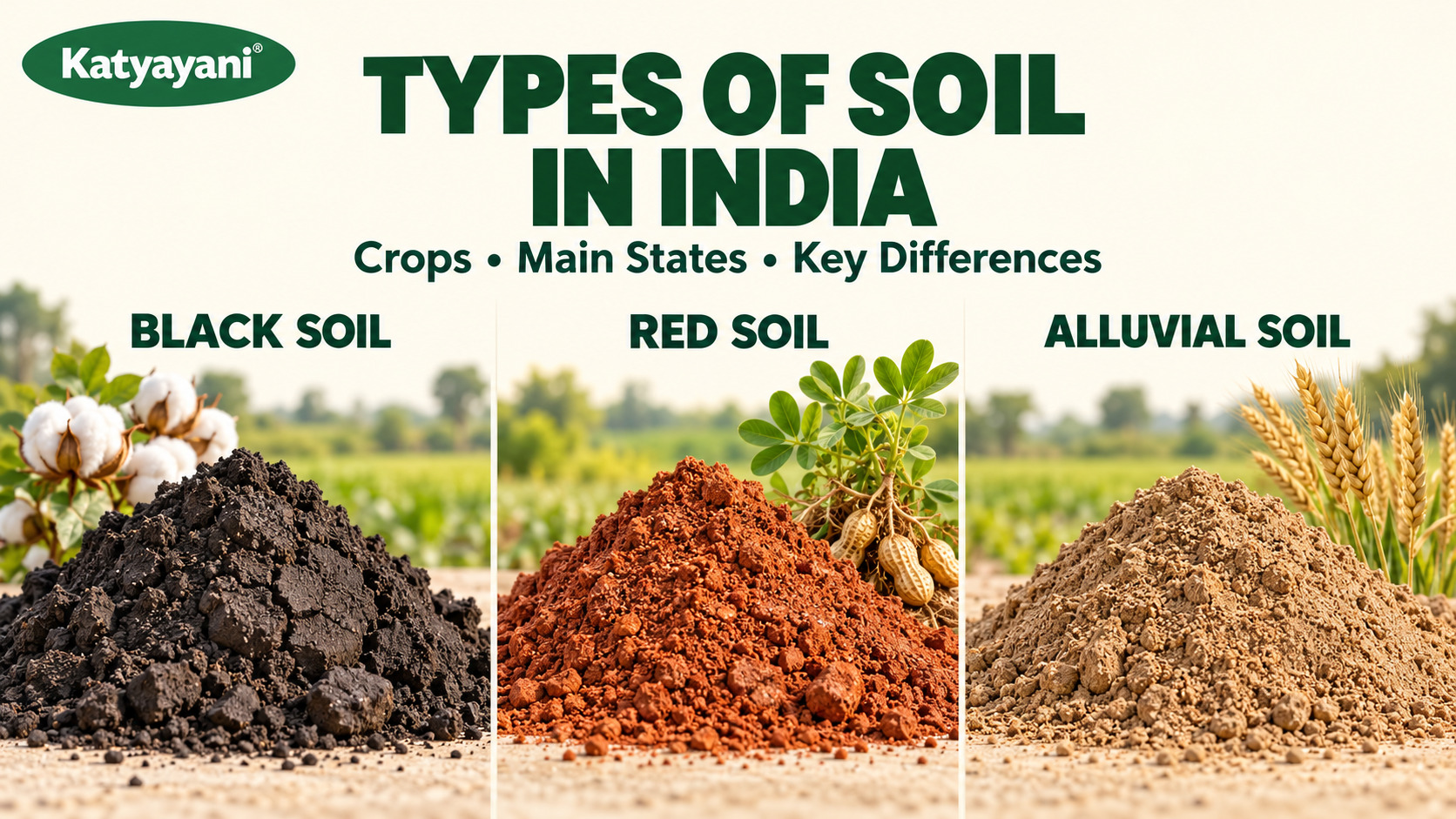
India has eight main soil groups in the ICAR classification: alluvial, black (regur), red, laterite, arid or desert, saline and alkaline, peaty and marshy, and forest and mountain. No single soil is best for every crop. Alluvial soil of the Indo-Gangetic plains covers the largest share of India and is the main base for wheat and rice. Black soil holds the most water and is the cotton soil, but it is low in nitrogen, phosphorus, zinc and organic matter and is hard to work. Red soil is light, acidic and low in fertility but responds well to manure, lime and balanced fertiliser. Laterite suits plantations. The best soil depends on your crop, your water and the depth of the soil.
What are the main types of soil in India?
India has eight main soil groups in the ICAR classification: alluvial, black (regur), red, laterite, arid or desert, saline and alkaline, peaty and marshy, and forest and mountain soils. The first four cover most farmland. Each forms from a different rock or river deposit under a different climate, and that decides its colour, texture, acidity and crops.
| Soil | Where it comes from | Colour and texture | Main limits |
|---|---|---|---|
| Alluvial | Silt carried and laid down by rivers (Ganga, Brahmaputra and delta rivers) | Light grey to brown; sandy loam to clay | Low nitrogen and organic matter |
| Black (regur) | Weathered Deccan basalt (volcanic rock) | Dark grey to black; heavy clay, over 50 percent clay | Sticky when wet, hard and cracked when dry; low N, P, S, Zn, organic matter |
| Red | Weathered granite and gneiss, old crystalline rocks | Red to yellowish brown; sandy loam to loam, often with a clay layer below | Acidic, low organic matter, crusts and erodes |
| Laterite | Heavy rain leaching bases and silica from rock | Reddish, gravelly, often hard | High acidity, low P, K, Ca, Zn, B |
| Arid (desert) | Wind-blown sand in dry western India | Sandy, poor profile | Little water, wind erosion |
| Saline and alkaline | Salts collecting in the root zone in dry or poorly drained land | Often with a white crust (saline) or a hard, dispersed top layer (sodic) | Salt or sodium damage to roots |
| Peaty and marshy | Waterlogged humid land where plant matter does not rot fully | Dark, heavy, high organic matter | Needs drainage, acidic |
| Forest and mountain | Hill slopes under forest | Varies with height; rich in humus | Thin, erodible, deficient in lime, P and K |
The table above summarises properties given by Khosla (UGC e-PG Pathshala), FAO and Kanwar (ICRISAT). The rest of this guide takes each soil in turn, then answers the two questions most farmers really ask: which soil suits my crop, and what do I do about the weak points of the soil I have.
Which soil covers the largest area in India?
Alluvial soil covers the largest share of India, mainly across the Indo-Gangetic plains, the Brahmaputra valley and the delta regions. Black and red soils come next across the peninsula. Laterite, arid, saline and alkaline, peaty and marshy, and forest and mountain soils cover smaller areas, each concentrated in particular regions.
| Soil | Relative extent | Where it mainly lies |
|---|---|---|
| Alluvial | Largest share of the country | Indo-Gangetic plains, Brahmaputra valley, deltas |
| Black (regur) | Large | Deccan plateau: Maharashtra, Madhya Pradesh, Gujarat and neighbours |
| Red | Large | Peninsular India: Andhra Pradesh, Tamil Nadu, Karnataka, Odisha |
| Laterite | Smaller | High-rainfall belts such as Kerala and the Western Ghats coast |
| Arid and desert | Smaller | Western Rajasthan and neighbouring dry areas |
| Saline and alkaline | Patches within other soils | Dry or poorly drained land, mainly in the north and west |
| Peaty and marshy | Small | Waterlogged humid coasts |
| Forest and mountain | Smaller | Himalayan and hill regions |
Salt-affected land has a measured national figure from ICAR-CSSRI, given in the saline and alkaline section below.
Black soil is described in more than one way. Kanwar separates deep black soil (Vertisol) from the medium-deep and shallow black soils that are only partly vertic, so deep black soil is only part of what farmers call black soil.
Which soil is best for farming in India?
The best soil depends on the crop, the water and the depth of the soil. Alluvial soil is the most widely cultivated and carries the wheat and rice belt of the Indo-Gangetic plains. Black soil suits cotton and crops grown on stored moisture. Red and laterite soils suit groundnut, millets and plantation crops with the right inputs.
| Crop group | Soil that commonly suits it | Why |
|---|---|---|
| Wheat, rice, sugarcane | Alluvial | The Indo-Gangetic plains are the main wheat region |
| Cotton, soybean, chickpea on stored moisture | Deep black | Holds 200 to 300 mm of plant-available water in the profile (Kanwar) |
| Groundnut, finger millet, pulses on rain | Red (well drained) | ICAR dryland trials show response to FYM, lime, sulphur and zinc |
| Tea, coffee, rubber, cashew, coconut | Laterite and hill soils | Listed for these soils in the Khosla chapter and the Kerala Soil Survey |
| Rice after drainage in waterlogged land | Peaty and marshy | FAO: often good rice when drained and fertilised |
Be careful with the word fertile. Black soil is called inherently very fertile by FAO because it holds bases and water, yet the same soil is short of nitrogen, phosphorus, sulphur, zinc and organic matter. Alluvial soil is easy and deep but is short of nitrogen and organic matter. Fertility in the book and yield in the field are different things, and the second one depends on what you add and how well you manage the water.
The Indo-Gangetic plains, which are mostly alluvial, account for over 70 percent of national wheat production according to a study of 25 plains soils.
What is alluvial soil? Colour, texture, nutrients and where it is found
Alluvial soil is river-deposited silt, found across the Indo-Gangetic plains and Brahmaputra valley and in the delta regions. FAO lists Punjab, Haryana, Uttaranchal, Uttar Pradesh, Bihar, West Bengal and Assam, plus coastal strips. It is near neutral to slightly alkaline, deep and easy to work, but low in nitrogen and organic matter.
Two sub-types matter in the field. Khadar is the new alluvium in low-lying land that floods, and it is more fertile. Bhangar is older alluvium on higher ground about 30 metres above the flood level, clayey, generally darker, with lime nodules (kankar) below the surface. Both are described in the Khosla chapter.
| Property | What the sources say | Source |
|---|---|---|
| Reaction | Near neutral to slightly alkaline | FAO |
| pH across 25 plains sites | 4.3 to 9.1 (strongly acidic to strongly alkaline) | PMC study |
| Texture across 25 plains sites | Sandy loam commonest (10 sites), then sandy clay loam (5), loam (4), clay loam (4), silt loam (1), clay (1) | PMC study |
| Organic carbon | 0.14 to 0.90 percent, described as generally low | PMC study |
| Available nitrogen | 92 to 347 kg per ha | PMC study |
| Available phosphorus | about 2.5 to 65.4 kg per ha | PMC study |
| Available potassium | 98 to 482 kg per ha | PMC study |
| DTPA zinc | 0.4 mg per kg (deficient) to 2.8 mg per kg (adequate) | PMC study |
| Nutrient gaps | Nitrogen and organic matter are low almost everywhere; phosphorus and zinc vary by field | FAO; Khosla; PMC study |
That spread is the real lesson. Alluvial soil is a family, not one soil. A sandy loam in western Uttar Pradesh and a clay in the Bihar plains need different water and different fertiliser, and the table shows pH from strongly acidic to strongly alkaline inside the same plain. Treat the soil report of your own field as the truth, not the textbook line.
What grows best: wheat, rice, sugarcane, maize, cotton, jute and oilseeds, per the Khosla chapter. For wheat sowing windows and basal doses by zone see our wheat sowing planner. For sugarcane, which is also an alluvial-plain crop, see the sugarcane guide. If wheat turns yellow after the first irrigation on alluvial soil, the wheat yellowing guide walks through zinc, sulphur, manganese and nitrogen timing.
What is black soil (regur)? Why it suits cotton and where it is found
Black soil, or regur, is a heavy clay soil formed from Deccan basalt. It has over 50 percent clay, a pH of 7.5 to 8.6 and a high water store, which is why it grows cotton and dry-land crops on stored moisture. It is found mainly in Maharashtra, Madhya Pradesh, Gujarat, Karnataka, Andhra Pradesh and Tamil Nadu.
The facts below are from Kanwar's ICRISAT paper unless marked. Vertisols are heavy clays with clay content above 50 percent and a profile deeper than 90 cm for the deep type. They have a high cation exchange capacity (45 to 60 meq per 100 g), a pH of 7.5 to 8.6 and over 80 percent base saturation. The clay is the swelling type, so the soil shrinks and cracks deeply when dry and swells when wet. It stays hard when dry and sticky when wet.
| Property | Black soil figure or fact | Source |
|---|---|---|
| Clay | Over 50 percent; the Khosla chapter says 62 percent or more | Kanwar; Khosla |
| pH | 7.5 to 8.6 | Kanwar |
| CEC | 45 to 60 meq per 100 g | Kanwar |
| Plant-available water | About 200 to 300 mm in a profile of about 180 cm | Kanwar |
| Depth classes | Deep over 90 cm; medium 50 to 90 cm; shallow under 50 cm | Kanwar |
| Organic matter, N, P, S, Zn | Generally low | Kanwar |
Why do so many black soil fields lie fallow in kharif? Because the soil is hard to work. If ploughed too dry it breaks into huge clods, and if ploughed wet it sticks. Kanwar reports that ploughing right after the dry-season crop, at the right moisture, gives a good seedbed with little effort because these soils are self-mulching. In some regions the land is left fallow in the rainy season and cropped only afterwards.
Crops. On deep black soils the ICAR dryland book recommends sequences such as soybean in kharif followed by safflower or chickpea in rabi, and maize or sorghum followed by chickpea or safflower. On medium-deep black soil it recommends soybean with pigeonpea (4:2) and sorghum with pigeonpea (2:2). On shallow black soil it limits farmers to kharif soybean (about 90 days), blackgram (about 70 days) and maize. Cotton is the classic crop; the Khosla text says the soil is called black cotton soil because cotton is its most important crop. For chana on black soil, our chickpea guide covers sowing, nutrition and disease.
Management gaps. Kanwar notes that without moderate doses of phosphate and nitrogen, and occasional zinc sulphate, satisfactory yields are not possible on these soils. The ICRISAT farm showed that even after about 1,000 kg of P2O5 over 8 years, Olsen phosphorus had not risen above medium. In one ICAR dryland zone profile, calcareous black clays with kankar are described as highly deficient in available phosphorus because of strong phosphorus fixing. For zinc, a source such as zinc sulphate 33 percent can be used as per your soil test.
Low infiltration is another trap. ICAR-CRIDA describes medium and deep calcareous black clays in parts of Karnataka and Andhra Pradesh with an extremely low infiltration rate, improved by lowering the exchangeable sodium percentage to under 5 by gypsum plus vertical mulching. If your black soil ponds and crusts, ask for an ESP and pH test before you add gypsum. Our gypsum guide explains when gypsum helps and the dose.
What is red soil? Fertility, pH, crops and where it is found
Red soil forms on old granite and gneiss and gets its colour from iron. It is light, often acidic, low in organic matter and short of nitrogen, phosphorus, sulphur and zinc. FAO lists Andhra Pradesh, Tamil Nadu, Karnataka, Maharashtra, Odisha, Goa and the north east. It responds strongly to manure, lime and balanced fertiliser.
ICRISAT's Alfisol description gives a base saturation of about 80 percent or less, a pH of 5.6 to 6.7 at its centre, and low total and available moisture storage. The chromic Luvisols (Haplustalfs and Rhodustalfs) are the main red soils of India, mostly in Andhra Pradesh, Karnataka and Tamil Nadu, on undulating land with 600 to 1,250 mm rainfall, and they are highly erodible without crop cover (Kanwar). FAO adds limited depth, poor water and nutrient holding, excess drainage and runoff.
| Red soil issue | What the ICAR dryland trials found | Source |
|---|---|---|
| Surface crust after rain | Crust strength fell with 10 t per ha FYM, 5 t per ha maize residue or 25 t per ha sand, and seedling emergence and yield rose | ICAR-CRIDA |
| Coarse topsoil over fine subsoil | Inverting the profile to 30 cm raised surface clay, water retention, yield and fertiliser efficiency | ICAR-CRIDA |
| Fertiliser placement | Banded fertiliser beat broadcasting | ICAR-CRIDA |
| Fertiliser alone | Continuous fertiliser alone gradually reduced finger millet yield; NPK plus 10 t per ha FYM stabilised it | ICAR-CRIDA |
| Rotation | Finger millet followed by groundnut raised finger millet yield by 30 percent | ICAR-CRIDA |
| Green leaf manure | 50 percent N from green leaf manure plus 50 percent NPK matched full inorganic fertiliser | ICAR-CRIDA |
| Acidity | Lime increased oilseed and pulse yields | ICAR-CRIDA |
| Sulphur | 10 kg per ha for pulses and 20 kg per ha for oilseeds raised yield | ICAR-CRIDA |
| Zinc | Zinc sulphate at 10 kg per ha improved maize yield | ICAR-CRIDA |
| Potassium | About 500 ppm non-exchangeable K, no crop response; N and P alone drew it down to 260 ppm in 5 to 6 years | ICAR-CRIDA |
That last row is easy to miss. Red soils are often told to need potash, yet the ICAR trial found no response at first and a slow drop when only N and P were applied. Check the K figure in your own report before you buy potash, and again every few years.
In another ICAR region (red sandy loams of Anantapur, Kurnool and Chittoor in Andhra Pradesh) the soils are described as near neutral, deficient in nitrogen and zinc, medium to high in potassium and phosphorus, with serious crusting, high infiltration and only 10 to 15 cm of available water per metre of soil. Red soil is therefore not one thing either: pH, depth and nutrient gaps change from district to district.
Crops: the Khosla chapter lists cotton, wheat, rice, pulses, millets, tobacco, oilseeds, potatoes and fruits, and ICAR-CRIDA lists groundnut, finger millet, pigeonpea and maize in the trials above. Sulphur for pulses and oilseeds is a cheap fix; for a sulphur source, ammonium sulphate (N 21 percent, S 24 percent) is used on groundnut, mustard, pulses and cotton, and the dose should follow your soil test.
What is laterite soil, and which crops grow on it?
Laterite is a deeply weathered, reddish, gravelly soil formed under heavy rain, which strips out bases and silica. FAO places it in Kerala, Tamil Nadu, Karnataka, Andhra Pradesh and the north east. It is acidic, short of P, K, Ca, Zn and B, and suits plantation crops, coconut and cashew.
FAO lists the constraints as low bases and silica from leaching, high acidity, and aluminium and manganese toxicity. The Kerala Soil Survey describes laterite as a strip between the coastal belt and the hilly midland, at about 10 to 100 m above sea level, generally suitable for most dryland crops, with coconut, arecanut, banana, tapioca, vegetables, yams, pepper and pineapple grown. On shallow laterite outcrops only cashew with vegetables can be grown, according to the Kerala department page. The Khosla chapter adds tea, coffee, rubber, cashew and cinchona, and paddy in low-lying patches with fertiliser.
Acidity is the main handle. The ICAR liming figures are in the acid soil section further down. In plantation land, the first action is a soil test for pH and aluminium; lime and organic matter then follow.
What are arid or desert soils, and which crops suit them?
Arid soils are sandy, poorly developed and dry, found in western Rajasthan and parts of Haryana, Punjab and Gujarat. Water shortage and wind erosion are the limits, so drought-hardy millets, pulses and barley fit. With canal irrigation, the same sand can grow wheat, mustard and cotton.
FAO describes desert soils (Arenosols, Calcisols and Gypsisols) as sandy with poor profile development, water deficiency and high susceptibility to wind erosion; a gypsic layer is common in extremely arid areas such as Bikaner and Jaisalmer. The Khosla chapter puts annual rainfall under 50 cm, nitrogen deficiency, phosphate richness, and lists barley, rape, cotton, wheat, millets, maize and pulses..
What are saline and alkaline (sodic) soils, and how big is the problem?
Saline soils carry too much soluble salt; sodic or alkaline soils carry too much exchangeable sodium and have a high pH. ICAR-CSSRI says about 6.73 million ha in India is salt-affected, of which 2.95 million ha is saline, across 16 states. Sodic land needs gypsum; saline land needs drainage and leaching.
The same CSSRI brochure estimates annual crop losses from salinity and sodicity at 16.84 million tonnes and projects that affected area could reach 16.2 million ha by 2050. FAO lists Rajasthan, Punjab, Haryana, Uttar Pradesh, Madhya Pradesh, Maharashtra and Gujarat among the affected states, and it notes that with gypsum these soils can carry rice followed by wheat.
Two guides cover the detail. Soil salinity: causes, symptoms, EC and pH limits and reclamation covers how to tell saline from sodic. Gypsum in agriculture covers dose, method and timing. The first step on a white-crusted field is a lab test for pH, EC and exchangeable sodium, not a bag of gypsum.
What are peaty, marshy, forest and mountain soils?
Peaty and marshy soils form in permanently waterlogged humid land: parts of Kerala, Odisha, the Sundarbans in West Bengal and the south-east coast of Tamil Nadu. They are high in organic matter and acidic, and give good rice once drained and fertilised. Forest and mountain soils are humus-rich but thin and acidic in the hills.
FAO says peaty (Histosols) soils need proper drainage and fertilisation, and then often produce good rice. The Khosla chapter describes the soil as black, heavy and highly acidic, deficient in potash and phosphate, with paddy grown after the monsoon water recedes. For forest and mountain soils it describes them as rich in humus, deficient in lime, phosphorus and potash, with spices, coffee, tea and tropical fruits in the south and barley, maize, wheat and temperate fruit in Uttarakhand, Jammu and Kashmir and Himachal Pradesh.
In the north east, where more than 80 percent of soil is acidic according to the Indian Farming 2025 review, the fix is lime in the furrow, discussed in the improvement section.
Which soil is best for which crop? A crop-by-soil table
Match the crop to the soil depth, water and acidity first. Wheat, rice and sugarcane do best on alluvial soil. Cotton, soybean, chickpea and safflower do best on deep black soil. Groundnut, finger millet and pulses fit red and light soils. Tea, coffee, rubber, coconut and cashew fit laterite and hill soils.
| Crop | Soil that suits it best | What the source says | Source |
|---|---|---|---|
| Wheat | Alluvial (Indo-Gangetic plains) | Plains are the main wheat region | PMC study, Khosla |
| Rice | Alluvial; drained peaty soil; reclaimed sodic soil | Rice then wheat after gypsum on sodic land; good rice on drained peat | FAO |
| Sugarcane | Alluvial | Listed for alluvial soil | Khosla |
| Cotton | Black soil; also red and alluvial | Called black cotton soil because cotton is the main crop | Khosla |
| Soybean | Medium to deep black | Sequences with safflower or chickpea; kharif soybean on shallow black | ICAR-CRIDA |
| Chickpea (chana) | Deep black (stored moisture) | Rabi after soybean, maize or greengram in deep black soil | ICAR-CRIDA |
| Safflower, sunflower | Medium to deep soils | Listed as medium deep to deep | ICAR-CRIDA |
| Sorghum (jowar) | Medium to deep black | Medium deep to deep soils; shallow soils only if the kharif crop fails | ICAR-CRIDA |
| Groundnut | Light, well-drained, shallow to medium deep, low clay | Shallow to medium deep with low clay content, well drained | ICAR-CRIDA |
| Pearl millet, pigeonpea, greengram, blackgram | Shallow to medium deep, well drained | ICAR-CRIDA lists these for shallow to medium-deep well-drained soils | ICAR-CRIDA |
| Horsegram, moth bean | Shallow, well drained | Listed for shallow well-drained soil | ICAR-CRIDA |
| Finger millet | Red soil | Finger millet then groundnut rotation raised yield by 30 percent | ICAR-CRIDA |
| Barley, millets, drought-hardy crops | Arid and desert soils | Listed with rape, cotton, wheat, maize and pulses | Khosla |
| Tea, coffee, rubber, cashew | Laterite; hill soils for tea and coffee | Listed for laterite and for forest and mountain soils | Khosla |
| Coconut, arecanut, pepper, pineapple, tapioca | Laterite (Kerala) | Grown on laterite midlands; only cashew on shallow outcrops | Kerala Soil Survey |
This table is a starting point. Water supply, sowing time and variety change the answer. Ask your Krishi Vigyan Kendra which varieties are recommended for your soil series.
Which states have which soil? A state-wise table
Alluvial soil dominates Punjab, Haryana, Uttar Pradesh, Bihar, West Bengal and Assam. Black soil dominates Maharashtra, Madhya Pradesh, Gujarat and parts of Karnataka, Andhra Pradesh and Tamil Nadu. Red soil is widest in Andhra Pradesh, Tamil Nadu, Karnataka and Odisha. Laterite lines the Western Ghats coast, and desert soil is mainly in Rajasthan.
| State or region | Main soils (from the sources) | Source |
|---|---|---|
| Punjab, Haryana | Alluvial; parts desert or salt-affected | FAO; Khosla |
| Uttar Pradesh, Bihar | Alluvial; sodic patches in the plains | FAO |
| West Bengal, Assam | Alluvial; peaty in the Sundarbans; laterite and acidic soil in Assam | FAO; Khosla |
| Rajasthan | Desert (arid); alluvial in the east; saline and sodic patches | FAO; Khosla |
| Gujarat | Black; alluvial and marine alluvium; saline coast | Khosla; FAO Vertisol page |
| Maharashtra | Black (main); laterite in the coast and ghats; red in parts | Khosla; FAO |
| Madhya Pradesh | Black; red and alluvial in parts | Khosla; ICAR-CRIDA |
| Karnataka | Black in the north, red in the south, laterite in the coast | Khosla; ICAR-CRIDA |
| Andhra Pradesh, Telangana | Black and red | Kanwar; Khosla |
| Tamil Nadu | Red (main), black in the south, laterite, peaty on the south-east coast | Kanwar; FAO |
| Kerala | Laterite (midland strip), peaty and marshy in the backwaters | Kerala Soil Survey; Khosla |
| Odisha, Jharkhand, Chhattisgarh | Red; laterite; alluvial in the delta; peaty on the coast | Khosla; FAO |
| North east | Acidic soils; over 80 percent acidic | Indian Farming 2025 (acid soil review) |
| Uttarakhand, Himachal Pradesh, Jammu and Kashmir | Forest and mountain soils | Khosla |
Soil boundaries do not follow state lines, so most states have more than one soil. Use the table to see the dominant soils, then ask your Krishi Vigyan Kendra which soil series your district falls in.
Black soil vs red soil vs alluvial soil: which one is better?
Alluvial soil suits irrigated grain crops, black soil suits moisture-limited crops like cotton and chickpea, and red soil suits light-soil crops like groundnut and finger millet. All three need organic matter and balanced nutrients.
| Feature | Alluvial | Black (regur) | Red |
|---|---|---|---|
| Texture | Sandy loam to clay | Heavy clay, over 50 percent clay | Sandy loam to loam, clay below |
| Reaction | Near neutral to slightly alkaline (varies widely) | pH 7.5 to 8.6 | Mostly acidic; pH 5.6 to 6.7 at the ICRISAT centre |
| Water | Depends on texture | Highest storage, cracks when dry | Low storage, drains fast |
| Workability | Depends on texture | Hard: sticky wet, hard dry | Crusts after rain |
| Organic matter | Low | Low | Low |
| Nutrient gaps | N, organic matter; P and Zn vary | N, P, S, Zn | N, P, S, Zn; sometimes lime |
| Typical crops | Wheat, rice, sugarcane, maize | Cotton, soybean, chickpea, sorghum | Groundnut, finger millet, pulses |
| Main states | Punjab, Haryana, UP, Bihar, West Bengal | Maharashtra, MP, Gujarat, Karnataka | AP, Tamil Nadu, Karnataka, Odisha |
One point that surprises people: black colour does not mean high organic matter. The Kanwar paper says tropical Vertisols are generally low in organic matter, and the dark colour comes from the clay, not from humus. Do not assume a black field is rich.
How do I find out which soil I have? Feel test, ribbon test, jar test and Soil Health Card
Start with the feel and ribbon test on moist soil, then the jar test for the sand, silt and clay split. Both are rough guides. For pH, salinity, organic carbon and nutrients you need a lab test, such as the one behind a Soil Health Card from your agriculture department or KVK.
- Feel test. Put soil in your palm, add a little water and knead it to a smooth, putty-like consistency. Rub it between your fingers: gritty means sand, smooth means silt, sticky means clay (Colorado State Extension).
- Ball squeeze. If a moist ball breaks with slight pressure it is coarse (sand or loamy sand). If it holds but changes shape easily it is medium (sandy loam or silt loam). If it resists breaking it is fine (clayey).
- Ribbon test. Squeeze a moist ball between thumb and finger into a ribbon and let it hang over the forefinger until it breaks. Under 1 inch and gritty is sandy; 1 to 2 inches not gritty is fine-textured; over 2 inches is clayey. As little as 20 percent clay can make soil behave as clayey.
- Jar test. Sift the soil, fill a clear straight-sided jar one-third with it, fill the rest with clean water, shake to a slurry and set it on a level surface. Mark the sand layer after 1 minute, the silt layer after 2 hours and the clay layer after 48 hours, then divide each layer height by the total height to get percentages and read the type on a soil texture triangle (Clemson HGIC).
These tests tell you texture, which separates a sandy red field from a heavy black one. They do not tell you pH, salt or nutrients. Black soil is easy to spot: deep cracks in summer and sticky clods in monsoon. Alluvial soil is the plain you stand on in Punjab or Bihar. Red soil is obvious by colour. Neither colour nor texture shows an acid, saline or zinc-short soil.
For that, use the Soil Health Card, which reports the nutrient status of your soil and gives fertiliser recommendations. You can get one through your state agriculture department or KVK. Our guide how to read your Soil Health Card explains each line, and soil pH and nutrient lock explains why a low or high pH can stop nutrients working.
What do Indian soils usually lack? Nitrogen, sulphur, zinc and organic matter
Across India nitrogen and organic carbon are low in most soils, and many soils are low to medium in phosphorus. Sulphur and potassium deficiency is increasing, according to FAO. Among micronutrients zinc is the most common gap, then boron.
| Nutrient | General pattern in Indian soils | Source |
|---|---|---|
| Nitrogen | Low in most soils | FAO |
| Organic carbon | Very low in most soils | FAO |
| Phosphorus | Low to medium in many soils | FAO |
| Potassium | Deficiency has become more widespread | FAO |
| Sulphur | Deficiency is increasing | FAO |
| Zinc | The most common micronutrient gap | FAO |
| Boron | The next most common micronutrient gap | FAO |
The pattern matches what the sources report for black and red soil: nitrogen, phosphorus, sulphur and zinc. That is why a plan built on urea and DAP alone leaves yield on the table in many soils.
How do you improve each type of soil?
Add organic matter to every soil. Beyond that the fix depends on the soil: gypsum for sodic soil, lime for acidic soil, drainage and leaching for saline soil, phosphorus, sulphur and zinc for black soil, and FYM, sulphur and lime for red soil. Test first, then match the amendment to the fault.
| Soil | Main fault | What the sources recommend | Source |
|---|---|---|---|
| Alluvial | Low N and organic matter; zinc varies | Balanced NPK on a soil test; zinc where DTPA zinc is low; crop residue and manure | PMC study, FAO |
| Black | Low OM, N, P, S, Zn; clods and stickiness | Moderate P and N, occasional zinc sulphate; plough at the right moisture; gypsum only if ESP is high | Kanwar, ICAR-CRIDA |
| Red | Crust, acidity, low OM, S and Zn | FYM 10 t per ha, banded fertiliser, green leaf manure, lime, S 10 to 20 kg per ha, zinc sulphate 10 kg per ha for maize | ICAR-CRIDA |
| Laterite and other acid soils | Aluminium toxicity, low P, Ca, Zn, B | Lime in the furrow at 0.2 to 0.4 t per ha, with the recommended fertiliser | ICAR NRM chapter |
| Sodic | High sodium, poor structure | Gypsum, reclamation with leaching | ICAR-CSSRI, KO gypsum guide |
| Saline | Excess soluble salt | Drainage and leaching, tolerant crops | KO salinity guide |
| Arid sandy | Little water, wind erosion | Drought-hardy crops, residue cover, irrigation where available | FAO |
| Peaty | Waterlogging, acidity | Drainage and fertilisation; then rice | FAO |
Start with organic matter because it helps every soil in the table. The soil microbiome guide explains what organic matter does for soil life. For a product, a vermicompost such as Katyayani enriched vermicompost lists 30 to 40 percent organic matter on its page and says it improves tilth and water retention in sandy and clay soils alike. Use the pack and your soil report for the dose. More options sit in the manures and soil conditioners collection.
How do you manage acid soil in red and laterite areas?
Lime is the standard fix for acid soil. ICAR trials applied lime at 0.2 to 0.4 t per ha in the furrow at sowing along with the recommended fertiliser. This raised yields by 49 to 189 percent over farmer practice and saved about 50 percent of chemical fertiliser, mainly in oilseeds and pulses. The benefit-cost ratio averaged 2.5.
The ICAR chapter says 25 million ha of cultivated land with a pH below 5.5 is critically degraded acid land and that adopting furrow liming on that area could add 25 million tonnes of foodgrain per year. That is ICAR's projection, not a measured national result. The 2025 Indian Farming review from ICAR in Meghalaya says more than 80 percent of north-eastern soils are acidic, that acid soils lack phosphorus, calcium, magnesium, boron and molybdenum while aluminium and iron are in toxic amounts, and that 500 kg of lime per hectare in the furrow raises pH towards neutral. It also lists green manuring, crop residue, organic manure and intercropping as helpers.
Two cautions. Doses differ because soils and lime quality differ, so base yours on a lime requirement test, not on a table. And lime is not a fix for sodic or saline soil; those are different problems with different cures.
What mistakes do farmers make about soil type?
| Mistake | Why it hurts | What to do instead |
|---|---|---|
| Choosing a crop by what the neighbour grows, not by soil depth and water | Groundnut on heavy clay or sorghum on thin soil fails in the same season | Use the crop-by-soil table above and ask the KVK about your soil series |
| Assuming black soil is rich because it is dark | Vertisols are generally low in organic matter, N, P, S and Zn | Apply a moderate P and N dose and test for zinc |
| Buying potash for red soil without a test | The ICAR trial found no K response at first because the soil held about 500 ppm non-exchangeable K | Check the K line in the report and re-test every few years |
| Using gypsum on any hard soil | Gypsum fixes sodic soil, not saline or merely compacted soil | Test pH, EC and ESP first; read our gypsum guide |
| Ploughing black soil at the wrong moisture | Big clods when dry, sticky smear when wet | Plough right after the previous crop at the right moisture, as Kanwar describes |
| Using only N and P on red soil for years | ICAR trial: K fell from about 500 to 260 ppm in 5 to 6 years | Add FYM, and test K |
| Treating the textbook line as your field | Alluvial pH ranged from 4.3 to 9.1 across 25 plains sites | Test your own field every two or three years |
Rotation also helps every soil, as the finger millet and groundnut example shows. Our crop rotation guide gives plans by region.
Conclusion
India has eight soil groups, but four decide most farming: alluvial for wheat, rice and sugarcane, black for cotton, soybean and chickpea on stored moisture, red for groundnut, finger millet and pulses with manure and lime, and laterite for plantations. No soil is best for every crop, so choose by crop, depth and water. What stays true almost everywhere is that soils are short of nitrogen and organic matter, and often sulphur and zinc. Do the feel and jar test, get a lab report or Soil Health Card, and fix the fault the report shows.
Questions Farmers Ask
What are the types of soil in India?
Which soil is best for agriculture in India?
Which is the most fertile soil in India?
Which crops grow in black soil?
Which crops grow in alluvial soil?
Which crops grow in red soil?
In which states is black soil found?
In which states is alluvial soil found?
Which is the largest soil group in India?
How do I identify my soil type at home?
Is black soil more fertile than red soil?
How can I improve poor soil?

Microbiologist
Microbiologist at Katyayani Organics. MSc in Microbiology, 2.6 years of experience.
View all authors

Leave a Comment