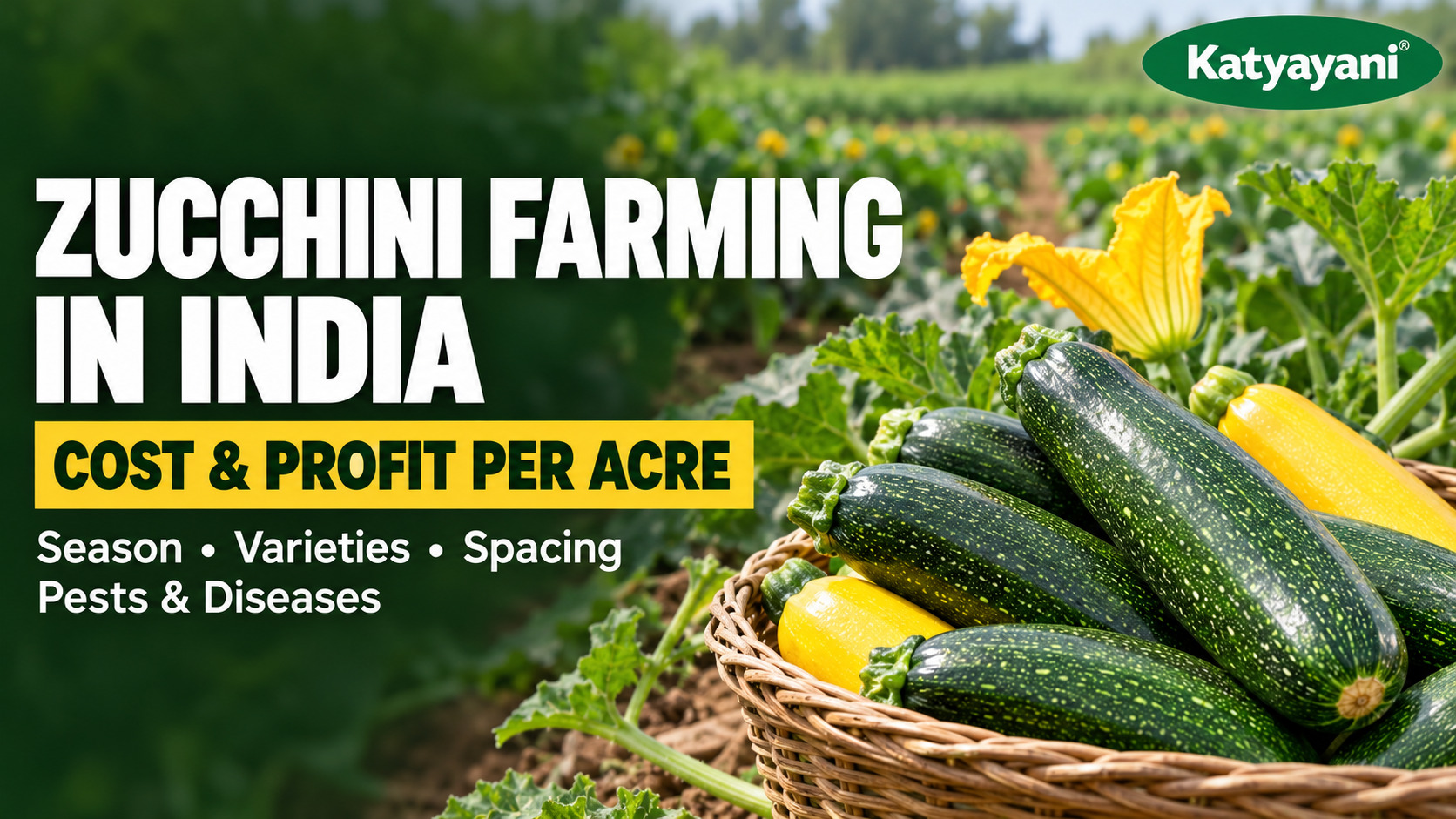
 14 min read
Zucchini (summer squash, chappan kaddu) grows well in India, mainly as a winter crop in the north plains: ICAR-IIVR says sow 20 October to 10 November (also first half of February), and harvest starts about 55 days after sowing. It is a bush plant, so it needs no support. Winter yield is 25-40 tonnes per hectare, about 10-16 tonnes per acre; spring-summer yield is only 8-10 tonnes per hectare. The ICAR-IIVR study works out to about Rs 57,000 cost and Rs 1.76 lakh net profit per acre, but that assumes 32 t/ha sold at Rs 18/kg. Check your live mandi price before you plan on those numbers.
What is zucchini, and is it the same as chappan kaddu?
Yes, it is the same crop. Zucchini is a summer squash, Cucurbita pepo, and ICAR-IIVR gives its Hindi names as chappan kaddu and vilayati kaddu. If a neighbour says "jukini" or you have searched "zucchini ki kheti", this is what you are looking for. The difference from pumpkin is simple: you pick zucchini young, while the skin is still soft, and you never let it grow into a hard-rinded fruit.
The plant is a bush with short gaps between leaves, so the fruits sit close to the main stem and keep coming one after another. The ICAR-IIVR article says that in India it is eaten mostly cooked, especially in big cities, though a tender fruit also works as a salad. That tells you who buys it. Think metro-city vegetable shops, supermarkets and hotel kitchens, not the usual village sabzi mandi. The ICAR article itself calls it a cash vegetable for peri-urban areas.
| Question | Answer | Source |
|---|---|---|
| Species | Cucurbita pepo (summer squash group) | ICAR-IIVR |
| Hindi names | Chappan kaddu, vilayati kaddu | ICAR-IIVR |
| Where it is grown (listed) | Punjab, Haryana, Delhi, Uttar Pradesh, Jammu and Kashmir, Himachal Pradesh, West Bengal | ICAR-IIVR |
| Plant type | Bush; male and female flowers on the same plant | ICAR-IARI (Pusa Pasand description) |
| Food value | About 17 calories per 100 g, with vitamin C, potassium and magnesium | ICAR-IIVR |
In plain words: the table tells you this is a north-India crop on paper, it is a bush so you do not need a trellis, and it is sold young. Everything else in this guide follows from those three facts.
Can you grow zucchini in India, and in which season?
Yes, mainly as a winter crop in the north plains. ICAR says to sow from September to November or in the first half of February, and calls 20 October to 10 November the best window. The plant is frost-sensitive and likes 24 to 27 degrees Celsius, so open-field growing in December to February is risky without protection.
| Situation | Sowing window (north plains) | First harvest | Source |
|---|---|---|---|
| Open field, winter crop | 20 October to 10 November (range September to November) | About 55 days | ICAR-IIVR |
| Open field, spring | First fortnight of February (IIVR); 3rd week of February to 1st week of March for Pusa Pasand (IARI) | 45 to 50 days for Pusa Pasand | ICAR-IIVR, ICAR-IARI |
| Low-cost naturally ventilated polyhouse | 3rd week of October to 1st week of November | 40 to 42 days for Pusa Pasand | ICAR-IARI |
| Plastic low tunnel | Last week of December to 1st week of January | 50 to 55 days for Pusa Pasand | ICAR-IARI |
How to read this table: each row is a different way of dodging the cold. If you sow in the open at the right time, you wait about 55 days for the first fruit. If you give the plant a polyhouse, it starts earlier and sells when fewer farmers have fruit. A low tunnel sits in between.
Here is why the season matters so much. ICAR-IIVR says tender zucchini can fetch a better price from December to February, when cucumber is scarce. That is the reason winter is the main season. It is also the reason a cold night in January hurts, because that is exactly when you want the plant to be producing.
What if you live outside the north plains? Both ICAR articles are about the north. I did not find an ICAR sowing calendar for Maharashtra, Gujarat, Karnataka or the south. If you farm there, ask your KVK for the local window. The principle will be the same: sow when nights are mild, and keep the crop away from frost and peak summer heat.
Which zucchini varieties and hybrids can you grow in India?
Public varieties named by ICAR include Kashi Shubhangi, Punjab Chappan Kaddu-1, Pusa Alankar and Pusa Pasand. Seed companies also sell private hybrids. I could not verify their yield or disease claims, so check what your local dealer actually stocks and ask to see results from your own district before you buy.
| Variety | Raised by | What the source says | Best for |
|---|---|---|---|
| Kashi Shubhangi | ICAR-IIVR Varanasi | Medium-maturing bushy plant, 8 to 10 dark green shiny fruits, average fruit weight 800 to 900 g, yield 600 to 650 q/ha, resistant to downy mildew. Recommended for Uttar Pradesh, notified 2019. Best in autumn, can be grown in spring | Winter crop in UP and nearby. Plan to pick much earlier than 800 g if your buyer wants tender fruit |
| Pusa Pasand | ICAR-IARI New Delhi | Heat tolerant, flattish round 70 to 80 g fruit, first picking 45 to 50 days, 16.0 t/ha in open field in spring-summer, 24.5 t/ha in polyhouse and 22.8 t/ha under low tunnel (trial averages) | Spring-summer open field and off-season protected cultivation, NCR Delhi |
| Pusa Alankar, Australian Green | ICAR-IARI (as described in the Pusa Pasand article) | Long cylindrical fruit | Winter crop where the market wants the long green zucchini |
| Punjab Chappan Kaddu-1, Champion, Romulus, Green Star, Orelia, Antier Green, Goldy, Adlika and others | Listed by ICAR-IIVR as options | Listed only; no yield data in the article | Check local availability |
One thing farmers often miss is fruit shape. The ICAR-IARI article says buyers in the north plains like flattish round fruit of 70 to 80 g, while long cylindrical fruit is the type salad and hotel buyers ask for. Before you pay for seed, find out which one your buyer wants.
Kashi Shubhangi deserves a careful reading. An 800 to 900 g fruit is a big fruit. For fresh eating ICAR-IIVR found the best taste at 200 to 325 g, so if you grow this variety you will still pick small and early.
Buy sealed, labelled packets from a licensed dealer and keep the bill. A bad seed lot can cost you the whole season. Our guide on how to identify fake farm inputs lists what to check on a pack.
How do you prepare the soil and field for zucchini?
Zucchini grows on most soils but likes well-drained loam or sandy loam with plenty of organic matter (ICAR-IARI). Plough two or three times with harrowing until the soil is fine. Mix in 15 to 20 tonnes of well-rotten farmyard manure per hectare, about 6 to 8 tonnes per acre by our arithmetic (ICAR-IIVR). If you do not have enough FYM, a compost such as vermicompost can fill part of the gap. The product page gives no nutrient analysis or per-acre dose, so ask the maker before you plan quantities.
- Make raised beds. ICAR-IIVR says that under surface irrigation the crop goes on 80 to 90 cm wide raised beds, with a seed or seedling on each side and a 7 to 10 cm margin. The bed keeps the neck of the plant out of standing water.
- Look for low spots. If water stays after irrigation, seedlings are more likely to collapse. ICAR-IARI recommends a drench against damping off, but drainage comes first.
- Get a soil test. Ask for pH, organic carbon, nitrogen, phosphorus and potash before you fix the dose. Our post on how to read a soil health card shows what the numbers mean.
Seedlings that collapse at the base a few days after emergence are the classic damping-off picture. ICAR-IARI advises a seed treatment and a seedling drench with a fungicide, and says to follow the label. A biological option is a Trichoderma product. Our Trichoderma viride bio fungicide page says it works against wilt, rot, blight and damping off, and lists pulses, chilli, paddy, cereals, fruits and vegetables. It does not name cucurbits and its dose section is blank, so confirm the squash dose with the maker.
What are the seed rate, spacing and sowing method for zucchini per acre?
ICAR-IIVR gives 2.25 kg of seed per hectare, about 0.9 kg per acre. ICAR-IARI gives 3 to 5 kg per hectare for Pusa Pasand, about 1.2 to 2 kg per acre. Spacing runs from 60 to 75 cm between rows with 50 cm between plants (IIVR) to 90 x 60 cm on raised beds (IARI). The two ICAR sources do not agree, so pick by variety and bed layout.
| Item | ICAR-IIVR (salad zucchini) | ICAR-IARI (Pusa Pasand) | Per acre (our arithmetic) |
|---|---|---|---|
| Seed rate | 2.25 kg/ha | 3.0 to 5.0 kg/ha | About 0.9 kg (IIVR); 1.2 to 2.0 kg (IARI) |
| Spacing | Row 60 to 75 cm, plant 50 cm (text). The summary box in the same article says 100 x 75 cm | 90 x 60 cm, raised beds, seeds sown diagonally | 90 x 60 cm gives about 7,500 plants per acre; 60 x 50 cm gives about 13,500 |
| Plants per hectare | 25,000 to 30,000 (text) | Not stated | IIVR figure is about 10,000 to 12,000 per acre |
| Sowing method | Direct seed, or seedlings in half-kg polybags; 25-day-old seedlings with 2 true leaves | Direct seed 2 to 3 per pit then thin to one, or plug-tray seedlings at 28 days (2 leaves), one per hill | Transplants save seed and give an even stand |
What the table means for you: the IIVR article contradicts itself on spacing, because its text says 60 to 75 x 50 cm and its summary box says 100 x 75 cm. I show both and flag it in the checklist. Closer spacing gives more plants per acre but also more humid air under the leaves, and that helps powdery mildew. If you have drip and raised beds, 90 x 60 cm is the layout IARI actually tested.
For seedlings, ICAR-IIVR suggests a polybag mix of soil, vermicompost or FYM and sand in a 2:1:1 ratio. ICAR-IARI uses cocopeat, vermiculite and perlite in 3:1:1 for plug trays. If you sow direct, put 2 or 3 seeds in a pit and keep the strongest one once seedlings are up.
How much fertiliser does zucchini need, and when?
ICAR-IIVR text gives 60 to 80 kg nitrogen and 40 to 50 kg each of phosphate and potash per hectare, which is about 24 to 32 kg N and 16 to 20 kg P2O5 and K2O per acre. Put all the phosphate and potash and half the nitrogen in at planting. Give the rest of the nitrogen about four weeks later. Adjust everything to your soil test.
| Crop stage | What to apply | Source |
|---|---|---|
| Land preparation | 15 to 20 t/ha well-rotten FYM (about 6 to 8 t per acre) | ICAR-IIVR |
| At sowing or transplanting | All phosphate and potash, half the nitrogen | ICAR-IIVR |
| About 4 weeks after sowing | Remaining nitrogen as top dressing | ICAR-IIVR |
| Open field, spring (Pusa Pasand) | At last ploughing: 100 kg urea, 200 kg single super phosphate, 80 kg muriate of potash per hectare; top dress 50 kg urea at 20 days (per acre: about 40, 81, 32 and 20 kg) | ICAR-IARI |
| Polyhouse (Pusa Pasand) | Per 100 sq m bed area: 250 kg FYM, 1.2 kg N, 800 g P, 600 g K, with N split at one month and just before flowering | ICAR-IARI |
| Drip fertigation | Water-soluble 18:18:18 or 19:19:19, twice a week in 8 to 10 splits | ICAR-IIVR |
| Boron | 1 g borax per hill, or two foliar sprays of 0.03 percent borax 30 days apart; reported to raise fruit yield significantly | ICAR-IIVR |
In plain words, the table is a basal-plus-top-dress plan. Most of the feed goes in before or at sowing, one nitrogen top dress follows at 20 to 30 days, and boron is the small extra that ICAR-IIVR links to better fruit yield. The summary box in the IIVR article lists NPK as 100:50:50 kg per hectare, higher than its own text. If your soil is poor, start with the text range and add more only if plants look pale. Too much nitrogen gives soft, dark leaves that mildew and aphids like.
On boron: ICAR-IIVR recommends borax, and that is the tested route. If you prefer a ready liquid, our YieldBor boron 10 percent SC page describes a foliar, drip or drench boron fertiliser and claims better flowering and fruit set. The page lists no crops and gives no trial data, so treat those claims as the maker's own and ask for the squash dose. You can compare the schedule with our cucumber fertiliser guide, since the two crops are close relatives.
How should you irrigate zucchini, and does mulch help?
Keep the soil evenly moist and avoid swings between dry and flooded. ICAR-IIVR describes drip irrigation every third day for 45 to 60 minutes between November and February. Plastic mulch (black, black-silver, reflective or biodegradable) cuts weeds, saves water and reduces aphids, and ICAR-IARI recommends black plastic on the raised beds.
- Treat the drip time as a starting guess. It comes from one station. Dig a few centimetres next to a plant a few hours after irrigation. Moist but not muddy is what you want.
- Weed early. ICAR-IIVR says weeds are a serious problem in the early stage. If you are not using mulch, weed and hoe once and earth up at 20 to 25 days.
- Earth up. ICAR-IARI says earthing up is essential to cover the roots and hold the bush.
- Cut old leaves. ICAR-IARI advises removing older leaves regularly for light and air, which helps against pests and disease.
- Read the mulch basics. Film colours and organic mulch depth are covered in our mulching guide.
Does zucchini need hand pollination, and why do flowers drop without fruit?
Under a polyhouse or low tunnel, yes. ICAR-IARI says hand pollination is needed and should be done on freshly opened flowers between 8 and 10 in the morning. In the open field, bees do the job. If early flowers drop, that is usually fine. If female flowers or tiny fruits drop, look for poor pollination or stress.
Here is the scene many first-time growers describe. The plant is full of flowers, but nothing sets, and the flowers fall. Ask Extension, a US university extension service, explains it. Male flowers open first and drop because they have no work yet. Female flowers show up one to two weeks later. You can tell them apart because a female flower has a tiny fruit at its base. ICAR-IARI adds that the flowers are large and solitary, which makes hand pollination easy.
- Go early. Between 8 and 10 am the flowers are fresh (ICAR-IARI).
- Pick a male flower. It has a thin stalk and nothing swelling behind it. Peel back the petals.
- Touch the pollen to the centre of a female flower, the one with the tiny fruit behind it. This is the general method extension services describe; ICAR gives only the time of day.
- Repeat daily while the plant is flowering. One miss does not matter, a week of misses does.
- Open the cover in low tunnels once frost risk is over so bees can work. ICAR-IARI says to remove the plastic in the second half of February.
| What you see | Likely cause | What to do |
|---|---|---|
| Many flowers, no fruit, early flowers drop | Males open first; this is normal for the first one to two weeks | Wait. Check again when female flowers with a tiny fruit appear |
| Tiny fruit turns yellow, shrivels and drops | The flower was not pollinated, common under cover or in cold, wet weather | Hand pollinate every morning; open the sides for air and insects |
| Female flowers dry before opening | Water or heat stress (Ask Extension) | Keep moisture even, use mulch, avoid midday stress |
| Fruit with a narrow, shrivelled tip | Not confirmed from an ICAR source for zucchini; poor pollination and nutrition are common suspects | Check pollination and boron first, then ask your KVK |
Read the table from left to right: the first column is what you see, the second is the most likely reason, the third is what you do tomorrow morning. The last row is the one I could not source from ICAR, so it is only a prompt to check the basics.
What pests attack zucchini, and how do you manage them?
ICAR sources name leaf miner, whitefly, aphids, mites and cutworm. Aphids and whitefly matter most because they carry viruses. Walk the field twice a week, turn leaves over, pull out badly damaged ones and spray only a product whose label allows squash. ICAR-IIVR says winter pests are usually minor.
| Pest | How to spot it | First steps | Source |
|---|---|---|---|
| Leaf miner | White winding tunnels inside leaves; marginal losses in winter | Neem seed kernel extract 4 percent at weekly interval | ICAR-IIVR |
| Aphids and whitefly | Sticky leaves, curling, sooty mould; whitefly flies up when you shake the plant. Both can spread viral disease | Reflective or plastic mulch cuts aphids; pull out infected plants early | ICAR-IIVR, ICAR-IARI |
| Mites | Fine speckling and a dull look on the leaf; serious in spring-summer | Check the underside with a hand lens. Use a label-approved acaricide only if needed | ICAR-IARI |
| Cutworm | Seedlings cut at ground level overnight | ICAR-IARI names a soil insecticide at sowing; check the label before using it | ICAR-IARI |
| Fruit fly and red pumpkin beetle | Maggots in fruit, stung fruit that rots; beetle chews leaves. Common on cucurbits | Traps and scouting; I found no zucchini-specific ICAR page | See VERIFY |
Whitefly and aphids matter twice, once for the damage they do and once for the virus they carry. If you want a bio option, the aphid insecticide collection on our site is titled for watermelon and includes a Verticillium, Beauveria and Metarhizium bio product plus chemical options. The listings do not name squash. Read the pack and ask your KVK before spraying squash.
Mites are mostly a spring-summer problem in ICAR-IARI. Turn the leaf over and look for speckles and a dull colour. Our red mite insecticide collection (fenpyroximate, hexythiazox and abamectin products) is titled for watermelon. None of these has a squash row in the CIB&RC list I searched, so do not assume the label covers zucchini. Check the pack first.
For fruit fly, the usual cucurbit approach is a pheromone trap placed before flowering. The melon fly lure page lists gourds, melons, gherkin and cucumber, not zucchini. It says to hang about 8 traps per acre from one week before flowering, a foot above the crop, and the lure lasts about 30 days. When I checked, that page showed the lure as out of stock. The ICAR articles I read say nothing about fruit fly in zucchini, so treat this as a sensible cucurbit practice, not a zucchini recommendation.
Dose warning. ICAR articles name some chemicals with doses, but zucchini or summer squash has no row in the CIB&RC list I read (all 104 pages, text-searched), so I am not printing a dose for any chemical. Read the label for crop, dose, water volume and waiting period. ICAR-IARI says to use no synthetic plant protection chemical in the 15 days before harvest. Since you will pick every two or three days, plan sprays around the picking calendar.
Cucurbit pest scouting is much the same as for cucumber, so the pest section of our cucumber guide is worth reading too. For what non-chemical sprays can and cannot do, see biopesticides, types and examples.
What diseases affect zucchini, and what are the symptoms?
Watch for powdery mildew, downy mildew and viral mosaic. Powdery mildew looks like white flour on the leaf, mostly around fruit set. Downy mildew shows as yellow patches on top and a grey to purple fuzz underneath. Mosaic shows as mottled, twisted, stunted leaves and bumpy fruit, spread by aphids and whitefly.
| Disease | Symptoms | What helps | Source |
|---|---|---|---|
| Powdery mildew | White powdery spots on leaves; ICAR-IIVR says squash is prone during fruit set and fruit development | Preventive fungicide on a squash label, good air flow, remove old leaves. ICAR-IARI recommends preventive sprays at 8 to 10 day intervals | ICAR-IIVR, ICAR-IARI |
| Downy mildew | Greyish-brown to purple growth under the leaf; can kill plants within days if infection is early (University of Florida, via search summary). Likes humid, cool nights | Preventive fungicide on a label that allows squash. Kashi Shubhangi is listed as resistant | ICAR-IARI; ICAR-IIVR (variety) |
| Mosaic virus (ZYMV and others) | Yellow mosaic or mottling, blistered and distorted leaves, stunting, mottled and knobby fruit. Aphids spread it within seconds of feeding, so spraying often comes too late | Pull out infected plants, control weeds, use reflective mulch, buy good seed. Insecticide alone is often not enough (see UConn IPM on cucurbit viruses) | ICAR-IARI (mentions viral disease); UConn extension |
| Damping off of seedlings | Seedlings collapse at the base after emergence | Seed treatment and a seedling drench as per label; avoid wet low spots | ICAR-IARI |
| Collar rot | Not sourced from an ICAR page for zucchini | Raised beds and good drainage are the sensible first step. Ask your KVK | See VERIFY |
If you see white powder, think powdery mildew and act early, because it builds fast once fruit sets. If you see yellow angular patches with fuzz underneath after a humid spell, think downy mildew. If new leaves come out mottled and crinkled, think virus, and remember that no spray cures it, so remove the plant.
For powdery mildew, our powdery mildew fungicide collection lists sulphur, tebuconazole plus sulphur, thiophanate methyl and hexaconazole products and is titled for watermelon. There is also a liquid Ampelomyces quisqualis bio fungicide, Mildew Mantra, described as targeting powdery mildew, though its page names no crops. For downy mildew, the downy mildew fungicide collection has three chemical fungicides (carbendazim plus mancozeb, metalaxyl plus mancozeb and mancozeb) and also names no crop. I found no CIB&RC squash row for any of them, so read the label for squash before you buy.
ICAR-IARI says to begin preventive sprays for both mildews at 8 to 10 day intervals and to stop chemical sprays 15 days before harvest. Rotate fungicide groups and read our spray methods guide for coverage and nozzle basics.
When and how do you harvest zucchini, and what size should the fruit be?
Pick 9 to 12 days after the flower opens, when the fruit weighs about 200 to 325 g and is 20 to 23 cm long with a glossy skin. ICAR-IIVR found that fruit left beyond 15 days had a hard rind and prominent seeds and was not fit for fresh eating. The first pick comes about 55 days after sowing, and ICAR-IIVR reports 10 to 12 harvests.
| Days after flower opens | Fruit length (cm) | Diameter (cm) | Weight (g) | Taste score (9-point scale) |
|---|---|---|---|---|
| 8 | 17.7 | 3.41 | 137.0 | 7.7 |
| 9 | 20.5 | 4.45 | 208.0 | 8.2 |
| 10 | 22.3 | 4.40 | 281.5 | 8.3 |
| 11 | 22.8 | 4.59 | 315.5 | 8.1 |
| 12 | 24.2 | 4.74 | 354.5 | 8.0 |
| 13 | 25.7 | 4.99 | 438.0 | 7.2 |
| 15 | 26.5 | 5.89 | 528.0 | 6.3 |
The table comes from an ICAR-IIVR trial (Table 1 in the article; the 14-day row is left out for space). Taste scores are best at 9 to 11 days and fall after 12. Between day 12 and day 15 the fruit gains about 170 g but loses taste, which is the marrow you forgot to pick. Zucchini grows that fast, so a field you skip for four days will have fruit you cannot sell as tender.
The practical result is a picking round every second or third day through the picking period. I found no sourced labour figure per acre, so count your own picker-days in the first season. Cut with a short piece of stalk and a clean knife, and keep older leaves trimmed so the next fruit sets properly.
Grading and packing: ICAR-IARI says to grade by size and carry fruit in plastic crates with fillers, not gunny bags, to avoid bruises. Buyers pay for clean, uniform, glossy fruit, and one bruised crate can undo a good day. Because the fruit loses its shine quickly (ICAR-IIVR), harvest in the morning and get it to the buyer the same day if you can.
How many zucchini make a kilo? At the 200 to 325 g tender weight in the ICAR trial, a kilo is roughly 3 to 5 fruits (our arithmetic from those weights). Pusa Pasand fruit is much smaller at 70 to 80 g, so a kilo is about 12 to 14 fruits.
How much yield can you expect from zucchini per acre?
ICAR-IIVR says average winter yield is 25 to 40 t/ha, about 10 to 16 tonnes per acre, and up to 70 t/ha (about 28 tonnes per acre) in ideal conditions. Spring-summer yield is far lower at 8 to 10 t/ha, about 3 to 4 tonnes per acre. In ICAR-IARI trials, Pusa Pasand gave 16.0 t/ha in the open field and 24.5 t/ha in a polyhouse.
| Situation | Yield per hectare | Per acre (our arithmetic) | Source |
|---|---|---|---|
| Winter, average | 25 to 40 t | About 10 to 16 t | ICAR-IIVR |
| Winter, ideal conditions | Up to 70 t | Up to about 28 t | ICAR-IIVR |
| Spring-summer | 8 to 10 t | About 3.2 to 4 t | ICAR-IIVR |
| Pusa Pasand, open field, spring-summer | 16.0 t (5-year average); 15.45 t at Karnal | About 6.5 t | ICAR-IARI |
| Pusa Pasand, polyhouse (winter) | 24.5 t | About 9.9 t | ICAR-IARI |
| Pusa Pasand, low tunnel (winter) | 22.8 t | About 9.2 t | ICAR-IARI |
| Kashi Shubhangi (variety listing) | 600 to 650 q = 60 to 65 t | About 24 to 26 t | ICAR-IIVR |
My advice for planning: use the winter 10 to 16 tonnes per acre range, not the 70 t/ha best case. The Kashi Shubhangi number is from a variety listing with large fruit, not a farmer average. Expect lower if you sow late, miss pollination or lose plants to virus. The summary box in the IIVR article also gives 350 to 380 q/ha, which is about 14 to 15 tonnes per acre and sits inside that range.
Polyhouse versus open field, in numbers: the IARI trials gave 24.5 t/ha in a polyhouse against 16.0 t/ha in the open for the same variety, about 53 percent more (our arithmetic), and picking started at 40 to 42 days instead of 45 to 50. Those trials do not include the cost of the structure, so a higher yield alone does not prove higher profit.
What is the cost of cultivation and profit per acre in zucchini farming?
The only costed figure I could source is from ICAR-IIVR. Cost is Rs 1,40,640 per hectare, about Rs 57,000 per acre. It assumes a marketable yield of 32 t/ha (about 13 tonnes per acre) sold at Rs 18 per kg, which gives gross income of Rs 5,76,000 and net profit of Rs 4,35,360 per hectare, about Rs 2.33 lakh gross and Rs 1.76 lakh net per acre. It is one study with an assumed price, so use it as an optimistic case.
| Item (ICAR-IIVR, one hectare) | Per hectare | Per acre (divide by 2.47) |
|---|---|---|
| Cost of production (seed, field preparation, intercultural work and so on) | Rs 1,40,640 | About Rs 57,000 |
| Marketable yield | 320 q (32 t) | About 13 t |
| Bulk selling price assumed | Rs 18 per kg | Rs 18 per kg |
| Gross income | Rs 5,76,000 | About Rs 2.33 lakh |
| Net profit | Rs 4,35,360 | About Rs 1.76 lakh |
| Benefit-cost ratio | 4.10 | 4.10 |
| Crop duration in winter | 100 to 110 days | 100 to 110 days |
To use this for your own field, work out net profit as (kilos you actually sell x price you actually get) minus your total cost. ICAR does not list what sits inside the Rs 57,000 beyond seed, field preparation and intercultural work. Check whether it covers drip, mulch film, picking labour, crates and transport. For cost per bigha, divide the per-acre figure by the number of bigha in an acre in your state, because the size of a bigha changes from state to state.
The next table asks "what if". I kept the ICAR cost of about Rs 57,000 per acre fixed. In real life picking cost goes up with yield, and a failed crop still costs you most of the inputs. The prices are what-if figures, not forecasts and not mandi rates.
| Yield per acre | At Rs 10 per kg: net | At Rs 18 per kg: net | At Rs 30 per kg: net |
|---|---|---|---|
| 3.5 t (spring-summer range) | Rs -22,000 (loss) | Rs 6,000 | Rs 48,000 |
| 10 t (low end of winter range) | Rs 43,000 | Rs 1,23,000 | Rs 2,43,000 |
| 13 t (ICAR-IIVR costed case) | Rs 73,000 | Rs 1,77,000 | Rs 3,33,000 |
| 16 t (high end of winter range) | Rs 1,03,000 | Rs 2,31,000 | Rs 4,23,000 |
How to read it: the top row is a spring-summer crop. At 3.5 tonnes and Rs 10 per kg you lose money, and at Rs 18 you barely break even. Move down to a winter crop and the same price gives you a clear profit. Move right and the price does most of the work. That is why the season and the buyer matter more than any single input.
- Price is the big unknown. I found no official Indian mandi rate for zucchini. An IndiaMART seller in Thane lists Rs 40 per kg retail in 250 g packs, and a Tridge report for Pune gave about USD 0.38 per kg in December 2024 (both from search summaries, not mandi data). Check your nearest market, a hotel supplier, or the e-NAM and APMC rates.
- Protected cultivation costs more. The polyhouse yields are higher but the structure cost is not in the ICAR-IIVR figure. See the polyhouse and shade net subsidy post for support schemes.
- First-season rule. Start with a quarter to half an acre and fix a buyer before you sow. Zucchini is picked often and spoils quickly, so a crop with no buyer becomes marrows.
Can you earn Rs 1 lakh a month from zucchini farming?
Only in a good case. The ICAR-IIVR costed case gives about Rs 1.76 lakh net per acre over a 100 to 110 day crop, so roughly Rs 50,000 per month per acre over 3.5 months (our arithmetic). Rs 1 lakh a month would then need about two acres, a good winter crop, working pollination and a buyer paying near Rs 18 per kg. At spring-summer yields it does not work.
You may see claims such as "Rs 50,000 profit per acre" in project-report pages and news articles. I could not find a source behind them, so I did not use them. The honest answer is a range, and the what-if table shows it. A small first trial tells you more than any projection.
Does zucchini do well in a polyhouse, and what extra care does it need?
Yes, as an off-season crop. ICAR-IARI trials gave Pusa Pasand 24.5 t/ha in a naturally ventilated polyhouse (mid October to mid February), against 16.0 t/ha in the open field in spring-summer, with first harvest in 40 to 42 days. Under cover you must hand pollinate and watch for mildew, because the air is more humid. The cost of building and running a structure is covered in our greenhouse farming cost guide.
- Ventilate. Open the side curtains in the daytime. Still, humid air favours mildew.
- Hand pollinate daily between 8 and 10 am (ICAR-IARI).
- Cut older leaves often for air and light (ICAR-IARI).
- Check subsidy first. See whether a scheme applies in your state before you build.
- Be careful with parthenocarpic hybrids. Some private zucchini hybrids are sold as setting fruit without pollination. I did not find an Indian public source for this, so ask the seed company for trial data in your region before paying extra.
Common mistakes in zucchini farming and how to avoid them
| Mistake | What happens | Do this instead |
|---|---|---|
| Sowing in December to February in an open north plains field | Frost and cold nights stop fruit set; ICAR calls growing then difficult | Sow 20 October to 10 November, or use a polyhouse or low tunnel |
| Skipping a few days of picking | Fruit passes 15 days after flowering and gets a hard rind and seeds (ICAR-IIVR) | Pick every second or third day at 200 to 325 g |
| Ignoring pollination under cover | Fruit yellows and drops | Hand pollinate 8 to 10 am daily |
| No raised beds or mulch | Weeds, wet necks, more aphids | Raised beds and plastic mulch (ICAR-IIVR, ICAR-IARI) |
| Spraying a chemical close to picking | Residue risk; ICAR says none for 15 days before harvest | Plan sprays around the picking calendar and read the label for waiting period |
| Treating every leaf spot with the same fungicide | Wrong product, wasted money | Identify the mildew type first with the symptom table above |
| Assuming Rs 1.76 lakh per acre is guaranteed | Disappointment if price or season is poor | Run the what-if table with your own price and yield |
| Looking for a buyer after the crop is ready | Zucchini is perishable and picked often; unsold fruit gets overgrown | Agree a buyer or outlet before sowing |
If I had to pick two from this list for a first-season grower, it would be the picking rhythm and the buyer. Both are free to fix and both decide whether the season pays.
A simple crop calendar for the north plains winter crop
| Time | Job | Source |
|---|---|---|
| Before sowing | Soil test, FYM, raised beds, drip and mulch laid | ICAR-IIVR, ICAR-IARI |
| 20 October to 10 November | Sow, or transplant 25 to 28 day seedlings with 2 true leaves | ICAR-IIVR, ICAR-IARI |
| 20 to 25 days | Weed, hoe, earth up; first top dress of urea in the IARI plan | ICAR-IIVR, ICAR-IARI |
| About 4 weeks | Top dress remaining nitrogen; start scouting for aphids and whitefly | ICAR-IIVR |
| Around flowering | Boron if used; begin preventive mildew plan; hand pollinate if under cover; set fruit fly traps a week before flowering if you use them | ICAR-IIVR, ICAR-IARI; trap timing from the lure product page |
| From about 55 days | Pick every second or third day at tender size | ICAR-IIVR |
| Through the picking period | Remove old leaves, scout leaf undersides, no chemical within 15 days of picking | ICAR-IARI |
Conclusion
Zucchini pays when the season fits your climate and you know your buyer before you sow. ICAR-IIVR data puts the winter crop at about Rs 57,000 cost and up to Rs 1.76 lakh net per acre. A spring-summer crop or a low price can wipe that out. Start with a quarter or half acre, pick on time, write down your cost, yield and price, and scale up only after your first picking season.
Questions Farmers Ask
How much does 1 kg of zucchini cost in India?
How many zucchini make 1 kg?
Can zucchini be grown in India?
What is the best time to sow zucchini in India?
How much profit can you make from zucchini per acre?
How to earn Rs 1 lakh per month in farming with zucchini?
What is the seed rate and spacing for zucchini per acre?
Which zucchini varieties are grown in India?
Does zucchini need hand pollination?
What are the common diseases of zucchini?
What pests attack zucchini?
When should zucchini be harvested and how many times?

Microbiologist
Microbiologist at Katyayani Organics. MSc in Microbiology, 2.6 years of experience.
View all authorsRead Next in Rabi & Horticulture Crop Guides
Integrated Pest Management (IPM) in Banana: Weevils, Aphids, Thrips, Nematodes, Sigatoka and Panama Wilt, Stage by Stage

Beetroot Farming in India: Sowing Time, Varieties, Seed Rate, Fertiliser, Diseases, Yield, Cost and Profit per Acre


Leave a Comment