 20 min read
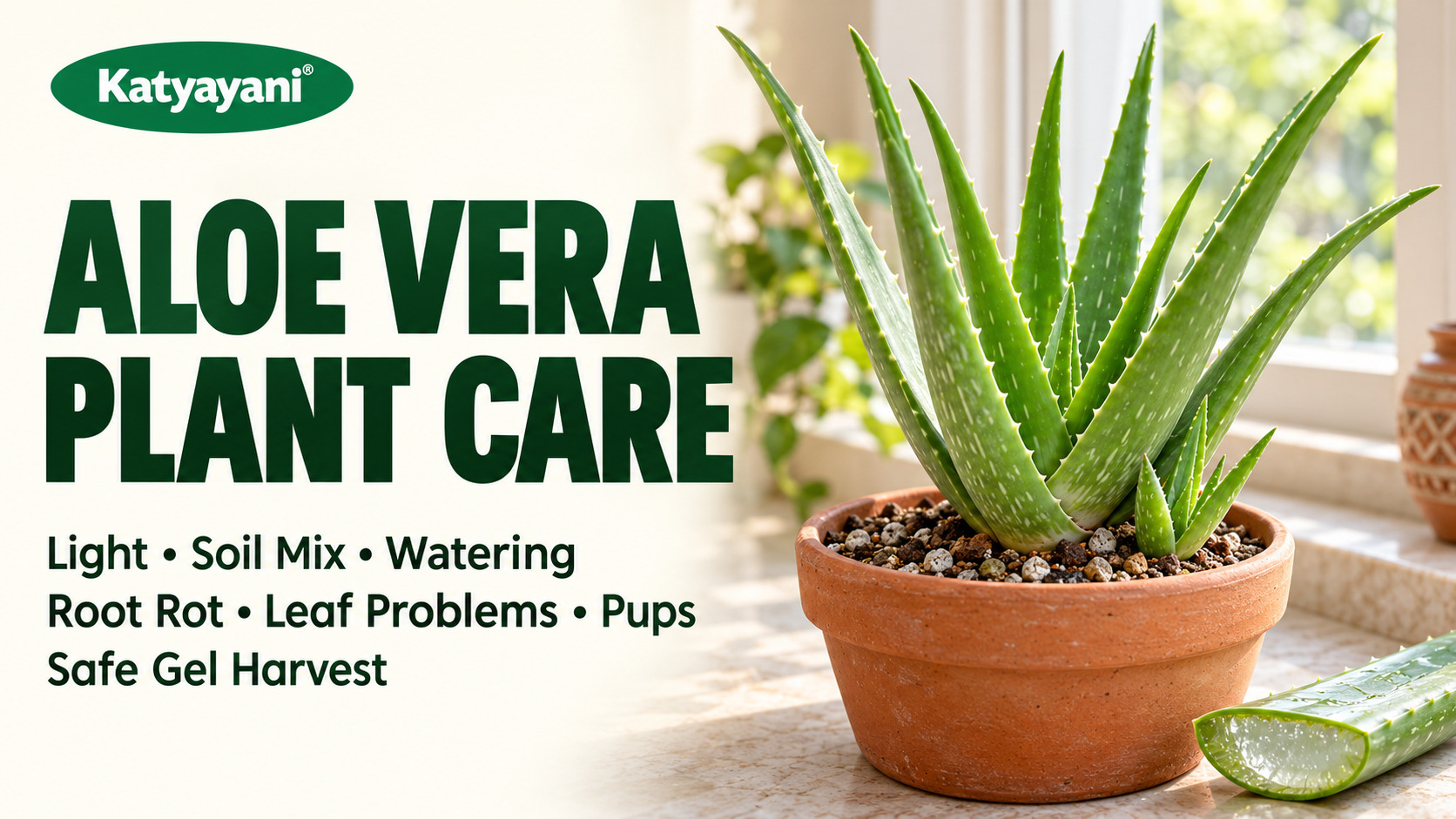
Aloe vera needs bright light, a fast-draining mix and a pot with holes. Water deeply, then wait until the soil has dried out completely before watering again, and water less in winter when the plant slows down. Overwatering and root rot are the main cause of death, and advanced rot has no cure. Repot about every two years and remove pups once they are a couple of inches tall. Do not eat the plant without medical advice.
How do you take care of an aloe vera plant at home? The basics in one table
Give an aloe vera plant bright light, a gritty fast-draining mix, a pot with holes and water only after the soil is fully dry. Keep it above about 10 degrees C and feed it lightly, if at all. Most problems come from too much water, not too little, so when in doubt, wait another few days.
| Need | What the sources say | Source |
|---|---|---|
| Light | Bright, indirect light (SDSU); full to partial sun, near a sunny window (Penn State); south window best, east or west also works (UNH) | SDSU, Penn State, UNH |
| Soil | Sandy soil or cactus mix; or 1 part potting soil, 1 part sand, 1 part perlite or lava rock | SDSU, Penn State |
| Pot | Large drainage hole; clay is best; never leave the pot sitting in a saucer of water | Arizona, NC State, UNH |
| Water | Soak thoroughly, then let the soil dry out completely before watering again; much less in winter | SDSU, Penn State |
| Temperature | 55 to 85 degrees F (about 13 to 29 degrees C); no frost; stress below 50 degrees F (10 degrees C) | SDSU, UNH |
| Feed | Often none needed (SDSU); one light spring feed (Arizona); monthly liquid feed May to August in the UK (RHS) | SDSU, Arizona, RHS |
| Repot | About every two years, into a pot slightly larger | Penn State |
| Pests | Mealybugs, aloe scale, aloe mite, aphids | SDSU, NC State, RHS |
Aloe vera (Aloe barbadensis miller, ghritkumari in Hindi) has thick leaves that store water, which is why it forgives a missed watering far more easily than a flooded one. Keep that one idea in your head and most of the guide below will make sense.
How much light does aloe vera need?
Aloe vera needs bright light for most of the day. SDSU Extension says bright indirect light; Penn State says full to partial sun; UNH says a south-facing sill is perfect and an unobstructed east or west window also works. Too little light gives a leggy plant with weak leaves, and too much sun can turn the leaves brown.
Let the plant guide you. A stretched plant with drooping leaves wants more light. Brown patches on the side facing the glass or the sun mean it is getting more than it can handle.
- Turn the pot every week or two. Penn State advises rotating the container so every side gets light, otherwise the plant leans.
- Low light: Penn State says grow lights are a good option where natural light is poor. Without enough light the plant stretches, and SDSU says the leaves droop.
- Too much sun: PlantVillage warns that too much sun turns the leaves brown, so do not move a plant from a dim spot straight into the strongest light.
What is the best soil for aloe vera? A cactus mix recipe you can make
Aloe vera needs a coarse, fast-draining mix. Penn State Extension gives a homemade recipe of 1 part potting soil, 1 part sand and 1 part perlite or lava rock. A bought cactus or succulent mix also works. Plain garden soil or heavy potting soil stays wet too long and invites root rot.
| Mix | Recipe | Source |
|---|---|---|
| Penn State homemade mix | 1 part potting soil + 1 part sand + 1 part perlite or lava rock | Penn State Extension |
| Arizona mix | Good commercial potting mix with extra perlite, granite grit or coarse sand added, or a packaged cactus mix | University of Arizona |
| SDSU | Sandy soil or a pre-mixed cactus potting medium | SDSU |
| RHS | Peat-free cactus compost, or peat-free loam-based compost with added horticultural grit | RHS |
A packaged cactus or succulent mix saves the trouble of blending your own. Whichever route you take, the aim is the same: coarse, gritty material that lets water run straight through.
The TNAU farming page for aloe says the plant can grow in anything from sandy coastal soil to loam, tolerates pH up to 8.5 and is sensitive to waterlogged conditions. For pots, the waterlogging point is the one that matters. Our post on terrace garden soil mix explains how to build a free-draining base for the rest of your containers.
Which pot is best for aloe vera, and how big should it be?
Use a pot with at least one drainage hole, preferably a large one. NC State recommends several holes and says clay is best. Choose a size only slightly larger than the root ball, as Penn State advises.
- Drainage: UNH says a well-drained mix helps only if the container has at least one drainage hole. Arizona asks for a large hole.
- Clay: NC State says clay is best.
- Saucer: UNH says never let the plant sit in a saucer of standing water. Empty the saucer after watering.
- Size: Penn State says repot into a pot slightly larger, leaving 1 to 1.5 inches (2.5 to 3.8 cm) between the root ball and the pot edge, with the leaves just above soil level.
How often should you water aloe vera?
Water aloe vera deeply, then wait until the soil is completely dry before the next watering. Go by the soil, not the calendar, and water less in winter when the plant slows down.
PlantVillage gives a useful way to check: let the soil dry down 7.5 to 10 cm (3 to 4 inches) for an older, established plant, or 3.5 to 5 cm (1 to 2 inches) for a young one. Push a finger or a dry wooden stick in. If it comes out damp or dark, wait. Penn State's split is simple: in the growing season, from early spring to early fall, water thoroughly when the soil surface is dry; from fall through winter, reduce watering so the soil is barely moist and the leaves do not shrivel.
| When | What the plant is doing | How to water | Source |
|---|---|---|---|
| Growing season (early spring to early fall) | Actively growing | Water thoroughly when the soil surface is dry | Penn State |
| Fall through winter | Growth slows | Reduce watering so the soil is barely moist and the leaves do not shrivel | Penn State |
| Winter | Slows down or goes dormant | Reduce watering | SDSU |
| Older, established plant | Any time | Let the soil dry down 7.5 to 10 cm (3 to 4 inches) before watering | PlantVillage |
| Young plant | Any time | Let the soil dry down 3.5 to 5 cm (1 to 2 inches) before watering | PlantVillage |
| Every watering | Roots need air | Never leave the pot standing in a saucer of water | UNH |
Soak the soil until water runs out of the drainage hole, then empty the saucer. SDSU adds that aloe needs no extra humidity, so skip misting.
How can you tell overwatering from underwatering?
Look at the leaf and the soil together. Overwatered aloe has soft, mushy, brown or translucent leaves on wet soil. Underwatered aloe has thin, wrinkled, puckered or yellowing leaves on dry soil. SDSU says an underwatered plant recovers once watered again; a plant sitting in water risks root rot.
| Sign | Overwatered | Underwatered |
|---|---|---|
| Leaf feel | Soft, squishy, waterlogged | Thin, wrinkled, puckered |
| Leaf colour | Brown, dark, translucent, or yellow and soft | Yellow and shrivelled, tips browning (SDSU) |
| Soil | Wet or damp long after watering | Dry |
| Fix | Stop watering; check roots; repot into dry mix | Water thoroughly; SDSU says the plant recovers once watered |
To decide, push a finger or a dry stick into the soil as described above. Damp or dark on the stick means wait. A dark, soft base is the sign of rot, and the root rot section below tells you what to do.
Why are my aloe vera leaves turning brown, yellow or thin?
Most leaf problems come from water, light or cold. Brown and mushy points to overwatering. Thin, wrinkled and yellow points to thirst. Brown and crispy on the sun side points to too much sun. Brown tips near a window point to cold or draught. Use the table to match what you see.
| What you see | Likely cause | What to do | Source |
|---|---|---|---|
| Soft, mushy, brown or translucent leaves, damp soil | Overwatering, early root rot | Stop watering, unpot, check roots, repot in dry mix | SDSU, NC State |
| Thin, wrinkled, puckered, yellow leaves, dry soil | Too little water | Water thoroughly; plant recovers once watered | SDSU |
| Brown, crispy patches on leaves facing the glass or sun | Too much sun, especially after a sudden move | Move back a little and bring it into strong light gradually | PlantVillage |
| Brown tips, discoloured leaves near a draughty window | Cold stress | Move away from the glass; keep above 10 degrees C | UNH |
| Plant tall, stretched, leaves weak or drooping | Too little light | Move to brighter spot or add a grow light | SDSU, Penn State |
| Yellow spots turning brown, sometimes orange spore masses underneath | Aloe rust (fungus) | Usually no treatment (SDSU); cut off bad leaves and keep conditions less humid | SDSU, PlantVillage |
| Sticky leaves, white cottony bits at the leaf base | Mealybugs | See the pest section | SDSU |
| Dark base, plant collapsing, foul smell | Root or basal rot | See the root rot section | SDSU, PlantVillage |
Yellow leaves can have causes beyond water and light. Our yellow leaves on houseplants chart covers nutrient-related yellowing for houseplants in general. For aloe, which SDSU says usually needs no fertiliser, check water and light first.
One more cause is age. When lower leaves dry up or are removed, the plant does not replace them at the bottom, which is how a tall bare stem forms (Ask Extension).
What causes root rot in aloe vera, and how do you save the plant?
Root rot is caused by soil that stays wet. SDSU says it comes from overwatering and has no treatment once advanced, so catching it early matters. These are the aloe-specific points; the general rescue method for any potted plant is in our root rot in containers guide.
- Look at the roots. The Ask Extension answer describes healthy roots as firm and light-coloured, and says mushy or black roots should be removed.
- Save what is healthy. PlantVillage notes that pieces of a plant with basal rot may be saved by taking cuttings above the rotted part.
- Let cuts seal before planting. Ask Extension says a cutting needs a sealed base and should sit for a day or three before planting. Arizona gives about a week for offsets to dry and scab over.
- Replant in fresh, dry cactus mix in a pot with holes. New roots take time; Arizona says an offset roots in about a month.
Two Fatal Rots: PlantVillage describes two rots that can kill the plant: Fusarium basal stem rot (base turns reddish brown to black, favoured by cold, damp conditions) and bacterial soft rot (watery, darker rotting leaves, favoured by hot, wet weather; avoid overwatering). If the whole base is black and soft, cuttings from healthy tissue above the rot are the way to keep the plant going.
Why are aloe vera leaves soft and mushy?
Soft, mushy leaves point to overwatering. SDSU describes overwatered aloe as soft and mushy and warns that a plant sitting in water risks root rot. Stop watering and check the roots; if the base is dark and soft as well, follow the root rot points above.
Then check the pot. UNH says a well-drained mix helps only if the container has at least one drainage hole, and that the plant should never sit in a saucer of standing water. Fix the pot and the mix, or the problem comes back.
Does aloe vera need fertiliser?
Usually very little. SDSU says no fertiliser is typically needed, because the plant grows naturally in poor soil. Arizona suggests one light application of indoor plant fertiliser in spring. RHS suggests a general liquid feed monthly from May to August in the UK. If you feed, go light.
If you prefer an organic option for that one light feed, Katyayani's enriched vermicompost is a fully decomposed, odourless product suitable for home gardening. Aloe is a low feeder, so keep it light.
When and how should you repot aloe vera?
Repot about every two years, according to Penn State. Pick a pot only slightly larger, leaving 1 to 1.5 inches (2.5 to 3.8 cm) around the root ball. Use fresh cactus mix and set the leaves just above the soil.
- Slide the plant out, shake off old soil and trim any dead or black roots (Ask Extension).
- Place it in the new pot with leaves just above the soil level, as Penn State advises.
- Fill with fresh cactus mix and press lightly. Do not pack it.
- Let any cut surfaces seal for a day or three (Ask Extension) before watering. Then water thoroughly and return to the dryness rule.
How do you propagate aloe vera from pups?
Aloe vera spreads by pups, small plants that grow around the base. Arizona Extension says to remove them once they are a couple of inches tall, cut with a clean sharp knife, let the wound dry and scab over for about a week, then plant in fresh mix. It roots in about a month.
- Choose a pup that is a couple of inches tall with several sets of leaves (PlantVillage).
- Free the pup. Tip the plant out and find where the pup joins the mother. Cut it away with a clean, sharp knife, as Arizona describes.
- Dry the wound for about a week (Arizona) until it scabs over.
- Plant in a small pot of gritty mix. PlantVillage advises watering deeply once and then holding back so the plant is pushed to make roots.
- Keep it in bright light and check the mix before every watering.
RHS suggests separating offsets in spring or early summer. Seed is possible, but Arizona says it is slow and works best in greenhouse conditions, so for a home grower pups are the practical route. TNAU's farming page also describes root suckers as the usual way to multiply the crop in India. A mature aloe flowers on a tall spike once it is at least three years old (NC State) and needs enough light to do so (UNH).
What pests and diseases attack aloe vera?
The common pest is the mealybug, which hides at the leaf base and leaves sticky honeydew. Aloe scale, aloe mite and aphids also occur. Diseases are aloe rust, leaf spot and the rots. A well-drained mix and good air movement help keep a home plant healthy.
| Problem | What it looks like | What to do | Source |
|---|---|---|---|
| Mealybugs | White cottony clusters at the leaf base, sticky honeydew, sooty mould | Insecticidal soap can be used; follow the label | SDSU, NC State |
| Aphids | Clusters at leaf bases and rolled leaf ends, honeydew | Insecticidal soap and keeping natural enemies | PlantVillage |
| Aloe rust | Pale yellow spots turn brown; orange spores underneath; cool, humid weather | Self-limiting, usually needs no treatment | SDSU, PlantVillage |
| Anthracnose or leaf spot | Water-soaked spots becoming tan or brown with a reddish edge, in warm wet weather | Remove spotted leaves; keep water off the leaves | PlantVillage, NC State |
| Basal stem rot, soft rot | Dark, rotting base or watery leaves | Take cuttings from healthy tissue | PlantVillage |
For hand removal, soap sprays, sticky traps and the rest of the toolkit that applies to any pot plant, see our organic pest control for home gardens guide. Identify the pest first, then pick the control.
If you are thinking about neem oil, read our neem oil in the home garden post first for the correct dilution and when not to use it.
How do you care for aloe vera in the monsoon and other wet weather?
In wet, humid weather, water only when the soil has dried and never let the pot stand in water. SDSU links aloe rust to cool, humid conditions, and PlantVillage says bacterial soft rot is favoured by hot, wet weather. A pot that never dries invites root rot.
- Check before every watering. Use the dryness rule, even when the air is damp.
- Empty the saucer after rain or watering (UNH).
- Keep the drainage basics: a pot with holes, a gritty mix and, if you can, clay (NC State).
- Watch for rust and a soft base. Pale yellow spots turning brown are aloe rust and usually self-limit (SDSU). A soft, dark base is the sign to act.
If the plant is in a ground bed, TNAU describes aloe as sensitive to waterlogged conditions, so choose a spot where water drains away.
How do you care for aloe vera in winter?
In winter, aloe slows down. SDSU says it goes dormant, so reduce watering. Penn State says keep the soil barely moist so leaves do not shrivel. Keep it in bright light, away from cold glass and draughts, and above 10 degrees C.
- Water sparingly. Check the soil depth before watering.
- Keep it warm enough. UNH says aloe should not be grown in a room that dips below 50 degrees F (10 degrees C); drafty windows can discolour leaves and damage tips.
- Bring pots inside before frost. SDSU says aloe cannot tolerate frost, and Arizona says to bring outdoor pots in before the first fall freeze.
- No extra humidity needed. SDSU says the dry winter air in a home suits it, so skip misting.
Our post on indoor plant care in winter covers general winter care for the rest of your houseplants.
Is aloe vera edible, and is it safe for children and pets?
The leaf gel is used on skin, but the plant is not a casual snack. RHS marks Aloe vera as harmful if eaten and advises gloves when handling. SDSU says ingesting large quantities can cause nausea and indigestion. NC State rates it low-severity poisonous to people and a problem for cats, dogs and horses.
NCCIH explains why. Aloe products come from three parts: the gel (inner leaf), the latex (a layer just beneath the outer skin) and the whole crushed leaf. Taken by mouth, the latex can cause abdominal pain, cramps and diarrhoea. The US FDA required aloe latex to be removed from over-the-counter laxative products in 2002 because of a lack of safety data. NCCIH adds that oral use is unsafe in pregnancy and breastfeeding, and that people on medicines such as digoxin should talk to a doctor first.
| Question | What the sources say | Source |
|---|---|---|
| Is the plant harmful if eaten? | Yes: harmful if eaten (RHS); nausea and indigestion in quantity (SDSU) | RHS, SDSU |
| Poison rating | Low severity for people; a problem for cats, dogs and horses | NC State |
| Latex | Layer under the outer skin; oral use can cause cramps, diarrhoea | NCCIH |
| Gel on skin | Generally well tolerated, with occasional burning, itching or rash | NCCIH |
| Gel by mouth | Studies suggest short-term use up to 42 days is safe, but leaf extracts have been linked to cases of hepatitis | NCCIH |
| Pregnancy and breastfeeding | May be unsafe by mouth; consult a doctor | NCCIH |
Ghritkumari is widely used as a home remedy, so people often ask whether the leaf can be eaten. The sources above caution against eating it. If you want to take it by mouth, speak to a doctor and use a product made for that purpose, not a leaf cut at home.
The safest approach for a home with small children or pets is to put the pot out of reach and not leave cut leaves on the counter. The advice here applies to Aloe vera (Aloe barbadensis miller).
How do you harvest aloe vera gel safely?
Cut one mature outer leaf at the base with a clean knife, slice it open and scoop out the clear gel. Arizona describes using it for minor burns and insect bites. Use the gel on skin only, and do not eat it without medical advice.
- Pick a mature leaf. PlantVillage notes that harvest comes from the older outer leaves. Arizona describes cutting a mature leaf about 1 inch wide for minor burns and insect bites.
- Cut close to the stem with a clean, sharp knife and leave the centre leaves to keep growing.
- Slice and scoop the clear gel. Arizona says to slice the leaf and apply sap directly; if more is needed, slice again and squeeze.
- Keep the yellow latex out of your mouth. NCCIH describes the latex as a layer just beneath the outer skin, and says swallowed latex can cause abdominal pain, cramps and diarrhoea.
- Use the gel on skin only. NCCIH notes occasional burning, itching, rash and eczema from topical aloe.
Arizona says medical research has not validated many of the believed properties of aloe, and advises seeing a physician before using it for more than a cut, burn or insect bite. NCCIH says small studies suggest topical gel may help burns and some skin problems when combined with other treatment. Treat the gel as a simple home remedy for minor skin issues, not as a medicine.
Why is my aloe vera plant tall, leaning or not growing?
A tall, leaning aloe with a bare stem and widely spaced leaves is usually short of light. A plant that does not grow is either dormant in winter, root-bound, over- or under-watered, or in a small pot that has run out of room. Check light, roots and season before changing anything else.
- Leaning toward the window: rotate the pot every week or two (Penn State) and move it to brighter light.
- Long bare stem: the lower leaves have dried off and the plant has grown from the top. Ask Extension suggests cutting 2 inches below the last healthy leaf, letting the cut seal, and replanting.
- No growth in winter: normal. SDSU says it goes dormant.
- No growth in the growing season: check for roots filling the pot, a soggy mix or tired soil. Repot if it has been about two years.
- No flowers: a mature plant, at least three years old (NC State), with enough bright light (UNH), may flower. Do not expect flowers from a young plant on a dim sill.
- Slow in general: our post on why plants grow slowly goes through the common causes in more depth.
PlantVillage says the plant takes 4 to 5 years to mature. If yours is small and young, patience is part of the answer.
What are the most common aloe vera mistakes?
| Mistake | Why it hurts | Do this instead |
|---|---|---|
| Watering on a fixed schedule | Soil may still be wet; root rot follows | Check dryness first; use the finger test |
| Pot with no drainage hole, or water left in the saucer | Roots sit in water (UNH) | Use a pot with holes; empty the saucer |
| Heavy garden soil or all-purpose potting mix | Holds water too long | Use cactus mix or 1:1:1 potting soil, sand and perlite |
| Oversized pot | Penn State advises a pot only slightly larger | Go up only 1 to 1.5 inches in width |
| Misting the leaves | SDSU says no extra humidity is needed | Skip misting |
| Moving a plant straight into the strongest sun | Leaves brown (PlantVillage) | Avoid sudden strong sun |
| Leaving it in a cold draught | Leaf tips discolour; stress below 10 degrees C (UNH) | Move away from cold glass |
| Eating the leaf without advice | Latex can cause cramps and diarrhoea (NCCIH) | Use gel on skin only; ask a doctor about oral use |
Conclusion
Aloe vera rewards a gardener who does less. Give it bright light, a gritty mix and a pot with holes, water deeply only when the soil is completely dry, and cut watering back in winter. Catch soft, mushy leaves early, remove rotten roots and replant in dry mix. Repot about every two years, take pups when they are a couple of inches tall, and treat the gel as a skin remedy, not food, unless a doctor says otherwise.
Questions Farmers Ask
How often should I water my aloe vera plant?
What is the best soil for aloe vera?
Why is my aloe vera turning brown and mushy?
Can an aloe vera plant with root rot be saved?
Does aloe vera need direct sunlight?
How do I repot aloe vera and how often?
How do I separate and replant aloe vera pups?
Why are my aloe vera leaves thin and wrinkled?
How do I take care of aloe vera in winter?
What pests attack aloe vera?
Is aloe vera safe to eat or toxic to pets?
How do I harvest aloe vera gel safely?

Microbiologist
Microbiologist at Katyayani Organics. MSc in Microbiology, 2.6 years of experience.
View all authors

Leave a Comment