 14 min read
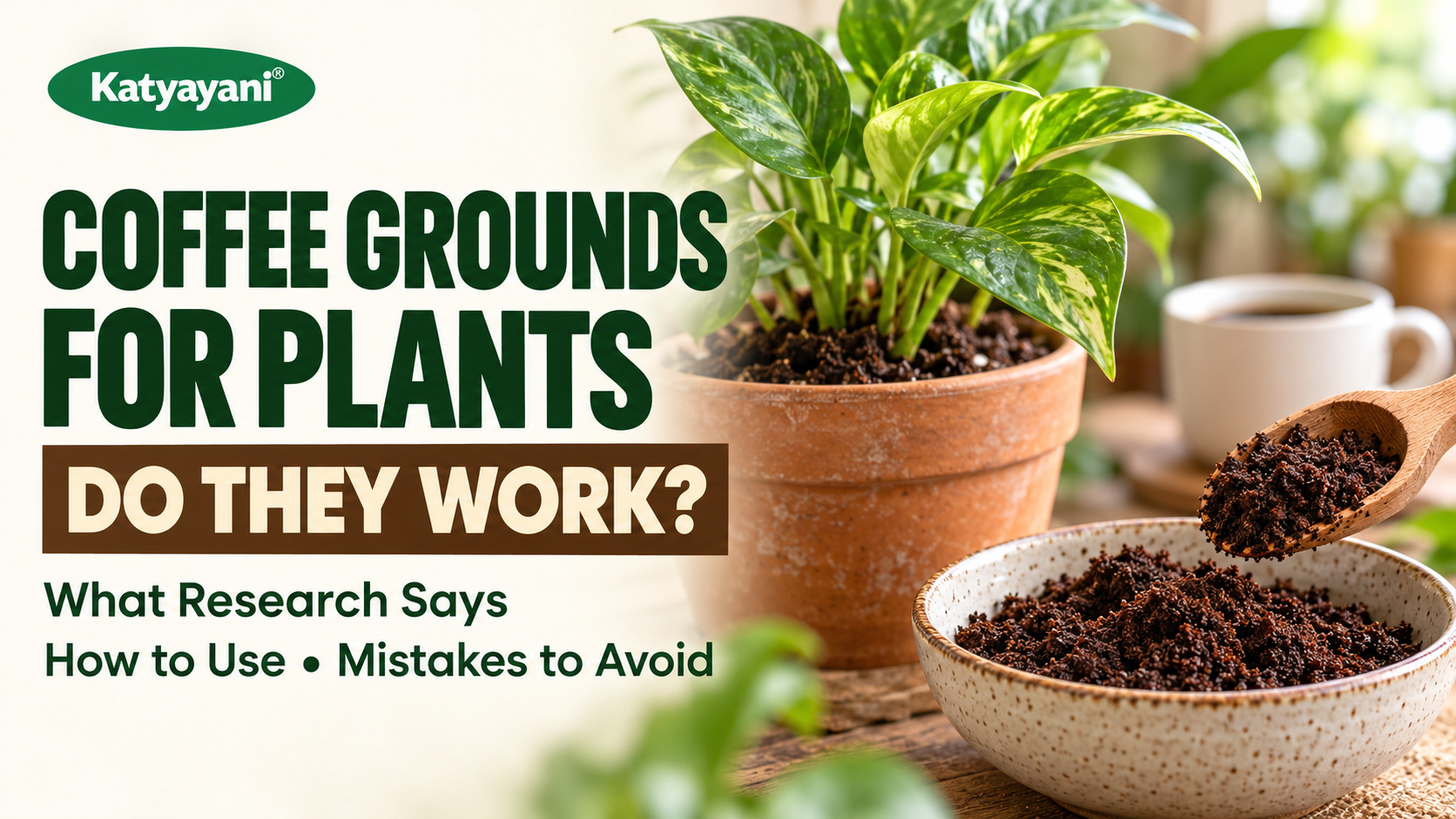
Used coffee grounds can help, but not as a quick fertiliser. They hold only about 1 to 2 percent nitrogen, and most of it is locked up until microbes break the grounds down. Oregon State and Washington State extension say the best use is in compost, kept to no more than 20 percent of the pile by volume. Used grounds are near neutral (pH 6.5 to 6.8), so they will not acidify soil. If you put them straight on soil, use about half an inch mixed into the top 4 inches, never a thick layer, and never where you are sowing seeds.
Do coffee grounds work as fertiliser for plants?
Only in a limited way. Used coffee grounds contain roughly 1 to 2 percent nitrogen and small amounts of potassium, phosphorus, calcium and magnesium, but Oregon State Extension says this is not enough to meet plant needs. Their real value is improving soil structure and feeding soil microbes, ideally after composting.
Search any gardening forum and you will find people swearing that coffee grounds turned their plants green overnight. Extension scientists do not back that. Oregon State Extension puts the nitrogen at about 1 to 2 percent, notes only minor amounts of the other nutrients, and says the main benefit is soil improvement: microbes feeding on the grounds release compounds that bind soil particles into stable crumbs, which helps drainage.
There is a catch. While microbes digest raw grounds they pull nitrogen out of the soil for themselves. Oregon State says breakdown temporarily ties up soil nitrogen and suggests adding a nitrogen-rich material such as composted manure, alfalfa meal or grass clippings to offset it. A University of Illinois Extension educator quoted in an Ask Extension answer makes the same point: nitrogen content alone does not make grounds a usable fertiliser, because microorganisms must break them down first.
In short, they help the soil more than they feed the plant, and they work best when composted. If your plants look pale, the cause is usually something else, and our yellow leaves nutrient deficiency chart is a better first stop than a spoon of grounds.
What do coffee grounds actually contain?
Used grounds keep part of the bean: protein (over 10 percent by weight, per WSU), oils, cellulose, lignin, phenolic compounds and a little caffeine. Among minerals, potassium is usually the largest, followed by phosphorus, magnesium and calcium. The carbon-to-nitrogen ratio starts near 25 or 26 to 1 and falls to about 10 to 1 as they break down.
| Item | What the source says | Source |
|---|---|---|
| Nitrogen | About 1 to 2 percent; not enough to meet plant needs | Oregon State Extension |
| Other nutrients | Potassium, phosphorus, calcium, magnesium; trace iron, copper, manganese, zinc | Oregon State Extension |
| Protein, oils, lignin, caffeine | Protein over 10 percent by weight; oils, cellulose, lignin, phenolics and small amounts of caffeine remain | WSU Extension |
| Largest mineral | Potassium, then phosphorus, magnesium, calcium | WSU Extension |
| Carbon to nitrogen ratio | About 25 to 26 : 1 at the start, about 10 : 1 after months of decomposition | WSU Extension |
That ratio is why timing matters. Raw grounds are still carbon-rich enough to starve plants of nitrogen for a while. Once bacteria and fungi have worked on them for several months outdoors, the proteins and caffeine break down and the nitrogen becomes usable. That is the whole reason extension services say to compost first.
Are coffee grounds acidic, and will they lower soil pH?
No. Used coffee grounds are close to neutral, about pH 6.5 to 6.8 according to Oregon State, and WSU says experiments found values from mildly acidic to somewhat alkaline. The acid in coffee mostly stays in the cup. Any pH change in the soil is small and temporary, so grounds will not make soil acidic for blueberries.
This is the most repeated myth in gardening, and it is worth being blunt about it. Oregon State names rhododendrons, azaleas, blueberries, gardenias and blue hydrangeas as the plants people hope to help, and says used grounds will not acidify soil enough to matter. WSU adds that the pH of grounds is unstable and any change stays in the small area right around them.
Fresh, unbrewed ground coffee is a different matter and should not be treated as a soil amendment at all, as the next sections explain. If your real problem is soil that is too alkaline or too acidic for the plant you are growing, test it and fix it properly. Our post on soil pH and nutrient lock explains how pH changes what a plant can take up.
Used or fresh coffee grounds: which is safe for plants?
Use only used (brewed) grounds, and preferably composted ones. WSU says fresh grounds are phytotoxic to many plants and are not recommended as an amendment or mulch. Oregon State warns that excess grounds put on soil before composting can suppress germination and slow growth because of caffeine residues (the same advice appears in the Oregon State news version of the story).
| Type | Safe for plants? | Best use |
|---|---|---|
| Used grounds, composted for months | Yes | Mix into soil or potting mix in small amounts |
| Used grounds, added to a compost pile | Yes, up to 20 percent of the pile by volume | Main recommended route |
| Used grounds, straight onto soil | Only a little, mixed in; risk of crust, mould and slow growth | Half an inch worked into the top 4 inches, with extra nitrogen |
| Fresh unbrewed ground coffee | No | Not recommended as an amendment or mulch (WSU) |
| Pure grounds as a mulch | Not advised | Cover with leaves, bark or wood chips if used at all |
There is lab and field evidence behind this caution. In a 2016 study by Hardgrove and Livesley, reported on the University of Melbourne research profile, broccoli, leek, radish, viola and sunflower were grown in three soil types with and without spent coffee grounds. The paper title states that applying grounds directly to urban agriculture soils greatly reduces plant growth. The authors suspected a toxic stress response, and soil pH alone did not explain the result.
How do you use coffee grounds in compost?
Add them as a green, nitrogen-bearing layer and keep them to no more than 20 percent of the pile by volume. Oregon State's recipe is 3 parts leaves, 1 part fresh grass clippings and 1 part grounds. Turn the pile weekly, watch the moisture, and expect finished compost in about 3 to 6 months.
Grounds are one of the easiest kitchen wastes to compost because they are fine and break down quickly. The Ask Extension answer quoting Illinois Extension gives a simple 1 : 1 : 1 mix of grounds, dry material such as leaves, and green material such as grass clippings. It also notes that composting heats the pile, which helps kill weed seeds and pathogens. Texas A&M AgriLife says grounds have a high enough carbon content that composting them needs no special additives.
- Mix, do not dump. A thick layer of wet grounds packs down and goes slimy. Spread them thinly and mix with dry leaves, shredded paper or cardboard.
- Let them cool first. WSU says hot grounds can kill beneficial microbes, so cool them before adding.
- Filters are fine. Oregon State says paper coffee filters can go in the pile.
- Mould on stored grounds is harmless in compost. Oregon State says mould that grows on grounds kept in a covered container is simply composted along with them. Tip it into the pile rather than throwing it out.
- Ratio check. If your bucket holds one cup of grounds a day, pair it with several cups of dry leaves or shredded cardboard so grounds stay at or below one fifth of the volume.
A practical habit makes the ratio easy: keep a lidded tub by the kitchen sink for each day's grounds, and empty it into the compost bin every few days along with a good handful of dry leaves or shredded cardboard. This keeps smell and fruit flies down, and it stops grounds piling up into a wet, slimy layer.
For a balcony or terrace where a full heap is not practical, a lidded bin with dry leaves or cocopeat on top works. If you want to speed it up, a compost activator can help. Katyayani lists Dekumpose, a compost activator designed to speed up the breakdown of organic waste, including cellulose and lignin. Follow the pack for the amount.
How do you apply coffee grounds directly to garden soil or pots?
Use a little and mix it in. Oregon State's rule is about half an inch of grounds worked into the top 4 inches of soil, with a nitrogen source added to offset the temporary lock-up. That is roughly 1.3 cm into 10 cm. Do not leave grounds as a thick layer on the surface.
In practice, half an inch spread across a bed is a thin dusting, not a cup poured round the stem. In a pot, start with a light sprinkle that you mix into the top few centimetres with a fork. Texas A&M warns against thick surface layers, which form a crust, and suggests working them a couple of inches into the soil or adding them to compost.
| Method | Amount | Source | Watch out for |
|---|---|---|---|
| Worked into garden soil | About half an inch of grounds mixed into the top 4 inches | Oregon State | Add a nitrogen source such as composted manure or alfalfa meal |
| Surface use with nutrients low | No more than half an inch of composted grounds, then about 4 inches of coarse mulch such as wood chips | WSU | Get a soil test first; skip if nutrients are already good |
| In compost | No more than 20 percent by volume | Oregon State, WSU | Cool grounds first |
| Mulch under leaves or bark | Thin layer, covered | Oregon State | Bare grounds dry out and repel water |
| In potting mix | Use composted grounds in small amounts only | WSU Extension | Start with a light sprinkle and watch the plant |
WSU's advice to get a soil test first is worth following. If your nutrients are already optimal or high, there is no reason to add grounds. Our guide to a terrace garden soil mix that drains and feeds shows where small amounts of composted material belong in a pot mix.
Can you use coffee grounds as mulch?
Only in a thin layer and covered. Oregon State says to cover grounds with leaves or bark mulch so the surface does not dry out and repel water. WSU says to avoid thick layers of grounds alone because they compact and restrict moisture and air, and advises that if nutrients are low you apply composted grounds, then about four inches of coarse mulch.
A bare layer of coffee grounds behaves badly. The fine particles pack together, the top dries into a crust, and water runs off instead of soaking in. Under a cover of dry leaves, bark or wood chips, the same grounds stay damp and break down. Think of them as a seasoning on top of a proper mulch, not as the mulch itself.
WSU points out that grounds, like other good mulches, moderate soil temperature and help hold water, and that earthworms eat them. Those benefits only show up when the layer is thin enough to let air and water through. For general mulching rules, depth and material choices, see our guide on the benefits of mulching and how much to apply.
How much coffee grounds is safe, and how often can you use them?
Go small and infrequent. Use the published limits: up to 20 percent of a compost pile, or about half an inch worked into the top 4 inches of garden soil. For pots, start with a light sprinkle mixed in once, and wait a few weeks to watch the plant.
Oregon State warns that it has seen raised beds ruined by too much coffee. That is the real risk: a gardener who adds a cupful every day for months builds up a layer that stunts everything growing in it.
| Situation | Safe starting point (from published limits) | Practical tip |
|---|---|---|
| Compost pile | Up to 20 percent by volume | One part grounds to at least four parts other material |
| Garden bed | About half an inch mixed into the top 4 inches | Occasionally, not weekly |
| Potted plant | Mix composted grounds into the potting mix in small amounts | A light sprinkle mixed into the top soil, then watch the plant for a few weeks |
| Seed trays and seedlings | WSU: do not use where sowing seeds | None |
If a plant slows down, stop adding grounds and flush the pot with plain water. Our post on why plants grow slowly lists other causes to rule out.
Which plants like coffee grounds, and which plants dislike them?
The form and amount of grounds matter more than the plant. Composted grounds in small amounts are low risk for most garden plants, while fresh or thick grounds are risky for seedlings and young plants. Acid-loving plants gain nothing extra from the acidity idea.
| Plant group | What the sources say | Practical tip |
|---|---|---|
| Acid-loving plants (blueberry, azalea, gardenia, blue hydrangea) | Oregon State: used grounds will not acidify soil enough to help | Use a proper acidifying method and a soil test instead of grounds |
| Seedlings and newly sown seeds | WSU: do not use where sowing seeds; Oregon State: caffeine residues can suppress germination | Keep grounds away from seed trays and young transplants |
| Vegetables in beds (tomato, chilli, brinjal) | Hardgrove and Livesley 2016: growth fell when grounds were applied directly | Use only composted grounds, mixed into the bed before planting |
| Lawn | Texas A&M: turf research found spent grounds may improve fertiliser performance and may rival peat moss as an amendment | Thin dusting only |
| Houseplants | WSU: thick layers restrict air and moisture movement | Prefer composted grounds in a potting mix over a top dressing |
The label "plants that love coffee grounds" on many lists matters less than the form and amount of the grounds: composted, small and mixed in beats fresh, thick and on top for nearly any plant.
Are coffee grounds good for tomato and chilli plants?
Not as a direct feed. Tomato and chilli need steady nitrogen, potassium and calcium, and raw grounds temporarily lock nitrogen away. Extension research found direct application can reduce growth. If you want to use them, compost the grounds first and mix a small amount into the soil before planting, not around seedlings.
The Hardgrove and Livesley trial used broccoli, leek, radish, viola and sunflower, not tomato or chilli, and found direct application cut growth, so the safe approach for tomato and chilli is the same: composted, small, and never on seedlings. If you grow chillies in containers, our guide to growing chillies in pots covers a sound feeding plan, and the winter kitchen garden feeding schedule shows how to space compost and liquid feed.
One extra point from the Illinois Extension answer: the educator suggests a small trial first. If you want to test, try one pot, not your whole terrace.
Are coffee grounds good for roses and flowering plants?
Composted grounds in small amounts are safe for roses, but they are not a bloom booster. Roses want regular nitrogen, potassium and good drainage, which a thin dusting of grounds will not supply. Treat grounds as a soil conditioner that you mix in or compost, not as rose food.
Many pages claim that grounds make roses bloom more because roses "like acid". That reasoning falls apart on the pH point above. If you want to use grounds around roses, work a small amount of composted material into the top few centimetres, add your normal rose feed, and keep the grounds off the stem.
Can you put coffee grounds on houseplants?
Be careful. A top dressing of raw grounds in a pot forms a crust, holds water at the surface and can grow mould. Composted grounds mixed into potting mix in small amounts are the safer choice. For most houseplants, a regular potting mix and a proper feed work better.
Houseplants sit in a small volume of soil with no earthworms and little airflow, so mistakes show up faster than in a garden bed. WSU warns that thick layers of grounds restrict air and moisture movement, and Oregon State notes that bare grounds can dry out and repel water. In a pot that means water running down the sides and missing the roots. If the top of your pot looks dark, damp and fuzzy, scrape the layer off. Our guide to root rot in containers shows what too-wet roots look like.
Do coffee grounds repel slugs, ants and other pests?
Scattered grounds are not a proven pest control. WSU found no published evidence that grounds repel or kill garden pests, and Texas A&M AgriLife yard trials found little or no effect on fire ants. The slug research Oregon State cites is about caffeine solutions sprayed or drenched, not dry grounds on the soil surface.
Here is what Oregon State reports from the research it cites: a 1 to 2 percent caffeine soil drench made slugs leave the soil and die, and a 2 percent caffeine solution killed 95 percent of snails in orchid growing medium and did better than a metaldehyde slug bait. Its suggested home recipes are 1 part water to 2 parts strong brewed coffee as a soil drench, and 9 parts water to 1 part brewed coffee as a leaf spray. Oregon State says to test on a few leaves and check for burn after several hot, sunny days.
If you try a coffee spray, test it on a few leaves first, since strong coffee can scorch them. For slugs, ants, aphids and whitefly in a home garden, our organic pest control for home gardens post lists methods with a better record, and the neem oil dilution guide covers the common spray.
Can you use coffee grounds in a worm bin?
Keep coffee grounds out of worm bins. WSU Extension says they can injure or kill worms, so feed the worms your other kitchen scraps and put the grounds in a compost pile instead.
Worms are sensitive to what goes into the bin, and a bin fed heavily on any one waste can turn sour. Compost the grounds in an outdoor pile or a lidded bin with dry leaves, then use the finished compost in your pots.
If you want finished worm compost, Katyayani sells enriched vermicompost made with red wiggler worms and suitable for home gardening; follow the pack for the amount.
What are the common mistakes when using coffee grounds?
The big ones are using too much, using it thick on the surface, using it fresh, and using it near seedlings. Each has a source behind it: crust and mould, caffeine residues, nitrogen lock-up and growth loss. Almost every bad result people report comes from one of these four.
| Mistake | Why it hurts | Do this instead |
|---|---|---|
| A thick layer of grounds on the soil | Forms a crust, repels water, grows mould (Oregon State, Illinois Extension answer, Texas A&M) | Mix a little in or compost it; keep any surface layer thin and covered |
| Daily cupfuls into the same pot | Raised beds have been ruined by too much (Oregon State) | Save grounds for compost; add to soil rarely and lightly |
| Using fresh, unbrewed grounds | Phytotoxic to many plants (WSU) | Use brewed grounds only |
| Putting grounds near seedlings | Caffeine residues can suppress germination and slow growth (Oregon State, WSU) | Keep grounds away from seed trays and young transplants |
| Expecting acid-loving plants to benefit | Used grounds are near neutral (Oregon State) | Test soil pH and use a proper method |
| Skipping extra nitrogen | Microbes tie up nitrogen while breaking grounds down (Oregon State) | Add composted manure, alfalfa meal or grass clippings |
| Adding hot grounds to compost | Heat can kill beneficial microbes (WSU) | Let grounds cool first |
| Using grounds as a pest barrier | No published evidence of repellence (WSU); little effect on fire ants (Texas A&M) | Use methods with a track record |
Most bad results come from habit rather than plant choice. A cup of grounds poured on the same pot every morning adds up quickly, and the layer that builds is what blocks air, holds water at the surface and stunts the roots underneath. Saving the grounds for the compost bin avoids the problem completely.
If your soil already has a high level of nutrients, WSU says not to add grounds at all. A soil test costs little and removes the guesswork.
What about mould, crust and smell: how do you fix them?
Scrape off the layer, let the pot dry a little, and stop adding grounds to the top. White or grey fuzz on wet grounds is common mould; Oregon State says mould on stored grounds is harmless in compost. In a pot, though, it signals a layer that is too thick and too wet and is blocking air.
- Remove the grounds layer with a spoon, taking the top 1 to 2 cm of soil with it if it is matted.
- Let the surface dry before the next watering. Do not water on a schedule; check the soil first.
- Mix a little dry, loose material such as cocopeat or coarse sand into the top layer if it has compacted.
- Move the discarded grounds to a compost bin, where mould is harmless.
- If the plant is wilting even though the soil is wet, check the roots, as in our post on root rot in containers.
Store your daily grounds in a sealed container, as Oregon State suggests, or dry them on a tray in the shade for a day before adding them. Dry grounds are easier to mix in with other compost material.
Can caffeine in coffee grounds harm seedlings and other plants?
Yes, in the right conditions. Oregon State says excess grounds applied to soil before composting can suppress germination and slow growth because of caffeine residues, and WSU says not to use grounds where you are sowing seeds. Composting and ageing the grounds breaks down much of the caffeine and the other plant-toxic compounds.
WSU states that proteins and caffeine in grounds break down quickly during decomposition, which is why composted grounds behave so differently from fresh ones. The practical result: never put grounds in a seed tray, never sprinkle them around a just-transplanted seedling, and do not use them on a bed within the few weeks before you sow.
Indian context: what to do with filter coffee grounds
Grounds from South Indian filter coffee are used grounds, so the same limits apply: compost first, keep amounts small and never use a thick layer. Instant coffee leaves no grounds at all, so there is nothing to compost.
After brewing, filter coffee leaves a wet, spent residue. Dry it thinly on a tray or newspaper in shade before it goes into a compost bin; in monsoon humidity wet grounds mould quickly.
| Kitchen waste | Guidance | How to use it |
|---|---|---|
| Used coffee grounds (filter or brewed) | Up to 20 percent of compost, thin when used directly | Compost first; dry on a tray if damp |
| Instant coffee residue | No grounds to reuse | None |
What can you use instead of coffee grounds?
If you want a reliable boost for pots and beds, use well-made compost or vermicompost and a balanced plant feed. These supply nutrients in a form plants can use now, unlike raw grounds. Compost made partly from your own grounds, kept below the 20 percent ceiling, is the best way to use the grounds themselves.
For home gardens in India, finished compost or worm compost improves soil structure and adds microbes without the lock-up risk. Katyayani's enriched vermicompost is suitable for both organic farming and home gardening; it has organic matter of 30 to 40 percent. If you need to understand when a liquid or a granular feed makes more sense, our post on water-soluble vs granular fertiliser compares them.
Conclusion
Coffee grounds are a modest soil helper, not a miracle fertiliser. Oregon State, Washington State and Texas A&M agree on the core rules: use brewed grounds only, compost them first, keep them to no more than 20 percent of a compost pile, and use only a thin amount when mixing directly into soil. They will not acidify soil, they do not reliably repel pests, and a thick layer can hurt your plants. Start with one pot or one corner of your compost, watch for a few weeks, and keep your regular feeding plan.
Questions Farmers Ask
Are coffee grounds good for plants?
Do coffee grounds make soil acidic?
How much coffee grounds can I put on my plants?
Should I use fresh or used coffee grounds?
Can I put coffee grounds directly on soil?
Do coffee grounds repel slugs and ants?
Are coffee grounds good for tomato plants?
Can you put coffee grounds in a compost bin?
Can coffee grounds go in a worm bin?
Why do coffee grounds grow mould on my plant?
Are coffee grounds good for houseplants?
How long do coffee grounds take to break down?

Microbiologist
Microbiologist at Katyayani Organics. MSc in Microbiology, 2.6 years of experience.
View all authors

Leave a Comment