 17 min read
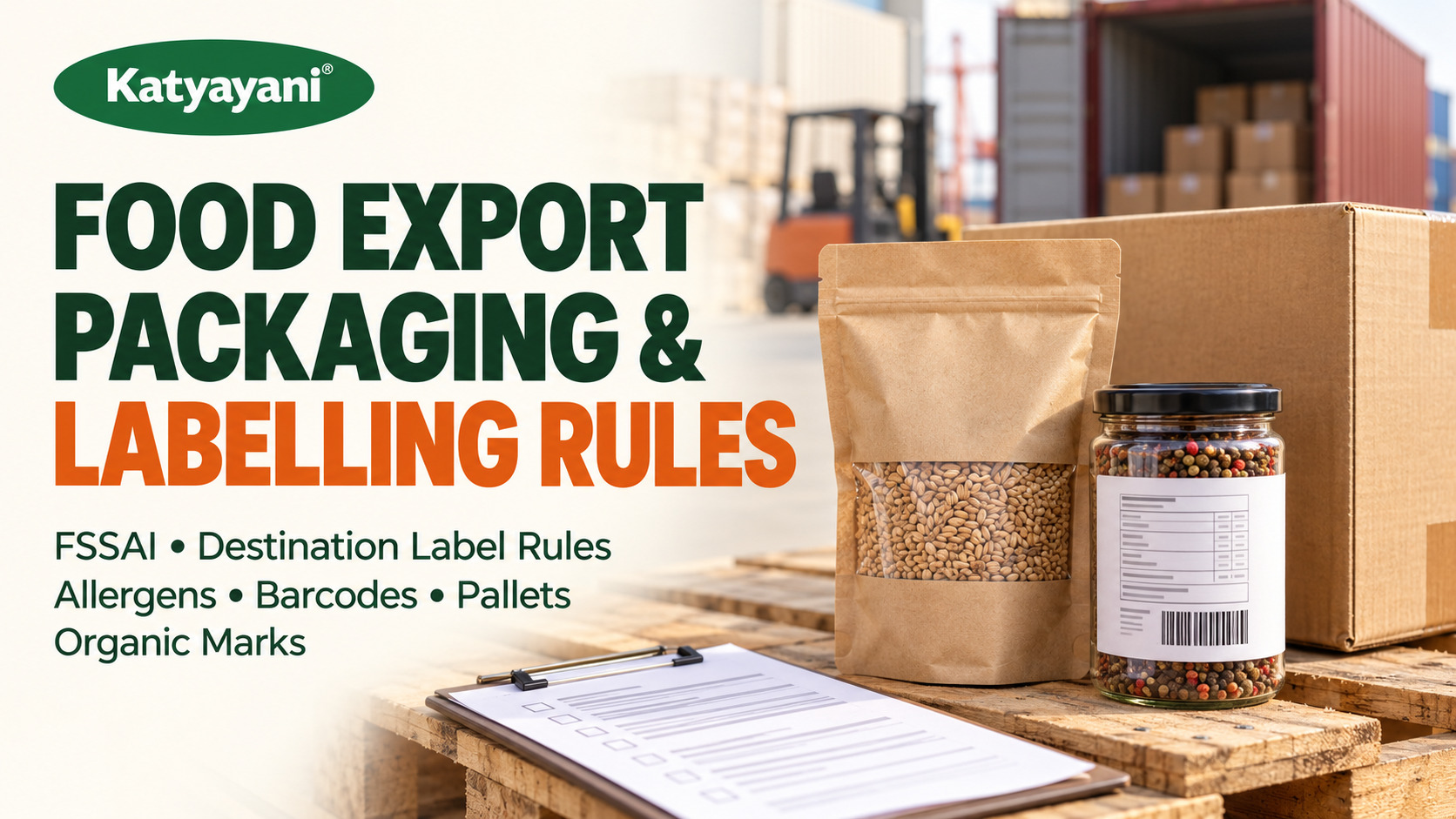
An export food pack carries two sets of rules. India expects the exporter to hold the right FSSAI licence and to check FSSAI and Export Inspection Council requirements for the product. The label content itself is set by the buyer country: EU rules, US FDA rules, Japanese-language labels, or Arabic labels for Saudi Arabia. Wooden pallets need an ISPM 15 mark, organic goods need the correct organic logo, and a barcode helps retail listing. Confirm every artwork with the importer before printing.
What are the packaging and labelling requirements for food exports from India?
Two sets of rules apply. India asks an exporter to hold the right FSSAI licence and to meet the inspection rules for the product. The content of the label, the language, the allergen list and the pack material are mostly set by the country that buys the food.
That second half surprises most first-time exporters. A pack that is perfectly legal in an Indian shop can be held at a European port because the allergen is not highlighted, or in Japan because the nutrition panel is only in English. So the real job is not to copy an Indian label. It is to ask the importer for the destination rules in writing, then build the artwork around them.
This guide walks through the Indian side first, then the main destination markets, then the pack, pallet and container, and ends with rejection causes and a checklist. Country rules are given at summary level and tied to regulator pages. Confirm the current text with your importer before printing.
What does India require on the label of an exported food product?
An exporter needs the right FSSAI licence for the kind of business (manufacturer or trader/merchant). Beyond that, check FSSAI and Export Inspection Council requirements for your product and destination. The label itself must first satisfy the importing country's food law, so the buyer's rule decides the content.
In practice an Indian exporter checks four things before printing. Is the licence valid and does it match the business that is actually exporting? Does the product fall under any inspection or certification scheme? What does the importer require on the label? And does the information on the pack match the invoice, the packing list and the licence details?
| Point | What to do | Why |
|---|---|---|
| Exporter licence | Keep a valid FSSAI licence copy for the business that exports, whether manufacturer or trader/merchant | Ports, buyers and auditors ask for it |
| FSSAI and EIC requirements | Check FSSAI and Export Inspection Council requirements for your product and destination | Rules differ by product category |
| Standards to meet | Ask the importer for the destination label rule in writing | The buyer's food law decides the label |
| Manufacturer or packer details | Print them if the contract or the destination rule asks for them | Many markets expect operator or packer details on the pack |
| Indian retail label | Do not assume an Indian retail label is enough for export | Destination language, allergen and date rules often differ |
If you ship from more than one port, ask your CHA or the local FSSAI authorised officer how requirements are applied at that port, and keep the answer in the shipping file.
Who inspects export food, and where do EIC and APEDA fit in?
The Export Inspection Council (EIC) and its Export Inspection Agencies run inspection and certification schemes. APEDA registers exporters of scheduled agri products and publishes packaging specifications. The EIC fruit scheme checklist asks whether packaging is non-toxic and food grade and whether labels meet national and importing-country requirements.
The EIC Certification Scheme for Fruit Products (CSFP) executive instructions set out an audit checklist. Its audit checklist has lines that apply to any packed food business. Packaging materials must be non-toxic and food grade. Labels must be as per the requirements of the national or importing country. Packaged products must carry a label with the information needed to handle, store and process them safely and to trace and recall a lot or batch. Containers and conveyances must keep the right temperature and humidity and must not carry non-food goods that could contaminate the load.
That document is an older scheme document (2011-12 issue), so use it as a picture of what inspectors look for. Whether inspection is mandatory or voluntary depends on the product, so ask your nearest Export Inspection Agency. For the registration side, read our IEC code for agri exporters guide, which covers the APEDA RCMC link.
APEDA's Packaging Standards page lists a Report on Technical Specification on Packaging for Fresh Fruits and Vegetables (24 July 2023), a Specifications of Packing document (2016), a Report on Development of Export Pack for Dehydrated and Freeze Dried Vegetables (2016) and Packaging Specifications for Exports of Guar Gum (2023). Download the one for your product and follow its carton and pack specifications.
What must an EU food label show?
For prepacked food sold in the EU, Regulation 1169/2011 requires the name of the food, ingredients, allergens, net quantity, a date of minimum durability or use-by date, storage and use conditions, the name and address of the food business operator, origin where omission could mislead, and a nutrition declaration.
The summary below follows the Food Safety Authority of Ireland page on Food Information to Consumers. Confirm any detail with your importer and the current regulation, and note that the UK has its own version of the rules.
| Mandatory particular | Detail from the FSAI summary |
|---|---|
| Name of the food | Must sit in the same field of vision as the net quantity |
| List of ingredients | In descending order of weight |
| Allergens | Any Annex II substance used in making the food and still present, even if altered; names as in Annex II and visually distinguished in the ingredient list (bold, italics or background colour) |
| Quantity of certain ingredients | Where an ingredient is emphasised or named in the food name |
| Net quantity | Same field of vision as the name of the food |
| Date of minimum durability or use-by | No longer required in the same field of vision |
| Storage and conditions of use | Special conditions, if any |
| Operator name and address | Name or business name and address of the food business operator |
| Country of origin or place of provenance | Where omission could mislead the consumer, or where specific legislation requires it |
| Instructions for use | Where the food would be hard to use properly without them |
| Alcoholic strength | Beverages above 1.2 percent ABV |
| Nutrition declaration | Mandatory on prepacked food since 13 December 2016, with exemptions |
In practice the EU importer is the "operator" whose name and address must appear when the food is placed on the market, so agree with your buyer whether the importer details are printed or stickered on arrival. Ask your importer which languages are needed for each country where the pack will be sold.
Which allergens must be declared, and how does the list differ by market?
The EU lists 14 allergens. The US lists nine major allergens, with sesame added from 1 January 2023. Japan makes eight mandatory. The lists overlap but are not identical, so a pack for several markets must carry the union of what each market asks, written the way each market wants it written.
| Market | Mandatory allergens | Source |
|---|---|---|
| EU | 14: cereals containing gluten, crustaceans, eggs, fish, peanuts, soybeans, milk, tree nuts, celery, mustard, sesame seeds, sulphur dioxide and sulphites above 10 mg per kg or litre, lupin, molluscs | FSAI summary of Annex II |
| United States | 9: milk, eggs, fish, crustacean shellfish, tree nuts, peanuts, wheat, soybeans, sesame | US FDA |
| Japan | 8 mandatory: shrimp/prawn, crab, walnuts, wheat, buckwheat, egg, milk, peanuts; 20 more are recommended | Tokyo Metropolitan Government |
Look at what is missing. Celery, mustard, lupin, molluscs and sulphites are EU allergens but not on the US list. Buckwheat and walnuts are on the Japanese list. A spice blend with mustard or celery seed, a very common Indian export, needs the allergen highlighted for Europe even if the US label would be silent. Sulphites matter for dried fruit and some pickles.
How you write it matters as well. The EU wants allergen names as in Annex II, visually distinguished in the ingredient list. The FDA wants each allergen source named at least once, either in brackets after the ingredient (for example "whey (milk)") or in a "Contains" statement; tree nuts, fish and crustacean species must be named. Japan advises checking secondary ingredients, cross-contact during manufacture and allergens in additives.
What does the US FDA require for imported food packs and labels?
Imported food must follow FDA labelling law, with text in English. Most foreign food manufacturers and packers must register their facility with FDA (renewed every two years), FDA must receive prior notice before the shipment is offered for import, and the US importer must run a Foreign Supplier Verification Program (FSVP) for you.
These points come from the FDA Importing Human Foods page. Labelling is needed for most prepared foods, such as cereals, snacks, canned and frozen foods and drinks. Nutrition labelling is voluntary for raw produce and fish. Dietary supplements have their own rules. FDA examines shipments and collects samples to check labelling, and at entry it compares the information you submit against its own data, so a mismatch can lead to a request for more information or a detention.
- Registration. Your facility number and the information in the registration should match what the importer and broker file.
- Prior notice. Filed before arrival, normally by the importer or broker. Give them correct product, manufacturer and shipper details.
- FSVP. The US importer must verify that you have adequate preventive controls, so expect questions or an audit request from the buyer.
- Language. English. The FDA page notes that in US territories where another language predominates, that language may be used.
For the statement of identity, net content and country-of-origin marking on a US pack, ask your US importer or customs broker for the requirement on your product.
What do the UK, Japan and Saudi Arabia ask for?
The UK has its own food information rules, separate from the EU's. Japan needs Japanese labels and date in year-month-day form. Saudi Arabia needs Arabic, or an Arabic translation, with the product name, packer, country of origin, ingredients and shelf life.
United Kingdom
The UK applies its own food information rules, so an EU label should not be assumed to be UK-ready. Get the current Food Standards Agency guidance and your UK importer's checklist before you finalise artwork. The common elements are the same as elsewhere: product name, ingredients, allergens, net quantity, dates, origin and the operator or importer details.
Japan
The Tokyo Metropolitan Government page says food sold in Japan, including imported food, must be labelled in Japanese, and food with nutrition information only in a foreign language cannot be sold. Required items include product name, ingredients, additives, date and storage method. Nutrition information covers calories, protein, fat, carbohydrate and sodium shown as salt equivalent. Dates are written year-month-day as an expiration date or best-before date. The example label shows the seller and the manufacturer with addresses.
Saudi Arabia
The US Commercial Service guide says prepackaged food needs Arabic, or an Arabic translation on the label. It lists the product name, packer's name, country of origin, ingredients by predominance, end-use instructions where applicable and shelf life. Country of origin can be in Arabic or English and must be permanent. Fresh meat and poultry need production and expiry dates, metric weight, storage temperature and a halal slaughter attestation. Each shipment of meat or poultry needs a halal certificate from a body accredited by SFDA, and pork and pork-derived ingredients such as lard, gelatin or rennet are banned. Confirm the date format with your buyer.
For other destinations the method is the same: ask the importer for the label standard, check it against the regulator page, and have the importer sign off the final artwork.
How should the shelf life, batch number and dates be printed?
Print a durability date the way the buyer country writes it, add a batch or lot number that you can trace to the production record, and add storage conditions. Japan wants year-month-day. The EU wants a date of minimum durability or a use-by date and storage conditions. Saudi Arabia requires shelf life on prepackaged food.
The EIC checklist is blunt about why: packaged products must carry information that lets the lot or batch be traced and recalled if needed. So the batch code on the pack, the batch code on your packing list and the batch code in your production record should be the same string. If an importer calls about a complaint six months later, that one match decides how much of the shipment is pulled. Even in India, buyers are told to check licence, label and batch details, as in our guide on what to check before buying agricultural products online; a clear batch code on your pack answers the same question for an overseas buyer.
- Pick one date format per market and keep it fixed on the artwork, not typed by hand on the line each day.
- Do not print a date you cannot defend. Keep shelf-life test or stability records for the product and the pack material.
- Keep storage text consistent with the actual pack, for example the same temperature on the label and on the container thermostat instructions.
- Check that ink-jet coding survives cold, damp and abrasion for chilled lines.
Do you have to print "Made in India" and a country of origin?
Origin marking depends on the destination. Saudi Arabia lists country of origin as mandatory on prepackaged food and wants it permanent, in Arabic or English. In the EU origin is mandatory where leaving it out could mislead the consumer, or where specific legislation requires it. For other markets, check the importing country rule, and print Made in India in English as a safe default.
Experienced exporters usually print "Product of India" or "Made in India" on the consumer pack and on the outer carton, because customs, buyers and retailers all look for it. Check how the buyer wants it worded: for a blend or a processed product, "Made in" and "Product of" can mean different things to different regulators.
Do not confuse the pack mark with the origin certificate. A certificate of origin is a trade document. Our guide to exporting agrochemicals shows the general shape of export paperwork, which is similar in outline for food.
How do you get a barcode (GS1) for export packs?
Register with GS1 India, the only authorised provider of barcodes starting with 890 in India, to get product numbers (GTINs). Retail chains and online marketplaces in India and abroad often ask for them. The page says barcodes from unauthorised sellers should be avoided.
According to the GS1 India website, its barcodes scan anywhere, are accepted internationally, and it also offers GS1 Digital Link QR codes and Data Matrix. Businesses that want to sell through retail chains or e-commerce marketplaces need GTINs. Use the GS1 India registration pages for fees and the company prefix steps.
A few practical points follow. Give each pack size and each variant its own GTIN. Print the barcode on the consumer unit and on the outer carton (the carton barcode uses a different number from the unit inside). Check with the buyer which format they scan. And if you pack for a private-label customer, ask who owns the GTIN, because the number belongs to the brand owner, not the packer.
Which packaging materials are allowed for food exports?
Food contact material must be non-toxic and food grade, and the EIC checklist says so in as many words. Beyond that, each market has its own migration limits and plastic rules. Ask the pack supplier for a food-contact declaration and the test report for the market you are shipping to.
| Pack layer | What to check | Who can give you the proof |
|---|---|---|
| Inner pouch, liner or tray | Food-grade, non-toxic, suitable for the temperature and moisture of the product | Pack supplier's food-contact declaration and test report |
| Printed film or label ink | Ink and adhesive should not transfer to the food | Printer and film supplier |
| Carton or outer case | Strength for stacking in a container; clean; odour free | Carton maker's strength test |
| Wooden pallet, crate or dunnage | ISPM 15 mark, or exempt material | Treatment provider authorised by the plant protection authority |
| Strapping, wrap, desiccant, oxygen absorber | Not in contact with food unless approved; mark if present | Supplier declaration |
Rule of thumb from experience: keep every pack-material document in one folder per SKU. When a buyer, auditor or port officer asks, you can answer in minutes instead of days. Migration limits and plastic rules differ by destination, so ask the pack supplier for the test report for your market.
What are the rules for wooden pallets and crates (ISPM 15)?
Wood packaging used in international trade must be treated and marked under ISPM 15. Heat treatment needs a minimum of 56 degrees C for at least 30 continuous minutes throughout the wood, including its core. The mark must contain the IPPC symbol, the country code, the producer or treatment provider code and the treatment code (HT, DH, MB or SF).
These details are from the IPPC ISPM 15 text (2018 version with Annexes 1 and 2). The mark must be legible, durable and not transferable, and placed where it is visible when the packaging is in use, preferably on at least two opposite sides. It must not be hand drawn, red and orange should be avoided because they are used for dangerous goods, and the shape is a rectangle or square with a border and a vertical line between the symbol and the code. Marking must always be under the authority of the national plant protection organisation.
| Item | ISPM 15 position |
|---|---|
| Treatments in Annex 1 | Heat treatment (HT), dielectric heating (DH), methyl bromide (MB), sulphuryl fluoride (SF) as listed in the mark codes |
| Heat treatment parameter | Minimum 56 degrees C for at least 30 continuous minutes throughout the profile, including the core |
| Exempt from the standard | Packaging made entirely of thin wood (6 mm or less), wood packaging made wholly of processed wood such as plywood, particle board, OSB or veneer, barrels for wine and spirit that were heated during manufacture, and some gift boxes |
| Who applies the mark | Producers or treatment providers authorised by the plant protection authority |
| Mark position | Visible, preferably on at least two opposite sides |
For an Indian exporter the practical advice is simple. Buy pallets and crates only from a supplier who can show you the authorisation and treatment records, check that the mark is clear on both sides, and keep the supplier invoice with the shipping file. Plastic and plywood pallets are exempt from the ISPM 15 mark, which is why many exporters of light cartons choose them. Our post on the phytosanitary certificate explains the separate certificate for the produce itself; the pallet mark does not replace that certificate.
How should fruit and vegetables be packed for export?
Fresh produce is packed in a registered packhouse, normally in corrugated cartons designed for the product, and moved under a controlled temperature. APEDA publishes a technical specification report for fresh fruit and vegetable packaging and product-wise brochures, so use those rather than a generic box. Follow their carton and ventilation specifications for your crop.
APEDA's Packaging Standards page lists the 2023 report on technical specification for packaging of fresh fruits and vegetables. The EIC fruit scheme checklist requires non-toxic food-grade packaging, labels as per the importing country, traceable lot or batch information, and conveyances that keep the required temperature and humidity. Add the plant health side, which is covered in the phytosanitary certificate post, and you have the main control points. Residue limits and approved pesticides also differ by destination; our pesticide registration by country comparison of EU, USA, Brazil, India and Africa shows how far national rules can differ.
| Stage | What to control | How to prove it |
|---|---|---|
| Harvest and receipt at packhouse | Grade, maturity, pesticide-use records, clean crates | Farm records, receiving log |
| Packing | Right carton and liner for the crop, clean hands and tools, lot code on every carton | Packing record linked to the lot code |
| Cooling and storage | Temperature and humidity set for the product | Temperature log (the exact set-point comes from the buyer or the APEDA product guidance) |
| Loading | Pre-cooled container, even stacking, no loose cartons | Container temperature record and photos |
| Documents | Phytosanitary certificate and lot match the carton markings | Cross-check before sealing |
One experience-based tip: take photos of the packed pallet, the labels, the container interior and the sealed door with the seal number. They cost nothing and settle most disputes about damage after arrival.
How do you label organic products for export?
Only use an organic logo when the lot is certified under the scheme the buyer country accepts. For India, that is the NPOP. For the EU, the European Commission says the EU organic logo can only be used on products certified organic by an authorised control agency or body, and imported organic food is subject to control procedures.
The APEDA NPOP page carries the India Organic logo and links the NPOP Regulation, 8th Edition (2024) and Procedures 2024. The European Commission organics page covers the EU logo. Read together, they mean the pack should show the correct logo, the certification body, and the details your certificate allows. Our NPOP vs PGS guide for export buyers explains why PGS produce cannot be exported as organic.
Check Before Printing: Organic logo and wording rules differ by destination and can change. Before you print organic artwork, download the current logo files and rules from the APEDA NPOP page and ask your certification body which logo and wording are allowed for your destination.
What are shipping marks, and what goes on the outer carton?
Shipping marks identify the consignment: consignee or buyer reference, destination, carton number, gross and net weight, country of origin and handling symbols. Match them to the invoice and packing list. Saudi Arabia, for example, asks for gross weight, the consignee's initials or name, consecutive numbering of multi-container shipments and country of manufacture on containers.
The Saudi list comes from the US Commercial Service guide. For other markets, the list below is practical advice from common export practice. Confirm with your importer and freight forwarder.
- Consignee and destination, as on the invoice.
- Carton count and number (for example 7 of 120).
- Product name, lot number and net and gross weight.
- Country of origin and the shipper's name.
- Handling marks, for example "keep dry" or "this way up", and a temperature mark for chilled or frozen lines.
- Barcode on the carton if the buyer's warehouse scans it.
The most common error is a mismatch between the carton print and the shipping papers: different spelling of the buyer name, a changed lot code or a different net weight. Print the marks from the same data file that creates the invoice and packing list.
How do you palletise and load a container?
Build stable pallets with the heaviest cartons at the bottom, stretch wrap the stack, and keep the stack inside the pallet edge. Use an ISPM 15 marked or exempt pallet. Match the container type (dry or reefer) to the product, and check the container is clean, dry and odour free before loading.
Pallet height and container load limits depend on the buyer, the shipping line and the container type. The EIC checklist expects that conveyances and containers must be adequately maintained to keep the required temperature, humidity and conditions, and must not be used for anything that could contaminate food. Ask your forwarder for the container's maximum payload and your buyer for any pallet height or footprint limit.
- Inspect the container first. Floor, walls, door seals, odour and moisture. Reject a container that smells of chemicals or earlier cargo.
- Do not mix food with chemicals or strongly scented goods in the same container.
- Use corner boards and strapping so cartons do not crush at the pallet edge.
- Fill voids with dunnage or air bags so the load does not shift.
- Photograph the load before sealing and record the seal number.
What are the most common reasons export food shipments get rejected?
Most rejections come from label content that does not match the importing country rule, a missing allergen, wrong language, a mismatch between the registration and the shipment data, unmarked wood, or an organic claim without valid certification. All of these are avoidable if the buyer approves the artwork and documents before printing and loading.
| Cause | Where it shows up | What to do |
|---|---|---|
| Label only in English or only in an unaccepted language | Japan (labels must be in Japanese), Saudi Arabia (Arabic or Arabic translation for prepackaged food) | Add the required language or a compliant sticker if the buyer confirms it is acceptable |
| Allergen missing or not highlighted | EU, US, Japan | Use the union of allergen lists and the market's declaration style |
| Registration mismatch | US FDA compares entry data against its records | Make facility name, address and registration data identical across documents |
| No ISPM 15 mark on wood | Any ISPM 15 market | Use marked or exempt pallets and keep treatment records |
| Organic claim without valid certificate or logo | EU and other organic markets | Print organic claims only on certified lots |
| Origin or batch mismatch with documents | All markets | Print from the same data as the invoice and packing list |
| Non-food-grade pack material | All markets | Obtain supplier food-contact declarations |
| Meat or poultry without halal paperwork | Saudi Arabia | Get the accredited halal certificate for each shipment |
Each cause above is avoidable with a signed-off artwork and a cross-check of pack, papers and pallet before loading.
Export packaging and labelling checklist before you ship
| Check | Done when | Where this is covered above |
|---|---|---|
| FSSAI licence for your business type is valid | Licence copy in the file | India label section |
| FSSAI licence details and any marking required for your product are on the consumer pack | Artwork checked | India label section |
| Importer has supplied the destination label rule in writing | Email or checklist saved | Destination sections |
| Name of food, ingredients, net quantity, date, storage and operator details match the buyer's rule | Importer approved the final artwork | EU, US, Japan and Saudi sections |
| Allergens declared using the union of all target-market lists | Allergen matrix signed by QA | Allergen section |
| Language(s) and sticker plan agreed | Buyer confirmed | UK, Japan and Saudi sections |
| Batch code identical on pack, packing list and production record | Sample cross-check done | Shelf life section |
| Country of origin printed as the buyer requires | Artwork checked | Origin section |
| GTIN allocated for each SKU and carton | GS1 certificate saved | Barcode section |
| Food-contact declarations for all pack layers | Folder per SKU | Materials section |
| Pallets and crates carry ISPM 15 mark or are exempt | Photo of the mark on two sides | ISPM 15 section |
| Organic logo used only on certified lots | Certificate and transaction record matched | Organic section |
| Shipping marks match invoice and packing list | Printed from one data file | Shipping marks section |
| Container inspected; load and seal photographed | Photos saved with seal number | Container section |
| Phytosanitary certificate matches the lot (fresh produce, plant products) | Cross-checked | Fruit and vegetables section |
Save this table as your standard operating checklist for every shipment. Add a column for each buyer country when you start shipping to a second market, and use the same file when you hire a new packing supervisor. If you also ship agri-inputs, our Indian agrochemical export market overview covers the demand side.
Conclusion
Export packaging and labelling rules come down to one habit: let the buyer country decide the label, let India decide the licence and the logo, and keep one set of data behind every printed word. Hold the right FSSAI licence, check FSSAI and EIC requirements, ask the importer for the destination label rules in writing, use the union of allergen lists, mark every wooden pallet under ISPM 15, use organic logos only on certified lots, and photograph the load. Confirm every rule with your importer before you print.
Questions Farmers Ask
What are the packaging and labelling requirements for food exports from India?
Do I need an FSSAI licence to export food from India?
Should an export label show the manufacturer or packer details?
What must be on an EU food label?
How many allergens must be declared for the EU, US and Japan?
Do US imports need English labels and FDA registration?
Do I need a barcode to export food?
Do wooden pallets for export need a special mark?
Is "Made in India" mandatory on export food packs?
What language should an export food label be in?
How do I label organic food for export?
Why do export food shipments get rejected for packaging or labels?

Microbiologist
Microbiologist at Katyayani Organics. MSc in Microbiology, 2.6 years of experience.
View all authors

Leave a Comment