 20 min read
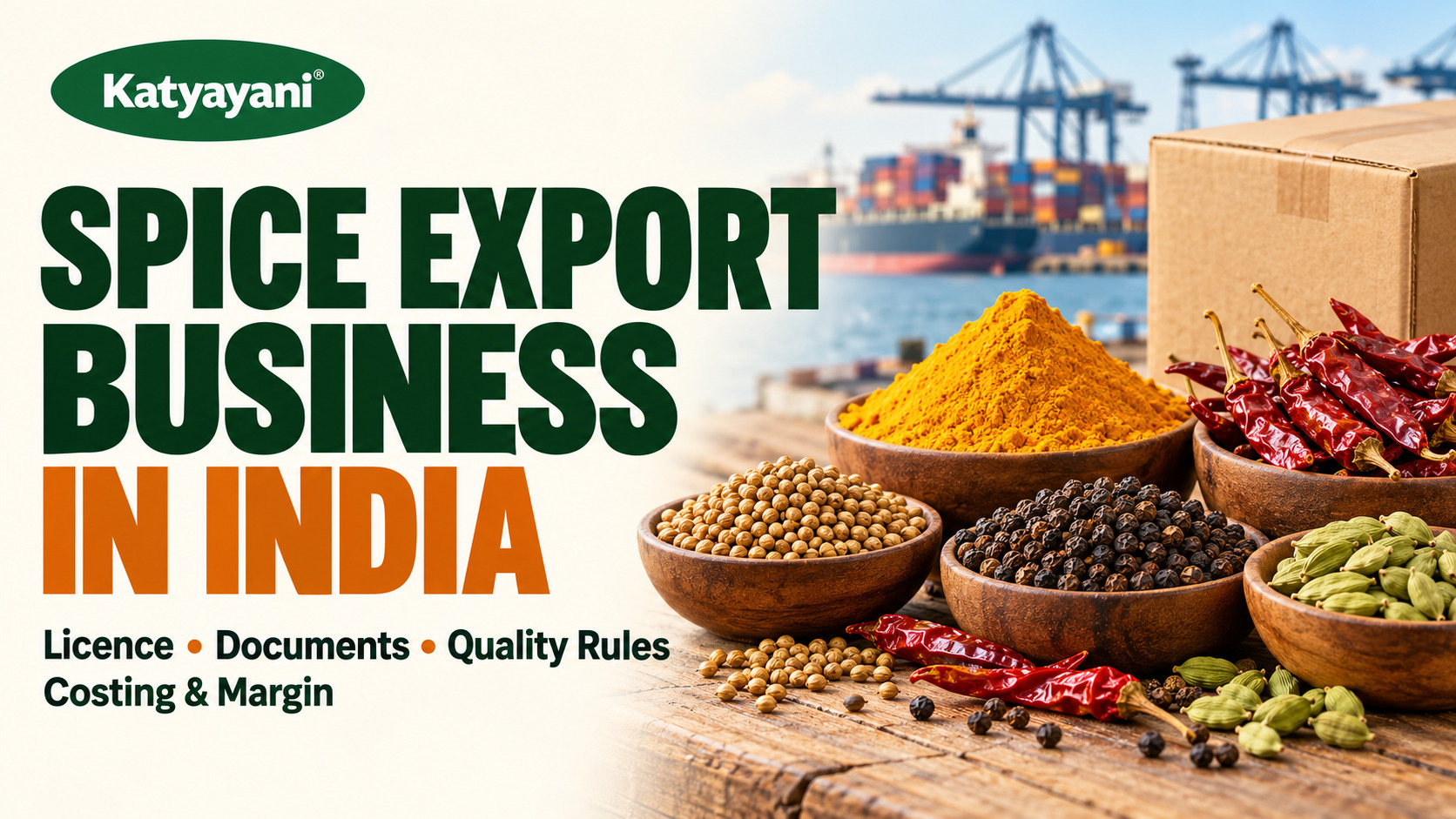
A spice export business needs an IEC from DGFT, a Spices Board CRES (Certificate of Registration as Exporter of Spices), a GST registration and a yearly GST LUT, plus FSSAI and a unit inspection if you process the spice yourself. India exported 17.34 lakh tonnes of spices worth Rs 39,140 crore (US$ 4.43 billion) in 2025-26, down from 17.99 lakh tonnes and US$ 4.72 billion the year before. The hard part is not the licence. It is passing buyer tests for ethylene oxide, Salmonella, aflatoxin and pesticide residue. Margins on plain whole spices are thin and depend on your own costing, so the costing section below gives a framework you can fill with real quotes.
How big is the spice export business in India, and which spices and countries lead?
India exported 17.34 lakh tonnes of spices and spice products worth Rs 39,140.11 crore (US$ 4,430.90 million) in 2025-26, according to the Spices Board export statistics. That is 4 percent less in volume and 6 percent less in dollars than 2024-25, when the Board reports 17.99 lakh tonnes, Rs 39,994.48 crore and US$ 4,722.65 million.
The Ministry of Commerce backgrounder gives a different dollar figure for the earlier year: US$ 4.45 billion for FY 2024-25 (PIB, May 2025). Use the Board figures when you quote a year, and write the source next to the number.
| Item | Share of export value, 2025-26 | Source |
|---|---|---|
| Chilli | 27 percent | Spices Board |
| Cumin | 12 percent | Spices Board |
| Spice oil and oleoresins | 12 percent | Spices Board |
| Small cardamom | 9 percent | Spices Board |
| Mint products | 8 percent | Spices Board |
| Turmeric | 7 percent | Spices Board |
| Curry powder and paste | 6 percent | Spices Board |
| Ginger and pepper (together) | 3 percent | Spices Board |
| Coriander | 2 percent | Spices Board |
| Destination | Share of export value, 2025-26 |
|---|---|
| USA | 14 percent |
| China | 12 percent |
| UAE | 9 percent |
| Bangladesh | 8 percent |
| Saudi Arabia | 5 percent |
| UK, Thailand, Malaysia, Indonesia | 3 percent each |
| Sri Lanka, Germany, Netherlands, Canada, Nepal, Australia | 2 percent each |
The Board page lists only the main items and countries, so the shares do not add to 100. Some background from the PIB note: India ships to about 200 destinations, spices make up about 9 percent of agricultural exports, and in 2013-14 India exported 817,250 tonnes worth US$ 2,267.67 million. Gujarat led exports in that note with 23.53 percent.
Read the trend honestly. A small fall in 2025-26 shows that this is not a one-way market. Prices, weather and buyer rules move the numbers, and a new exporter competes with established houses that already hold buyer contracts.
Which spice should a new exporter start with?
Start with a spice you can source consistently, test cheaply and sell in a standard grade. Chilli and cumin carry the largest export value, but they also face the toughest tests. Turmeric, coriander and ginger are common starting products. Pick one spice and one destination first, then widen.
| Choice | Why people start here | Watch-out |
|---|---|---|
| Whole cumin or coriander seed | Large trade, simple cleaning and grading, standard bag packing | Ethylene oxide and pesticide residue scrutiny; thin price gap between buyers |
| Dried chilli (whole or powder) | Largest item by value (27 percent in 2025-26) | Aflatoxin and ochratoxin A limits in the EU; unlisted colours in powder; colour and pungency specifications |
| Turmeric (finger, bulb, powder) | 7 percent of value; steady buyers | Colour (curcumin) specification; unlisted colours in powder; lead and pesticide limits set by the buyer |
| Ground and blended spices | Value-added, buyers pay more per kg | Manufacturer CRES, FSSAI, inspection, hygiene audits, retail labelling |
| Organic spices | Premium buyers | NPOP certification, traceable fields, separate storage, see the organic section below |
Whole versus ground matters more than most beginners expect. Whole spice is easier to store and to test, and a trader can handle it without a processing licence. Ground spice earns a higher price but moves you into manufacturing, with its inspection, hygiene and labelling duties. If you have never exported, whole spice from one region with one buyer is the lower-risk first step.
How do you start a spice export business? The steps at a glance
In order: get a GST registration and a bank account that handles foreign exchange, get your IEC, register with the Spices Board for a CRES, file a GST LUT, choose a spice and buyer, lock the specification and testing in the contract, then ship. Do not buy stock before the buyer's written specification is agreed.
| Step | What to do | Where it is covered |
|---|---|---|
| 1 | Set up the business entity, PAN, GST and a current account at a bank that deals in foreign exchange | Licences section |
| 2 | Apply for the IEC on the DGFT portal | IEC code for agri exporters |
| 3 | Apply online for the Spices Board CRES as merchant or manufacturer exporter | CRES section |
| 4 | File the annual GST LUT before your first export invoice | Licences section |
| 5 | Pick one spice, one grade, one destination; ask the buyer for the written specification | Quality section |
| 6 | Source, clean, grade, test and pack | Sourcing and testing sections |
| 7 | Check plant-health and destination paperwork | phytosanitary certificate guide |
| 8 | Agree Incoterms and payment terms, book freight, file the shipping bill | Freight section |
| 9 | Send documents, track payment, file your quarterly return to the Board | CRES section |
If you are new to the wider idea of building a farm-linked trading business, our overview of what agribusiness is and how it is structured gives the basics before you pick a model.
Which licences and registrations do you need to export spices?
You need an IEC from DGFT and a CRES from the Spices Board. You also need GST registration and, to export without paying IGST, a Letter of Undertaking each financial year. If you process spices yourself, the Board also asks for a valid FSSAI or pollution control certificate and a Udyam registration naming spice.
| Registration | Issued by | Needed when | Source |
|---|---|---|---|
| IEC (Importer-Exporter Code) | DGFT | Always. The Board says export without an IEC is not possible | Spices Board FAQ |
| CRES (Certificate of Registration as Exporter of Spices) | Spices Board, under Section 11 of the Spices Board Act | Mandatory in addition to the IEC for spices and spice products | Spices Board FAQ |
| RCMC | Not separately needed for spices | The CRES is treated as the RCMC since 1 April 2008 | Spices Board FAQ |
| GST registration | GST authorities | Required in the CRES document list; if you have none you submit a self-declaration | CRES circular |
| GST LUT (Form GST RFD-11) | You file on the GST portal | Before the first zero-rated export supply of the financial year | GST portal guide |
| FSSAI or pollution control certificate; Udyam | FSSAI / state PCB / MSME | Manufacturer exporters, per the CRES document list | CRES circular |
Two practical points. First, the name and address on the CRES follow the IEC, so apply for the IEC with the exact legal name you will use on invoices. Second, the LUT lets you export without paying IGST up front, but it is filed per financial year, so put a reminder in your calendar for March. The GST portal guide also says a person prosecuted for tax evasion of Rs 2.5 crore or more cannot use it.
Many consultancy sites add an FSSAI licence for every exporter and an APEDA registration. For spices the Board document list asks for FSSAI only from manufacturer exporters, and it does not ask for an APEDA registration. Check the destination country too, because some buyers ask for their own food-facility registration.
How do you get a Spices Board CRES, and what does it cost?
Apply online on the Spices Board portal with your IEC number, upload the documents, and pay the fee through the portal. The fee and the validity period of the registration are as per the Board's current schedule, so read the latest circular on indianspices.com before you apply. A manufacturer exporter's application also needs an inspection of the processing unit.
The document list below follows the Board's registration guidelines (circular of 1 March 2021). The Board updates its circulars for each registration block, so match the list against the current one on the portal. The Board FAQ explains the basics: the CRES is mandatory for spices in addition to the IEC.
Documents for a merchant exporter
- IEC certificate from DGFT
- PAN card
- GST certificate (or a self-declaration if you have none)
- Bank report on the Board's format, signed and sealed by your bank
- Proof of constitution: partnership deed, MoA and AoA with certificate of incorporation, or society registration; proprietors need no separate proof
- Authorisation letter if the applicant is an employee and not the IEC holder
Extra documents for a manufacturer exporter
- Udyam or MSME certificate that names spice
- Valid FSSAI or Pollution Control Board certificate showing the processing unit address
- Lease or rent agreement if the unit is rented
Documents upload as PDF, and the photograph as JPEG under 200 KB. Optional uploads such as HACCP, ISO or BRC certificates and factory-stuffing status can unlock extra facilities. Wrong or mismatched details are the usual reason for delay, because the Board issues the CRES as per the IEC details.
Returns, renewal and what can go wrong
Registered exporters submit quarterly returns in Form B (Board FAQ). The 2021 circular also said that if you did not export anything during your block, your renewal is not considered and you apply as a new exporter, so check the current rule before taking a CRES you may not use. One CRES is issued against one IEC.
Merchant exporter or manufacturer exporter: which one should you be?
Choose merchant exporter if you buy cleaned spice and ship it as it is, and manufacturer exporter if you clean, grind, blend or pack in your own unit. Merchant CRES is quicker and usually simpler. Manufacturer status needs a unit inspection and FSSAI, but gives you control of quality and the higher price of value-added products.
| Point | Merchant exporter | Manufacturer exporter |
|---|---|---|
| Fee and validity | As per the Board's current schedule | As per the Board's current schedule |
| Time | Faster; no unit inspection | Longer; follows a unit inspection |
| Extra papers | None beyond the base list | Udyam naming spice, FSSAI or PCB certificate, lease deed if rented |
| Control over quality | Depends on your supplier | Direct control in your own unit |
| Typical product | Whole seeds and pods, bulk | Powders, blends, retail packs |
| Main risk | Supplier lots that fail tests | Hygiene audits, Salmonella and ethylene oxide controls in your own plant |
A middle path many small firms take is to start as a merchant exporter with a registered, audited processor doing the cleaning and packing, and then move to their own unit after the first few repeat shipments. If you plan to raise money for a unit, our guide to the CGTMSE loan for agri MSMEs explains collateral-free credit for small processors.
What documents do you need for each spice shipment?
A typical shipment needs a commercial invoice, packing list, shipping bill, bill of lading or airway bill, a certificate of origin when the buyer asks for it, and a lab report or Board analytical report where required. Plant-health, fumigation and insurance papers depend on the destination and contract.
| Document | Who prepares it | Notes |
|---|---|---|
| Commercial invoice | Exporter | Buyer, seller, product description, quantity, value, incoterm |
| Packing list | Exporter | Number and type of packages, net and gross weight; must match the invoice |
| Shipping bill | Exporter or customs broker (CHA) | Customs export declaration; RoDTEP and other claims are made here |
| Bill of lading / airway bill | Shipping line or airline | Carries the title to goods and the consignee |
| Certificate of origin | Issuing agency as per the trade agreement | Only when the buyer or the agreement needs it |
| Certificate of analysis / lab report | Accredited lab or Spices Board lab | Pesticide residue, aflatoxin, moisture, microbiology, as agreed |
| Spices Board analytical report | Spices Board | Required for certain destinations and products; see ethylene oxide below |
| Phytosanitary certificate | Plant quarantine authority | When the importing country requires it, see our phytosanitary certificate guide |
| Fumigation or treatment certificate | Approved treatment provider | Only when the contract specifies |
| Insurance certificate | Insurer | When you sell on CIF or CIP |
The papers you need depend on the product, destination, mode of shipping and buyer contract. Most rejections at the port come from mismatches. The invoice says one weight, the packing list another, and the lab report names a different batch. Build one master sheet with batch number, weight, container number and test report number, and copy from it.
For the export code and the bank steps that go with these papers, see our post on the IEC code, GST LUT and bank AD code for agri exporters. That post also links the same documents to payment realisation.
What quality rules do buyers enforce on spices?
Buyers test for six things: ethylene oxide, Salmonella and other microbes, aflatoxin and ochratoxin A, pesticide residue, filth and foreign matter, and unlisted colours. Each destination has its own limits. The EU is strictest on residues, the USA is strict on Salmonella and filth, and many buyers add their own specification on top.
| Hazard | What is checked | Limit or rule | Source |
|---|---|---|---|
| Ethylene oxide (EtO) | EtO and its breakdown product 2-chloroethanol | The EU and other markets do not accept EtO residues in spices; the Spices Board requires testing for notified destinations. Read the Board's current circular and the buyer's specification | Spices Board circulars (check indianspices.com) |
| Aflatoxin | Aflatoxin B1 and the total of B1, B2, G1, G2 in chilli, pepper, nutmeg, ginger, turmeric | The EU, US and other markets set maximum limits; the limit depends on the spice and the country. Check the buyer country's current regulation and test the lot | Buyer country regulation |
| Ochratoxin A | Mould toxin, mostly in chilli, pepper, ginger, turmeric | The EU and other markets set maximum limits; check the current regulation | Buyer country regulation |
| Salmonella | Presence in a sample | FDA lists many spices (cumin, coriander, chilli, pepper, sesame and others) on a Salmonella red list and may detain shipments without physical examination | FDA Import Alert 99-19 |
| Pesticide residue | MRL per active ingredient per spice | Each country sets its own maximum residue limits; a spray allowed in India can fail abroad. Get the destination list from the buyer | Buyer country MRL database |
| Filth and foreign matter | Whole insects, rodent excreta, extraneous matter, mould | ASTA cleanliness specifications and FDA defect action levels; get the current text from ASTA | Board labs list ASTA and USFDA specification tests |
| Unlisted colours | Sudan dyes and others in chilli and turmeric powder | Buyer specification; Board lab offers Sudan dye tests | Board test list |
What is the ethylene oxide problem?
Ethylene oxide is a gas used to sterilise spices. It leaves residues that can turn into 2-chloroethanol, and the EU and several other markets treat both as unacceptable in food. The Spices Board has made analytical reports mandatory for notified spices going to certain destinations. Treat EtO as a critical hazard: use steam or other approved treatment, keep treated and untreated lots apart, and test before you load.
Rules and destinations change, so download the Board's current circular from indianspices.com and the buyer's specification before you sign a contract.
What does the FDA do with Indian pepper and other spices?
FDA Import Alert 28-02 lets US ports detain black pepper from India without examination unless it carries a certificate from the Export Inspection Council that lists lot numbers and test results for Salmonella, filth and mould (FDA 28-02). Alert 99-19 does the same for firms on its Salmonella red list, and a firm is removed only after showing that the cause was fixed. One detention stays on your record, so do not treat the first shipment as a trial.
How do pesticide residue limits (MRLs) affect spice exports?
A residue limit, or MRL, is the highest amount of a pesticide allowed on the spice in the importing country. Each market sets its own limits, and where none is set for a spice and chemical, some markets apply a very low default. So a spray legal in India can still fail a foreign test.
The practical effect is simple. Ask the buyer for the list of banned and restricted actives, hand that list to your growers before the season, and test lots before you pack. Residue failure is a farm-level problem that no cleaning step in the factory can fix.
- Get the destination MRL list first. Check the destination country's MRL database, or ask the buyer for their list, for each active your growers use.
- Use only labelled actives. In India, check the CIB&RC list for the crop; our post on pesticide registration by country shows how different the rules are between countries.
- Keep spray records and pre-harvest intervals. Buyers and auditors ask for them.
- Test the lot, not the field. Take a representative sample from the lot you plan to ship.
Where can you test spices in India, and what do tests cost?
The Spices Board runs Quality Evaluation Laboratories at Chennai, Guntur, Kochi, Mumbai, Narela, Tuticorin, Kandla, Kolkata and Jodhpur. Its price list covers physical, chemical, microbial, pesticide and mycotoxin tests. Private NABL labs also test, and buyers may name the lab. Check which lab the buyer accepts before you pay for tests.
| Test (Board list) | Minimum sample (g) | Price in the Board list (Rs) | Working days |
|---|---|---|---|
| Aflatoxin B1, B2, G1, G2 (HPLC) | 250 | 2,250 | 3 |
| Ochratoxin A (HPLC) | 250 | 2,500 | 5 |
| Salmonella | 100 | 1,700 | 8 |
| Organochlorine pesticide residues group | 200 | 2,500 | 6 |
| Organophosphorus pesticide residues group I | 200 | 2,500 | 6 |
| Organophosphorus group II | 200 | 2,500 | 6 |
| Pyrethroid residues (cypermethrin, fenvalerate) | 200 | 2,000 | 6 |
| Single pesticide compound | 200 | 1,500 | 6 |
| Moisture (ASTA method) | 250 | 400 | 2 |
| Extraneous or foreign matter | 250 or 500 | 300 | 1 |
| Sudan dyes (HPLC) | 100 | 2,000 | 2 |
| Heavy metals group | 100 | 500 | 5 |
These figures come from the Board price list page. The page carries no date, and fees may have changed or may exclude GST, so confirm at the lab. The list has no ethylene oxide row, so ask the Board lab directly about its EtO test and turnaround. A full panel for one lot of cumin (aflatoxin, ochratoxin A, Salmonella, four pesticide groups, moisture and foreign matter) comes to about Rs 16,650 on these rates before GST, plus whatever the Board charges for EtO.
Test the lot as it will be shipped. Test results apply to a lot, and a mixed lot can fail even if each part passed.
How should you pack and label spices for export?
Pack to the buyer's written specification: clean, dry, food-grade bags or cartons, sealed, with each bag marked for product, grade, lot number, net weight, origin and packing date. Bulk lots usually go in new polypropylene or jute-based bags with a food-safe liner. Retail packs follow the importing country's labelling law.
| Pack type | Typical use | Points to check |
|---|---|---|
| New woven bag with liner (bulk seeds) | Cumin, coriander, fennel, fenugreek to traders and processors | Moisture barrier, clean liner, stitched closure, lot marks |
| Multi-layer paper bags (powders) | Ground spices to industry | Food contact approval, seal strength, no taint |
| Carton with inner pouch (retail) | Branded spices | Label language, ingredients, allergens, best-before date, barcode as required by the market |
| Container liner or bulk bag | Large bulk loads | Dry container, no condensation, desiccant if the buyer asks |
There is no single packaging specification for all spices, so follow the buyer contract and the importing country's food-labelling law. Two practical rules help. Moisture is the enemy on a sea voyage, so ship at the moisture level agreed in the contract and use a dry container. And never reuse bags that carried chemicals or other cargo.
How do you source and process spices for export?
Buy from regulated mandis, aggregators, FPOs or processors who can give a traceable lot. Clean, sort, grade and test before you pack. Where possible, buy from growers who keep spray records. The Spices Board has spices parks with common cleaning, grading, grinding and packaging facilities, and offers plots to exporters and FPOs.
The PIB note lists eight spices parks: Chhindwara (garlic and chilli) and Guna (coriander) in Madhya Pradesh, Guntur (chilli) in Andhra Pradesh, Jodhpur (cumin) and Ramganjmandi (coriander) in Rajasthan, Puttady (cardamom and pepper) in Kerala, Raebareli (mint) in Uttar Pradesh and Sivaganga (chilli and turmeric) in Tamil Nadu. It also describes the SPICED scheme, with an outlay of Rs 422.30 crore up to FY 2025-26, covering value addition, FPOs and clean and safe spices.
| Source of supply | Advantage | Risk |
|---|---|---|
| Mandi or aggregator lots | Volume, quick | Mixed origin, weak spray records, hard to trace |
| FPO or contract growers | Traceability, agreed practices | Smaller volumes, needs training and records |
| Registered processor | Cleaning, steam treatment and grading done | Cost, need to audit hygiene |
| Spices park unit | Shared equipment | Capacity and plot availability |
If you plan to build a grower base, our explainer on SHG versus FPO helps you choose the group type to contract with. For chilli, residue and disease control at farm level start with integrated disease management in chilli and disease-resistant chilli varieties.
What do freight, ports and Incoterms mean for a spice exporter?
An Incoterm says who pays for which part of the journey and where risk passes to the buyer. Most new exporters quote FOB (free on board), which ends your cost and risk once the goods are loaded on the ship. Quote CIF only when you can arrange insurance and freight and the buyer asks for it.
| Incoterm | You pay for | Buyer pays for | Notes |
|---|---|---|---|
| EXW (ex works) | Goods ready at your gate | Everything from your gate | Rare for first exports; export clearance is unclear |
| FCA | Loading and export clearance at a named place | Main carriage and import | Works for containers and air |
| FOB | Everything until goods are on the ship at the Indian port | Ocean freight, insurance, import | Common and simple; sea and inland waterway only |
| CFR / CIF | FOB costs plus ocean freight (CIF also minimum insurance) | Import clearance and onward | Sea only. The ICC says CIF is reserved for maritime trade and often used in commodity trading |
| DAP | Delivery to the named place before unloading | Unloading and import duty | Needs a reliable freight partner |
The ICC Incoterms 2020 page has the official rule summary. For ports, the main spice ports named in trade guides are Mundra, Kandla (Deendayal), Nhava Sheva (JNPA), Kochi, New Mangalore, Chennai, Tuticorin (V.O. Chidambaranar), Visakhapatnam and Kolkata-Haldia. Freight rates change with the season and the lane, so ask two freight forwarders for written quotes per container to the destination port and compare the validity dates.
One trade rule: put freight validity and sailing dates in writing. A missed sailing leaves the container in port and your working capital waiting. Include a clause on who pays demurrage if the buyer's documents are delayed.
How much does it cost to export a container of spices? A costing framework
Total cost is every rupee spent from buying the raw spice to loading it on the ship, plus finance and any taxes not refunded. Build it per kg from real quotes: raw spice, cleaning and grading, testing, packing, inland freight, port charges, ocean freight if you sell CIF, finance, insurance and taxes. Leave no line blank.
| Cost head | What it covers | Where to get the figure |
|---|---|---|
| Raw spice | Purchase price per kg, adjusted for cleaning and grading loss | Supplier invoice or mandi receipt |
| Cleaning and grading | Sieving, sorting, steam or other approved treatment, labour | Processor quote or your own unit cost |
| Testing | Lab tests for the lot (aflatoxin, Salmonella, pesticide residue, EtO and others as the buyer requires) | Lab quote; see the Board test list above |
| Packing | Bags, liners, cartons, labels, palletising | Packaging supplier quote |
| Inland freight | Transport from your site to the port or container freight station | Transporter quote |
| Port charges | Customs broker, documents, terminal handling, stuffing, inspection | Customs broker quote |
| Ocean freight and Incoterm | Nil on FOB; ocean freight on CFR; freight and insurance on CIF | Two forwarder quotes with validity dates |
| Finance cost | Interest on money tied up from purchase until payment is received | Your bank rate and expected days to payment |
| Insurance | Cargo and, if used, export credit insurance | Insurer quote |
| GST and LUT | Input GST on purchases that you cannot claim back; nil IGST on export under LUT | Your CA and the GST portal |
| RoDTEP or other incentive | Reduces net cost if your tariff line is eligible | Current DGFT notification for your tariff line |
| Registration and overheads | Spices Board CRES fee spread across shipments, office, staff, bank charges, currency conversion | Your own records |
Check RoDTEP eligibility and rates for your tariff line on the DGFT portal before you count any incentive in your price.
What margin can you really expect from a spice export?
There is no standard margin. It depends on the spice, grade, buying price, testing cost, freight terms, payment days and exchange rate. Work it out for each container with the formula below, and never quote a price before every cost head has a real number against it.
| Item | Formula |
|---|---|
| Total landed cost (Rs) | Sum of all cost heads in the table above, minus any incentive received |
| Cost per kg (Rs) | Total cost divided by net kg shipped |
| Profit per container (Rs) | FOB sale value minus total cost |
| Margin on revenue (percent) | (FOB price per kg minus cost per kg) divided by FOB price per kg, multiplied by 100 |
| Break-even FOB price (Rs per kg) | Equals cost per kg |
| Sensitivity check | Repeat the calculation with raw spice 5 percent higher, ten extra days to payment and a weaker dollar; if profit disappears, the quote is too tight |
Treat any margin percentage you read on a consultancy site as a claim to test, not a promise. Margins are made at the buying and testing stage, not at the invoice, because the sale price is usually set by the buyer's market.
What eats the margin
- Raw material price jump. Every rupee per kg added to the buying price flows straight into cost on the whole container.
- Rejection or re-test. Another round of tests costs money and time, and a rejected container costs far more (return freight, storage, destruction or a forced discount).
- Late payment. Every extra month of waiting adds finance cost.
- Currency. If the buyer pays in dollars, a fall in the dollar between contract and receipt cuts your rupee revenue.
- Value-added shift. Powders, blends and retail packs can earn more per kg but need a manufacturer CRES, hygiene audits and marketing cost.
How do you find spice buyers, and how do you vet them?
Start with the Spices Board's trade enquiries and buyer-seller meets, trade fairs, your bank's trade desk and B2B portals. Then vet the buyer. Ask for company registration, a bank reference, the importing licence or food-business registration, and agree payment terms before you quote a price.
- Lead sources. Spices Board events and enquiries, sector trade fairs, importer directories, B2B portals and the trade commissions of destination countries.
- Vetting. Check the buyer's company registration and address, ask for a bank reference, search the name with the words fraud and complaint, and confirm the contact through a landline or a verified website.
- Payment terms. For a first order prefer an irrevocable letter of credit or advance payment. Open account only after a clean history. Ask your bank about export credit insurance.
- Samples. Send a sample from the same lot you will ship, with its test report, and keep a sealed counter-sample.
A first order is usually a trial. Buyers test you on lot consistency, document accuracy and response time, so reply to emails the same day and send documents the day the ship sails. That reputation lands the second and third order.
Why do spice shipments get rejected, and how can you reduce the risk?
Shipments are rejected for residue above the destination limit, ethylene oxide, Salmonella, aflatoxin, filth, wrong documents, or goods that do not match the contract specification. Most are avoidable with early testing, a clean supply chain and one document master sheet that every paper copies from.
| Cause | Why it happens | Prevention |
|---|---|---|
| Pesticide residue over the limit | Grower sprayed an active not allowed in the destination | Give growers the banned list; test every lot before packing |
| Ethylene oxide detected | Fumigation or sterilisation with EtO in the chain | Ban EtO in your contract, use steam, test raw material, packing material and final lot |
| Salmonella | Dirty drying yard, damp storage, poor hygiene | Clean floors, covered drying, steam treatment where the buyer accepts it, hygiene training |
| Aflatoxin or ochratoxin A | High moisture, slow drying, poor storage | Dry fast to the agreed moisture, store off the floor, test before shipping |
| Filth and foreign matter | Poor cleaning or storage | Sieve, sort, magnet and store in sealed lots |
| Document mismatch | Different weights or batch numbers across papers | One master sheet; second-person check before filing |
| Spec mismatch | Colour, pungency, curcumin or moisture outside the contract | Test against the contract spec, not just the legal limit |
If a lot fails, do not ship it anyway and do not mix it into a clean lot. Re-grade, re-clean or sell it to a market with a lower specification, and write down what went wrong so the next lot does not repeat it.
How do organic spice exports work, and what role do residue-free farm inputs play?
Organic spices are exported with an NPOP certificate for the farm and processor, and a per-shipment transaction certificate. Organic status does not mean a product passes residue tests automatically, so conventional exporters who want cleaner lots also use residue-free practices. Inputs help; records, labels and testing still decide acceptance.
For organic export, our post on NPOP versus PGS certification for export buyers explains the certificate, the conversion period and why a PGS-only certificate cannot support an organic export sale. Read it before you promise organic spice to any buyer.
Residue-free farming means fewer and better-timed sprays, bio-based inputs, and a spray diary for each plot. For sucking pests, activated neem oil is a plant-derived option. For chilli growers, the chilli Unnati organic kit combines NPK bio consortia, Trichoderma, mycorrhiza, Metarhizium, humic and fulvic acid and calcium solubilising bacteria with doses per acre.
Use the label dose, follow the waiting period on the pack, and ask your certifier before using any input on an NPOP farm. Neither a bio-input nor a chemical one replaces a lab test. If you also want to understand how the same export steps work for farm inputs, see how to export agrochemicals from India and the Indian agrochemical export market post.
What mistakes do first-time spice exporters make?
The most common are: shipping before the buyer's specification is written, skipping lab tests to save a small amount, buying from unknown suppliers, quoting without a full costing, and ignoring document accuracy. Most of them cost far more than the money saved.
| Mistake | What to do instead |
|---|---|
| Taking the CRES but never exporting in the block | Plan a first shipment inside the block; renewal is not considered if you did not export |
| Quoting a price without a landed cost sheet | Use the costing framework above with your real quotes |
| Using one lab report for many lots | Test each lot, as the shipped lot is the one that is checked |
| Ignoring the importing country's rules | Ask the buyer for the residue, microbial and labelling rules in writing |
| Buying on price alone from unknown mandis | Use traceable suppliers, FPOs or processors |
| Taking open-account terms on the first order | Use LC or advance payment until the buyer proves reliable |
| Skipping the GST LUT | File the LUT each year before the first export invoice |
Do these things in order for the first 90 days: register (IEC, CRES, LUT); choose one spice and one destination; collect the buyer's written specification; source a 2 to 5 tonne trial lot; test it; ship a small first order by sea or air on FOB or FCA; and review every cost line with the actual bills.
Conclusion
A spice export business is easy to register and hard to run well. The IEC, the Spices Board CRES and the GST LUT are the paperwork; the real work is a clean supply chain, early testing and a written costing for every container. India exported Rs 39,140 crore of spices in 2025-26, so the market is large, but the figures also dipped, and one rejected shipment can wipe out the profit of several good ones. Start with one spice, one buyer and one small container, keep every cost line honest, and check each rule on the official Board, DGFT and destination websites before you commit.
Questions Farmers Ask
Is spice export business profitable?
How to start a spice export business in India?
Is Spices Board registration mandatory for exporting spices?
What documents are required for spice export?
What is the fee for Spices Board CRES registration?
Which spices does India export the most?
Which countries import the most spices from India?
What is ethylene oxide in spices and why does it matter?
How much does it cost to test spices for export?
Do I need an FSSAI licence to export spices?
What is the difference between FOB and CIF for spices?
Can I export organic spices from India?

Microbiologist
Microbiologist at Katyayani Organics. MSc in Microbiology, 2.6 years of experience.
View all authorsRead Next in Export & Global Trade
APEDA Registration (RCMC): Who Needs It, Process on DGFT Portal, Fees, Documents, Validity and Renewal
Letter of Credit for Exporters: How It Works, Types, Documents, UCP 600, Costs, Discrepancies and Export Finance

Leave a Comment