 13 min read
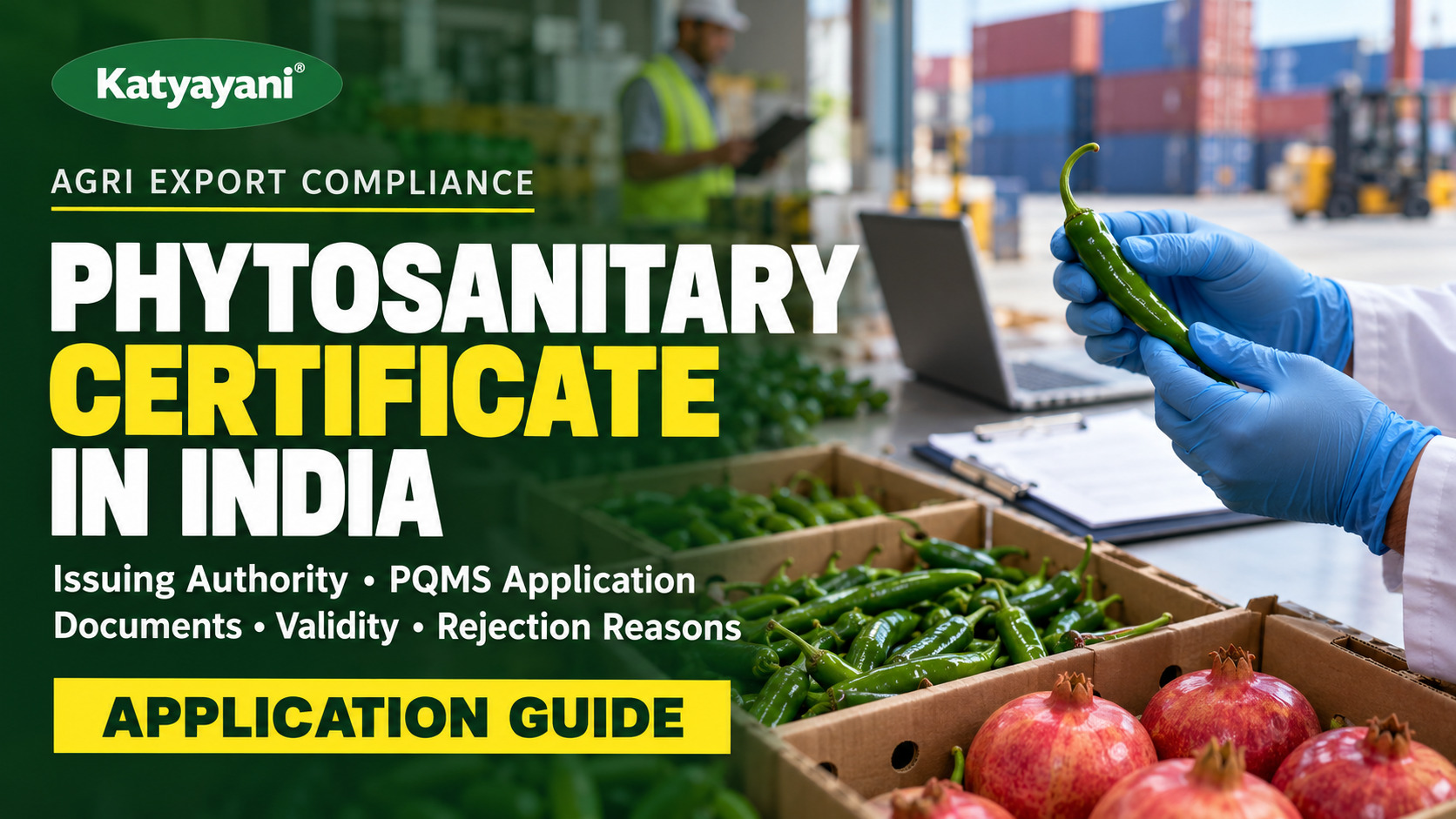
A phytosanitary certificate (PSC, often called a phyto) is an official plant-health document that says a consignment of plants or plant products was inspected and meets the importing country's plant quarantine rules. In India it is issued by the Plant Quarantine Stations of the Directorate of Plant Protection, Quarantine and Storage (DPPQS), the national plant protection organisation. Exporters register once on the PQMS portal and apply online before every export. The importing country decides whether you need one.
What is a phytosanitary certificate and what does it prove?
A phytosanitary certificate is an official paper (or now an electronic file) that tells the importing country one thing: this consignment was inspected by the plant protection authority of the exporting country and, as far as that authority can tell, meets your plant health import rules. The word comes from plant health. It is about pests and diseases of plants, not about food safety or quality.
The international rule book is ISPM 12, a standard of the International Plant Protection Convention (IPPC). ISPM 12 says the certificate attests that consignments meet phytosanitary import requirements, and that it is used for most plants, plant products and other regulated articles traded across borders. It also says the certificate should carry only plant health information. Pesticide residues, radioactivity, commercial details such as letters of credit, and quality do not belong on it.
That last point trips up many first-time exporters. A buyer who asks for a residue test report, a certificate of origin or a quality certificate is asking for a different document. The phyto only answers the plant quarantine question.
Think of it as a passport for the consignment. The border officer in the buyer's country reads it to decide whether to let the goods in, check them again, treat them or send them back.
Who issues the phytosanitary certificate in India?
In India the certificate is issued by the Plant Quarantine Stations of the Directorate of Plant Protection, Quarantine and Storage (DPPQS), Faridabad, under the Department of Agriculture and Farmers Welfare. DPPQS is India's national plant protection organisation. APEDA, the spices boards and your freight forwarder do not issue it.
The IPPC rule behind this is simple. Under Article V.2(a), inspection and everything that leads to the certificate must be done only by or under the authority of the official national plant protection organisation, and the certificate must be signed by public officers who are technically qualified and duly authorised. A private lab or a trader cannot sign one.
DPPQS lists 23 Plant Quarantine Stations on its official website. Pick the one that serves the port, airport, land border or inland container depot your cargo will leave from. The PQMS registration form asks you to choose a PQ station, so this decision comes early.
| Type | Stations named on ppqs.gov.in |
|---|---|
| Regional Plant Quarantine Stations (RPQS) | New Delhi, Bengaluru, Chennai, Mumbai, Kandla, Amritsar, Kolkata |
| Plant Quarantine Stations (PQS), Gujarat | Sanand, Pipavav, Mundra, Surat, Jamnagar, Gandhinagar, Ahmedabad |
| Plant Quarantine Stations (PQS), south and west | Hyderabad, Cochin, Mangaluru, Trivandrum, Calicut, Goa, Nashik, Nagpur, Indore |
The station names above are as listed on the DPPQS Plant Protection Network page, which shows 23 stations in all. Phone numbers and addresses change, so get them from the DPPQS site or the PQMS contact page rather than from an old blog.
Which portal is used now: PQMS, PQIS or e-Phyto?
Use PQMS. The DPPQS plant quarantine FAQ names it directly: register as an exporter in PQMS, which is a one-time exercise, and apply online well in advance before every export. Older blogs mention the Plant Quarantine Information System (PQIS) at plantquarantineindia.nic.in. DPPQS now points exporters to PQMS on its current pages.
PQMS (Plant Quarantine Management System) is an e-governance platform that the Centre for Good Governance developed for the Ministry of Agriculture. As the CGG project page describes it, exporters apply for phytosanitary certificates on it, importers apply for import permits and import release orders, and applicants can track their application status and view past records.
What about e-Phyto? An e-Phyto is simply the electronic version of the certificate. ISPM 12 says an electronic certificate is the electronic equivalent of the wording and data of the paper one, sent securely from the exporting country's authority to the importing country's authority. It is not a scanned copy mailed by e-mail. The IPPC runs a central ePhyto Hub for countries to exchange these files.
For India, an APEDA advisory of 28 February 2023 states that e-Phyto is implemented by India's NPPO through PQMS with effect from 1 March 2023 in the Grapenet system, that PQMS is mandatory for issue of e-Phyto, and that a Grapenet consignment ID is mandatory when applying through PQMS. Grape exporters to the EU are told to follow it strictly.
How do you apply for a phytosanitary certificate in India, step by step?
The route is: get an IEC, register once on PQMS, apply online for each consignment, pay the fee, present the goods for inspection, complete any treatment, and receive the certificate. Below is the path in order.
- Confirm the importing country's requirement. Ask your buyer or the destination country's plant protection website whether a phyto is required, whether an additional declaration or a specific treatment is needed, and whether e-Phyto is accepted. The importing country sets these rules.
- Keep your Importer-Exporter Code (IEC) ready. The PQMS registration form has a mandatory IE Code field with a Verify button, so register after your IEC is active.
- Register as an exporter on PQMS. The form asks for client type, IE Code, exporter name, purpose type, the PQ station, address lines, contact and mobile number, then your login details (first name, last name, e-mail and password). This is a one-time step.
- Apply online for each consignment. The DPPQS FAQ says to apply online well in advance prior to every export. Fill in commodity, quantity, destination and the shipment details, and upload the supporting documents.
- Pay the fee. Pay the fee for the application when the system asks for it.
- Present the consignment for inspection. DPPQS says export consignments and their packing materials are inspected for the importing country's requirements and international standards. Samples are taken and tested where needed, based on the pest risk of the commodity and the destination rules.
- Complete any treatment. Where required, treatments such as fumigation, hot water treatment, vapour heat treatment or irradiation are done through treatment providers accredited by DPPQS.
- Receive the certificate. Once the inspection is satisfactory and the destination requirements are met, the PSC is issued, in the model format of ISPM 12.
If you export grapes, the starting point is different. Log in to Grapenet, go to the PSC section, choose Apply for e-phyto, and you will be redirected to PQMS to register or log in. The Grapenet consignment ID must be in place first, as per the APEDA advisory.
What documents are needed for a phytosanitary certificate?
Every consignment needs an application on PQMS, which requires the exporter's IE Code. DPPQS also says treatments must be done through providers it has accredited, so keep the treatment record ready where treatment is required. Beyond that, the importing country sets any further requirement, such as an import permit or an additional declaration, so ask your buyer and your PQ station for the checklist that applies to your consignment.
Keep the invoice, packing list and shipping details consistent with what you enter in the application, because mismatches are a listed ground for refusal (see the rejection reasons below).
How long is a phytosanitary certificate valid?
ISPM 12 says the exporting country's authority may restrict how long a certificate stays valid between issue and export, and that the importing country can also set the period as part of its import rules. Check the destination country's rule for your product.
The reason for a time limit is simple. Once inspected, a consignment can pick up pests again if it sits in an open godown or a loose package. ISPM 12 notes the risk depends on the packing (sealed carton or loose), storage (open air or enclosed), commodity, season and pests. That is why the certificate is meant to be used soon after it is issued, for the single consignment it names.
An expired certificate cannot be fixed by writing a new date on it. Changes can be made only by the issuing authority, as explained next.
What if the certificate has an error, or the shipment changes?
Do not alter it yourself. ISPM 12 says alterations should be avoided; if one is unavoidable it must be made only on the original by the issuing authority, kept minimal, and stamped, dated and countersigned. A pen correction by a clearing agent can make the whole certificate invalid at the other end.
Replacement is allowed only in exceptional cases such as damage, change of address, destination or port of entry, or missing or wrong information. The issuing authority asks you to return the original and any certified copies, cancels it, and issues a new certificate with a new number. If the original cannot be returned, a replacement can still be issued with a statement that it replaces and cancels the earlier number and date.
A certified copy is different. It is a true copy validated by the authority (stamped, dated and countersigned), used mostly for re-export. It does not replace the original. If your buyer asks for a copy, ask the PQ station for a certified one, not a photocopy of your own.
Which products need a phytosanitary certificate?
The importing country decides. ISPM 12 says the certificate is used for most plants, plant products and other regulated articles traded across borders, and it can also cover articles such as empty containers where justified. Always check the buyer's country rule for your exact HS-code product.
ISPM 12 adds an important limit. Importing countries should not ask for a phytosanitary certificate for plant products that are processed to the point where they have no potential to introduce regulated pests.
Be careful about products that are not plant products. Organic fertilisers, biopesticides and agrochemicals are regulated mainly by registration and import rules of the destination country, not by a phytosanitary certificate. If you plan such exports, read our guides on how to export agrochemicals from India and pesticide registration by country. If your produce is organic, the NPOP certificate is a separate document; see NPOP vs PGS organic certification.
Do you need an IEC or APEDA registration before applying?
You need an IEC to register on PQMS, because the registration form has a mandatory IE Code field that you must verify. The certificate itself is applied for with DPPQS through PQMS, not with APEDA.
If you are still deciding what to export, our post on low-investment agriculture business ideas lists options with licence and risk notes.
What happens during the inspection and sampling?
DPPQS says export consignments and their packing materials are inspected for the importing country's requirements and international standards. Samples are taken and tested where needed, and inspection and testing depend on the pest risk of the commodity and the destination country's requirements.
The DPPQS FAQ also mentions registration of rice, chilli and peanut pack houses and accreditation of treatment providers, so the station may ask about your facility.
How many certificates does India issue? A look at the numbers
India issues a very large number of plant quarantine certificates every year. The PQMS project page shows export certificates rising from about 5.02 lakh in 2022-23 to about 6.47 lakh in 2025-26. Import certificates are around 1.1 to 1.5 lakh a year. The table shows what is on that page.
| Year | Export certificates (number) | Export quantity (lakh MT) | Import certificates (number) | Import quantity (lakh MT) |
|---|---|---|---|---|
| 2022-23 | 5,01,799 | 482 | 1,14,304 | 148 |
| 2023-24 | 5,53,410 | 372 | 1,39,218 | 184 |
| 2024-25 | 5,86,771 | 394 | 1,48,440 | 243 |
| 2025-26 | 6,47,351 | 419 | 1,47,320 | 218 |
The page also lists quantities in lakh numbers, which are left out of the table. The figures show a busy, routine system: lakhs of export certificates are issued every year.
Why do phytosanitary certificates get rejected?
Rejections fall into two groups: the certificate is faulty, or the consignment does not meet the destination's requirement. FAO guidance lists the faults: illegible or incomplete certificates, expired validity, unauthorised alterations or erasures, conflicting information, wording inconsistent with the model, and non-certified copies. Wrong declarations, missing treatment proof and pest finds cause the second group.
| Reason | What it looks like | How to avoid it |
|---|---|---|
| Illegible or incomplete | Blank fields, unreadable stamp | Check every field on the draft before it is signed |
| Validity expired or not followed | Shipment sails after the validity or the buyer's window | Apply close to the shipment date; ask for the destination's validity rule |
| Unauthorised alterations or erasures | Pen corrections or white-out | Ask the issuing station for a replacement; never edit yourself |
| Conflicting information | Quantity or consignee differs from invoice or packing list | Match weights, units, names and batch numbers across all documents |
| Wording inconsistent with the model | Free-text changes to the standard text | Use the system-generated certificate only |
| Non-certified copies | A scan or photocopy presented instead of the original or a certified copy | Request a certified copy from the authority |
| Fraudulent certificate | Not authorised by the NPPO, issued by an unauthorised person or on an unauthorised form, or with false information | Only use certificates from the PQ station through PQMS |
| Destination condition not met | Missing additional declaration, treatment record or pre-clearance test | Read the destination country's import conditions before you apply |
The FAO list is quoted from its guidance on invalid and fraudulent certificates, which says importing countries should not accept certificates they determine to be invalid or fraudulent. It also says importing countries may set their own requirements for language, validity period and units. A certificate that fails those can be refused at the border.
Remember also that a phyto does not protect you from other refusals. ISPM 12 says pesticide residues and quality do not belong on the certificate, so a residue or quality requirement from a buyer is a separate document.
What should you check before you apply? A practical checklist
- Destination rule. Does the country need a phyto, an import permit, an additional declaration, a treatment or e-Phyto?
- Your IEC and PQMS login. Verify the IE Code and test the login before the week you need it.
- Right PQ station. The one serving your port, airport or ICD.
- Product name and HS code. Use the commodity name and botanical name as per the buyer's contract. Mismatches create doubts at the border.
- Quantity and packing. Net and gross weight, number of packages and package type should match the invoice and packing list.
- Treatment plan. If fumigation or heat is needed, book a DPPQS-accredited provider and keep the certificate ready.
- Inspection point. Make the consignment accessible, uniformly packed and ready to open.
- Shipment timing. Count the validity window back from your sailing or flight date.
The certificate attests a specific consignment on a specific date, so the paperwork and the cargo must tell exactly the same story.
Conclusion
A phytosanitary certificate is a plant-health passport for one consignment, issued by India's DPPQS through its Plant Quarantine Stations and applied for on the PQMS portal after a one-time exporter registration. Get your IEC, confirm the destination country's rule, apply early, keep every document consistent and never edit a certificate yourself. Check the destination country's validity rule and count it back from your shipping date.
Questions Farmers Ask
What is a phytosanitary certificate?
Who issues the phytosanitary certificate in India?
How do I apply for a phytosanitary certificate in India?
What is the PQMS portal?
What documents are required for a phytosanitary certificate?
Can a phytosanitary certificate be corrected or replaced?
How long is a phytosanitary certificate valid?
What is the difference between a certified copy and the original certificate?
Which products need a phytosanitary certificate?
What is e-Phyto?
Why is a phytosanitary certificate rejected?
Can a farmer or FPO apply for a phytosanitary certificate directly?

Microbiologist
Microbiologist at Katyayani Organics. MSc in Microbiology, 2.6 years of experience.
View all authorsRead Next in Export & Global Trade
APEDA Registration (RCMC): Who Needs It, Process on DGFT Portal, Fees, Documents, Validity and Renewal
Letter of Credit for Exporters: How It Works, Types, Documents, UCP 600, Costs, Discrepancies and Export Finance

Leave a Comment